
CASE NAME: In Re- Noise and Environmental Pollution Paramjit Singh Bedi Vs. State Of Punjab
CASE NUMBER: Suo Motu Public Interest Litigation No. 01 of 2026
COURT: High Court of Judicature at Bombay
DATE: 22 September 2026
QUORUM: Justice G.S. Kulkarni and Justice Neela Gokhale
FACTS
A suo motu case was started by the Bombay High Court because of its serious concern about the increased levels of noise pollution and environmental pollution caused by the indiscriminate use of powerful music systems, amplifiers, musical instruments and fire crackers. The Court felt that although the Noise Pollution (Regulation and Control) Rules 2000 existed, there were still continued violations of the prescribed dB levels in cities like Mumbai, Thane, Pune and Nashik.
Complaints were heard by the Court in relation to excessive noise generated by several high wattage speakers, musical instruments and other such equipment as well as the use of fire crackers on public thoroughfares. It was felt that such events cause problems for people, especially children, senior citizens, students and ill people. The Court took into account issues of air pollution, hazardous smoke and other dangers created by the use of fire crackers.
ISSUES
- Whether the authorities were effectively implementing the Noise Pollution (Regulation and Control) Rules, 2000 during festivals and processions.
- Whether the unregulated use of loudspeakers, high-powered sound systems and other noise-producing instruments violated the prescribed noise standards and citizens’ rights.
- Whether bursting firecrackers on public streets during festivities could be permitted despite the restrictions under the Noise Pollution Rules.
- What measures were necessary to ensure effective and preventive enforcement of the noise and environmental pollution regulations.
LEGAL PROVISIONS
- Environment (Protection) Act, 1986 – Section 3(2)(ii), Section 6(2)(b) and Section 25: Empower the Central Government to take measures for environmental protection and frame rules.
- Noise Pollution (Regulation and Control) Rules, 2000 – Rule 3: Prescribes ambient noise standards and requires State authorities to take measures for noise abatement.
- Rule 4: Places responsibility on designated authorities for enforcement of noise pollution control measures.
- Rule 5: Regulates the use of loudspeakers and public address systems and requires prior written permission.
- Rule 5A: Restricts horns, sound-emitting equipment and bursting of sound-emitting firecrackers, particularly during night hours and in silence zones.
- Rule 6: Provides consequences for violations in silence zones.
- Rule 7: Provides a mechanism for complaints regarding excessive noise.
- Rule 8: Empowers authorities to prohibit or regulate the continuance of music, sound or noise.
- Article 21, Constitution of India: Right to life includes protection from conditions that adversely affect health and peaceful enjoyment of life.
- Maharashtra Police Act, 1951 – Section 37: Provides for prohibitory orders in specified circumstances.
- Bharatiya Nyaya Sanhita, 2023: Relevant provisions concerning public nuisance may apply to violations.
- Explosives Act, 1884: Relevant to regulation of fireworks.
ARGUMENTS
AMICI AND INTERVENORS:
It was contended that the Noise Pollution Rules should be strictly implemented and not just be confined to paper. The State Government should issue public notification regarding the days allowed for relaxation under Rule 5(3), appointing complaint authorities who can effectively enforce them. It was further contended that the policemen carrying decibel meters should keep an eye on processions and curb the excesses going beyond the permitted level.
STATE:
The State contended that the complaints received were dealt with appropriately and that adequate measures were taken wherever any violations were found. Nevertheless, the State did not deny the fact that the prescribed limits were not always adhered to in their strict sense.
RESPONDENTS:
State of Maharashtra, through the Commissioner of Police (Traffic), and other concerned authorities.
ANALYSIS
The Court noted that despite there being adequate statutory provisions and directions given by the court earlier, they had not been properly enforced. The Court made it clear that the Noise Pollution Rules could not be seen as just on paper and that festive occasions did not constitute an exception to the requirement for compliance with statutory noise standards. The Court made it clear that there was a need for preventive enforcement and not corrective enforcement which would have meant waiting until the citizens complained.
In particular, the Court took note of the detrimental consequences of noise and firework pollution and ruled that there is a duty on the part of the relevant authorities to prevent any such violations. The cumulative effect of granting multiple permissions in the same locality was another factor that the Court examined.
JUDGMENT
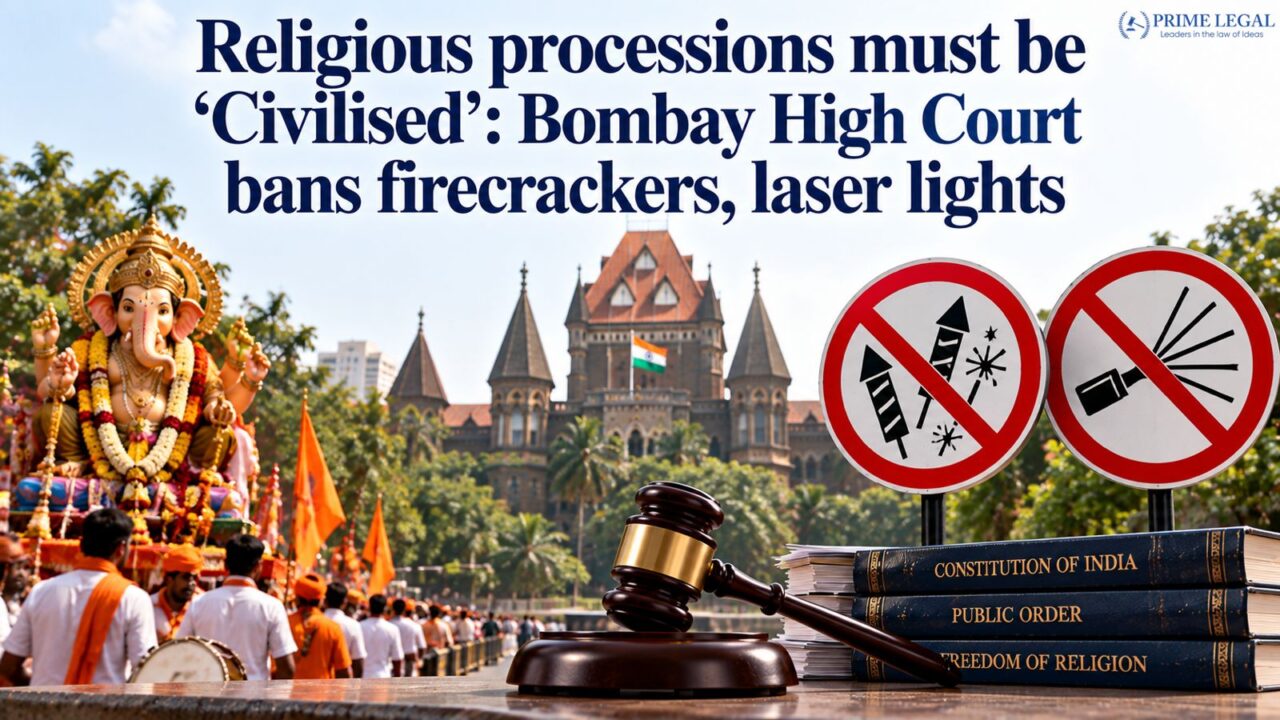
Various directions were provided by the High Court of Bombay in respect of stringent enforcement of the noise and environmental laws. The court directed that there should be a complete prohibition of bursting of crackers in the public streets and roads in the celebrations and the court also directed that laser light and high intensity light and beam shall not be allowed in the celebration processions.
The Court ordered the authorities to take steps to measure decibels, seize and confiscate any device that was causing a disturbance, and mandate the organizers who have been granted permission to install decibel meter and an internal sound limiter. Organizers were also required to display their permissions and details for accountability.
Furthermore, the Court asked that a large sum of money, ranging from ₹1 lakh and above in case of association or groups and ₹50,000 and above in case of individuals, be considered as the security deposit in case of violation of the decibel limits. The cumulative effect of the issuance of multiple permissions in the same ward was also to be taken into account.
Violations would entail penalties under the Noise Pollution Rules, in conjunction with the Environment (Protection) Act, 1986, and other relevant laws including the Bharatiya Nyaya Sanhita, 2023, Explosives Act, 1884, etc.
CONCLUSION
The Court of Bombay High Court pointed out that festival celebrations cannot supersede the statutory laws and rules pertaining to noise pollution and the environment. The verdict puts the onus on police, civic bodies, and other concerned authorities for taking steps to prevent the law from being flouted. The High Court has considered the implementation of noise pollution rules to be very important in connection with fundamental rights of citizens and directed authorities to adopt preventive measures to protect public health and the environment.
“PRIME LEGAL is a National Award-winning law firm with over two decades of experience across diverse legal sectors. We are dedicated to setting the standard for legal excellence in civil, criminal, and family law.”
WRITTEN BY: KHWAISH SACHDEVA

