
INTRODUCTION
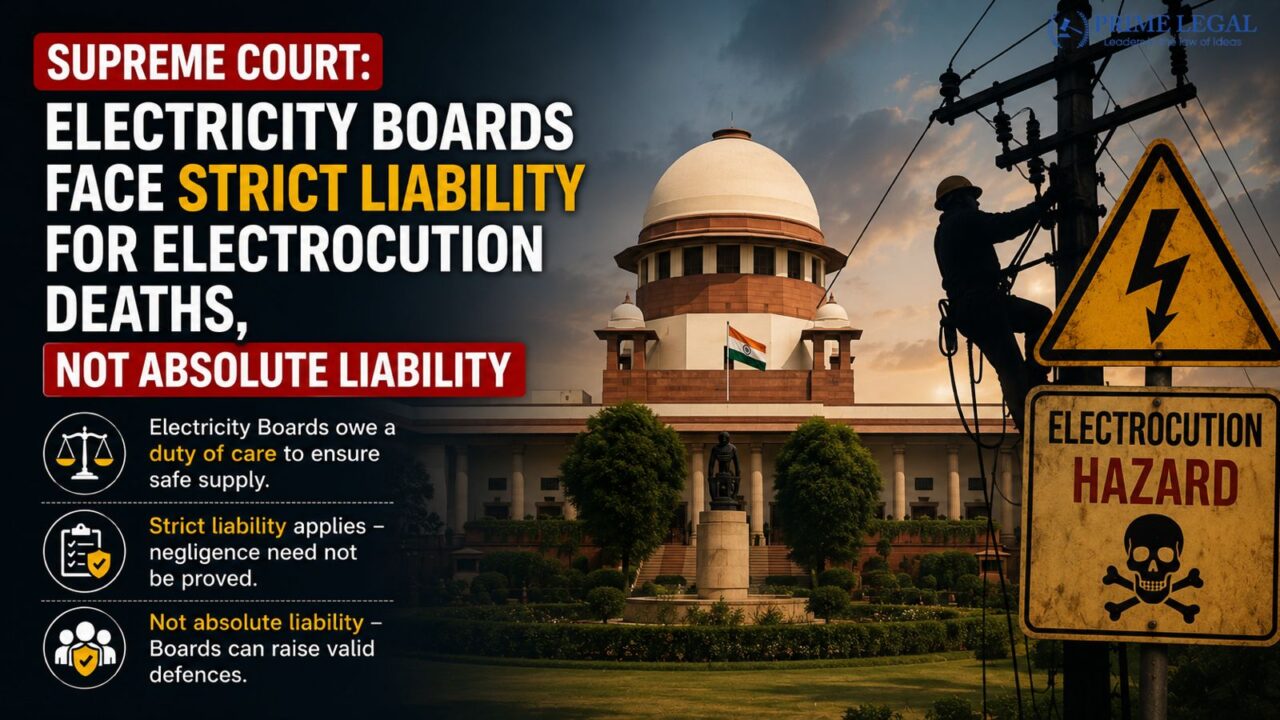
On 13 August 2026, the Supreme Court, in Karnataka Power Transmission Corporation Limited v. Rekha and others, 2026 INSC 847, set aside concurrent orders of the Karnataka High Court that had held the Karnataka Power Transmission Corporation (KPTC) absolutely liable for two electrocution incidents. A Bench of Justice Sanjay Karol and Justice Nongmeikapam Kotiswar Singh clarified that while electricity transmission is inherently dangerous and electricity boards can be held liable without proof of fault, the applicable standard is strict liability, not absolute liability, meaning recognised exceptions can still apply.
BACKGROUND
The case arose from two separate electrocution incidents in Karnataka. In one, a man died after coming into contact with an 11 kV transmission line; in the other, a person suffered severe injuries after coming into contact with a 66 kV line while attempting to retrieve a cricket ball. The victims filed writ petitions before the Karnataka High Court seeking compensation. The Single Judge and subsequently the Division Bench granted the petitions and issued compensation on the basis of the KPTC being held in absolute liability and applied the motor vehicle act, 1988’s ‘Multiplier Method’. KPTC challenged the maintainability of a writ petition in the absence of any facts agreed to by them and the standard of liability which the High Court had adopted.
KEY POINTS
- The Court found that a writ petition could not be filed when the accidents were caused by questions of fact hotly contested, and that there should be suitable alternate proceedings for these questions.
- The Court held that the multiplier method under the Motor Vehicles Act, 1988 cannot mechanically be applied to electrocution compensation claims, since the Electricity Act, 2003 does not prescribe any such method, even though Section 57 fixes the licensee’s liability to pay compensation.
- The Court distinguished strict liability under Rylands v. Fletcher, (1868) LR 3 HL 330, which permits recognised exceptions, from absolute liability under the The Oleum Gas Leak case, Mehta v. Union of India (1987) 1 SCC 395, which does not recognize any exceptions and is applicable to inherently hazardous industrial enterprises.
In Union of India v. Prabhakaran Vijaya Kumar and others, (2008) 9 SCC 527, the Court extended the principle of strict liability of the Rylands to electricity related accidents in Indian law. - The Court reasoned that electricity boards, engaged in an inherently dangerous activity, are best placed to distribute loss through insurance or pricing, and are therefore liable to compensate victims irrespective of fault, but only where none of the recognised exceptions to strict liability, such as an act of God or the claimant’s own default, apply.
RECENT DEVELOPMENTS
By restoring the strict liability standard rather than absolute liability, the Court has effectively preserved a defence for electricity boards in situations falling within the recognised exceptions. It allowed the appeal, granting the claimants leave to pursue compensation before the appropriate alternate forum instead of by writ petition. The ruling is likely to be closely watched by state electricity boards and transmission corporations, since it narrows the compensation standard applied in a large volume of ongoing electrocution litigation before various High Courts, several of which have in the past applied language drawn from both strict and absolute liability somewhat interchangeably.
CONCLUSION
The judgment draws a doctrinal line that had often blurred in electrocution litigation: strict liability, which permits defences, is the applicable standard for electricity boards, not absolute liability, which admits none. Practically, an electricity board can still be held liable without the claimant proving negligence, since the dangerous nature of electricity transmission alone justifies liability, but the board retains the ability to raise recognised defences such as an act of God or the claimant’s own fault. This case is also a useful reminder that writ petitions are not the appropriate route to resolve disputed compensation claims, a procedural point arguably as significant here as the liability question itself.
“PRIME LEGAL is a National Award-winning law firm with over two decades of experience across diverse legal sectors. We are dedicated to setting the standard for legal excellence in civil, criminal, and family law.”
WRITTEN BY: GAURAV VIBHU RANJAN

