
CASE NAME: Joyalbhai Nileshbhai Shah & Ors. v. State of Gujarat & Anr.
CASE NUMBER: R/Criminal Misc. Application No. 4465 of 2022
COURT: High Court of Gujarat at Ahmedabad
DATE: 14 July, 2026
QUORUM: Hon’ble Mr. Justice P. M. Raval
FACTS
Acting on an anonymous tip that gambling was taking place at House No. 83, 8th floor, Shaligram-2, Prahladnagar, Satellite, the police obtained a search warrant from the Deputy Commissioner of Police, Zone-7, and raided the premises. Inside, they found five individuals seated around a table in the dining room, with playing cards and coins of varying colours on it. An FIR was registered against the petitioners under Sections 4 and 5 of the Gujarat Prevention of Gambling Act, 1887, and a chargesheet followed in Criminal Case No. 17498 of 2021, pending before the 8th Additional Civil Judge and JMFC, Mirzapur, Ahmedabad. The petitioners approached the High Court under Section 482 CrPC seeking quashing of the FIR and all consequential proceedings, contending that the essential ingredients of the offence were entirely absent from the record.
ISSUES
- Whether the house in question satisfied the statutory definition of a “common gaming house” under Section 3 of the Gambling Act.
- Whether the element of profit or gain an essential ingredient for the offence was made out from the FIR or chargesheet.
- Whether the competent authority had applied its mind and conducted a genuine inquiry before issuing the special search warrant under Section 6 of the Act.
LEGAL PROVISIONS
- Sections 3, 4, 5 and 6 of the Gujarat Prevention of Gambling Act, 1887
- Section 482 of the Code of Criminal Procedure, 1973
- Case Law: Nimmagada Raghavalu and others, 1952 SCC OnLine Mad 87
ARGUMENTS
PETITIONERS: Senior Advocate Mr. Tejas Barot submitted that not a single ingredient of Section 4 of the Gambling Act was made out from a plain reading of the FIR the house raided did not fall within the statutory definition of a “common gaming house,” and there was no evidence whatsoever that it was being used for profit or gain by the person occupying it. It was further argued that the raiding party had no material to suspect the premises was a common gaming house even before entering, and that the competent authority, while issuing the special warrant, never arrived at any genuine satisfaction on this score — no real inquiry was conducted at all. Reliance was placed on Nimmagada Raghavalu, where it was held that gambling by itself is not an offence, and that occasional card-playing for money in a house does not automatically transform it into a common gaming house absent the element of profit or gain.
RESPONDENT: The Additional Public Prosecutor, Mr. K. M. Antani, argued that whether the house was actually used as a common gaming house is a question of evidence to be tested at trial, not decided at the threshold. Since a warrant had already been issued under Section 6 authorizing the search, it could not be said that there were no good grounds to suspect the house was being so used particularly given that the petitioners were caught with playing cards and coins of different colours, which prima facie pointed to gambling. It was urged that the petition deserved to be dismissed on this basis.
ANALYSIS
The Court examined the statutory definition of “common gaming house” under Section 3, which requires that the premises be used for profit or gain of the person owning or occupying it, whether by way of charge for the use of gaming instruments or the house itself. Going through the FIR closely, the Court found it silent on this very point — it recorded only that a tip had come in about gambling at the address, and that cards and coins were recovered upon the raid, but nowhere did it allege that petitioner No. 1 derived any profit or charge from the use of his house or the gaming instruments. The chargesheet fared no better on this front. The Court also scrutinised the timeline behind the special warrant: the tip was received at 23:52 hours, and the police left the station with the warrant by 00:15 hours a gap of barely 23 minutes, which the Court found telling of a purely mechanical exercise, with no real inquiry into whether the house met the statutory threshold of a common gaming house. The Court further noted that the FIR did not even use the vernacular term “Jugarkhana,” commonly employed to denote a common gaming house, reinforcing that the ingredient was never actually alleged. Cards, coins, and cash recovered from the petitioners’ pockets, without more, could not sustain an inference that petitioner No. 1 was profiting from the use of his house.
JUDGMENT
The High Court allowed the petition and quashed the FIR being II-C.R. No. 11191001210292 of 2021, along with all consequential proceedings, qua the present petitioners. Rule was made absolute to that extent, with direct service permitted.
CONCLUSION
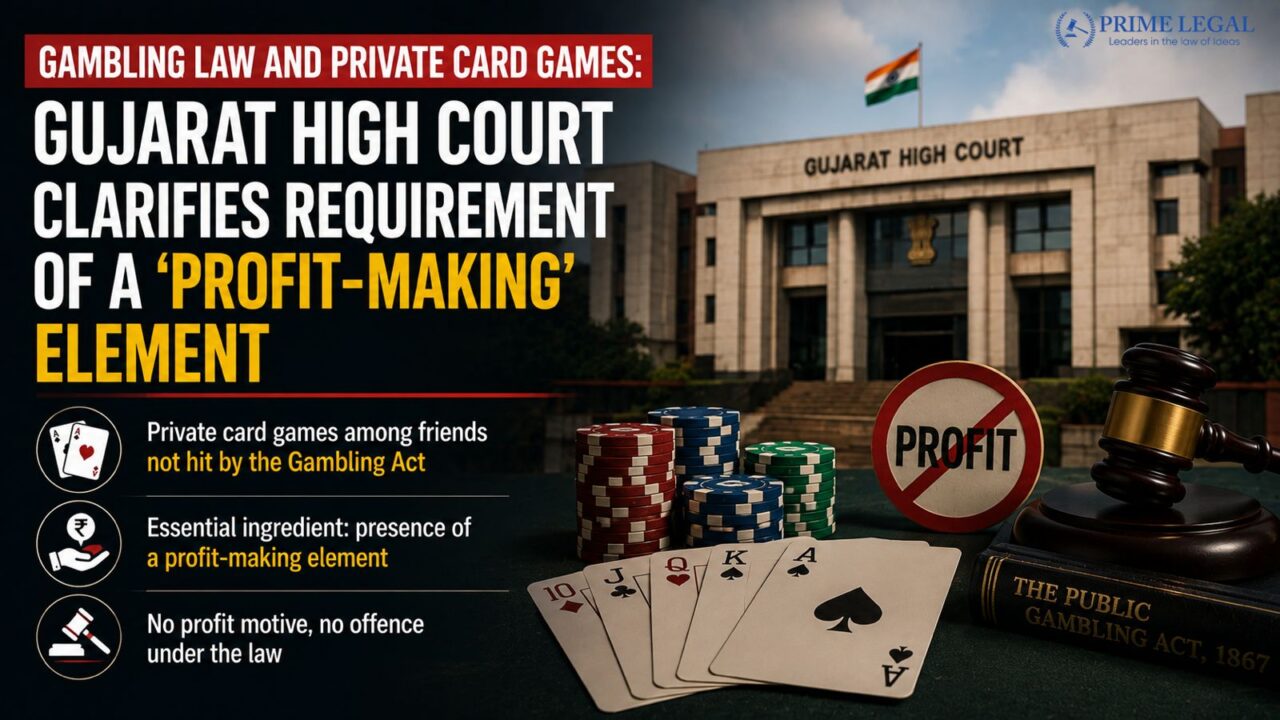
The judgment reaffirms that gambling, by itself, is not an offence; it becomes one only when it occurs within a “common gaming house,” a term carrying the essential ingredient of profit or gain to the person controlling the premises. An FIR silent on this element, however clearly it establishes that cards and money changed hands, cannot sustain prosecution under Sections 4 and 5 of the Gambling Act. The ruling also cautions that authorities issuing special search warrants under Section 6 must conduct a genuine, unhurried inquiry into whether the statutory threshold is met, since a mechanical exercise of this power risks becoming an instrument of harassment rather than law enforcement.
“PRIME LEGAL is a National Award-winning law firm with over two decades of experience across diverse legal sectors. We are dedicated to setting the standard for legal excellence in civil, criminal, and family law.”
WRITTEN BY: MAHFUZA FATHIMA
Read the Judgment copy below:
JOYALBHAI NILESHBHAI SHAH & ORS. Versus STATE OF GUJARAT & ANR

