
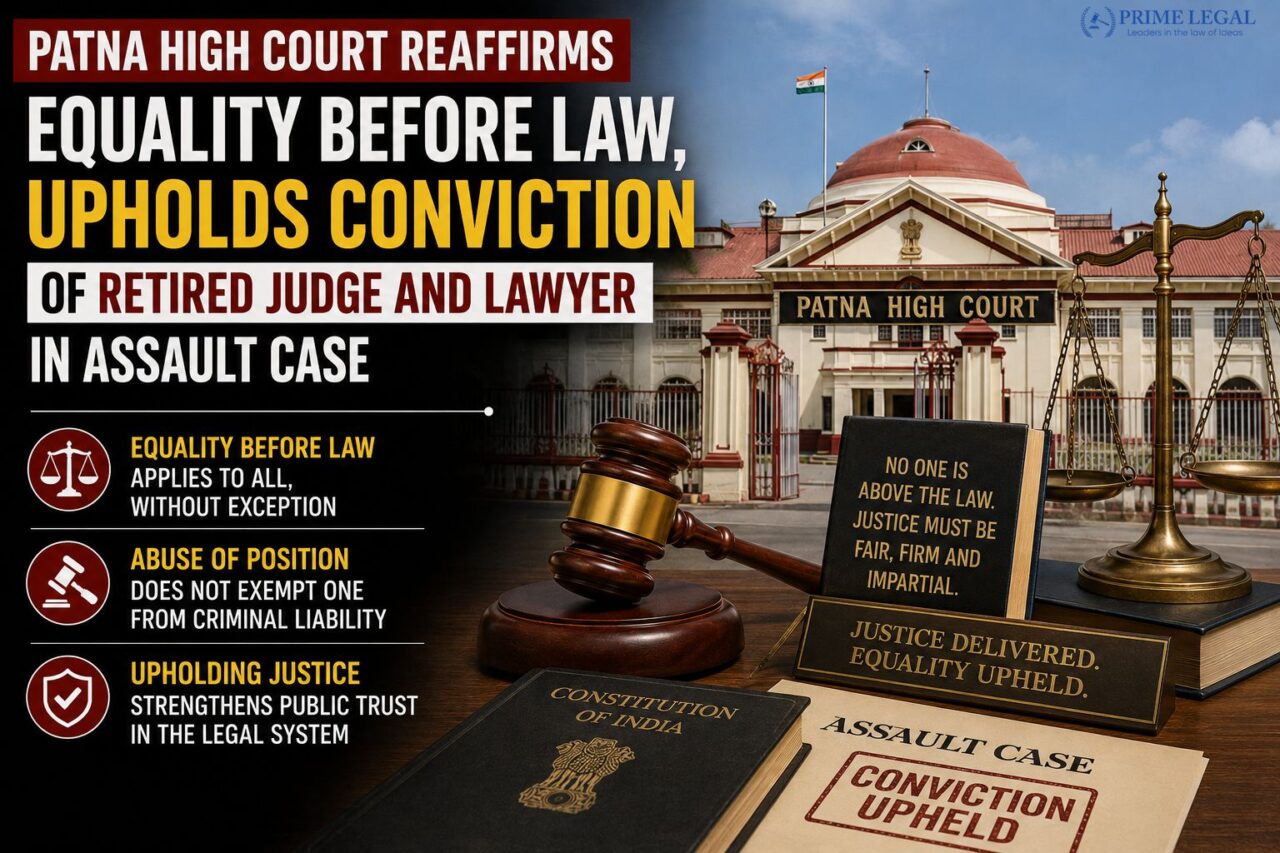
CASE NAME: Binod Kumar & Ors v. The State of Bihar
CITATION: Patna High Court CR. APP (SJ) No.220 of 2014 dt.01-07-2026
CASE NUMBER: Criminal Appeal (SJ) No.220 Of 2014 (Arising Out Of Ps. Case No.-40 Year-2005 Thana- Ara Muffasil District- Bhojpur)
COURT: High Court of Judicature at Patna
DATE OF JUDGMENT: 01-07-2026
QUORUM: Honourable Mr. Justice Purnendu Singh
FACTS:
The prosecution alleged, that on 27.02.2005 at about 7:30 A.M., when the informant, Rahul Kumar had gone out for attending the call of nature, the accused Binod Kumar assaulted him with a khanti on his back, and when he tried to flee, the 2nd accused Yogendra Ram assaulted him with a lathi on his head with an intention to kill, causing head injuries. Yogendra Ram was also accused of snatching a gold chain from the neck of the informant. When, on hearing the alarm raised by Rahul Kumar, his mother arrived at the place of occurrence, the accused Binod Kumar allegedly assaulted her with an iron khanti causing injury on her right hand, resulting in bleeding, while the 3rd accused Ranjan Kumar assaulted her with a lathi and the 4th accused Suchitra Kumari caught hold of her hair and slapped her. Following this, a written report, First Information Report was instituted. Chargesheet was submitted against the accused persons under Sections 323, 324, 307, 379 and 34 of the Indian Penal Code and the trial court convicted them for the offence under Section 323/34 of the Indian Penal Code. The appellants preferred criminal appeals against the judgment of conviction by the trial court.
ISSUES:
- Whether conviction under Sections 323/34 of the Indian Penal Code) is maintainable.
- Whether the prosecution has proved beyond reasonable doubt the components of Section 307 of the Indian Penal Code.
- Whether prior enmity between parties and inconsistent evidence rendered the prosecution case unreliable.
LEGAL PROVISIONS:
- Section 323 of Indian Penal Code, 1860 –Voluntarily causing hurt.
- Section 324 of Indian Penal Code, 1860 – Voluntarily causing hurt by using dangerous weapons.
- Section 307 of Indian Penal Code, 1860 – Attempt to murder.
- Section 379 of Indian Penal Code, 1860 – Theft.
- Section 34 of Indian Penal Code, 1860 – Acts done jointly by several persons.
- Section 313, Code of Criminal Procedure, 1973 – Power to examine the accused.
CASE LAWS:
- Pulicherla Nagaraju v. State of A.P. [(2007) 1 SCC (Cri) 500].
- Joseph v. State of Kerala [1995 SCC (Cri) 165].
- Jugatram v. State of Chhattisgarh [(2020) 9 SCC 520].
- Sivamani v. State [2023 SCC OnLine SC 1581].
- State of Madhya Pradesh v. Saleem [(2005) 5 SCC 554].
- Neeraj Dutta Vs. State [(Government of NCT of Delhi) (Criminal Appeal No. 1669 of 2009)].
ARGUMENTS:
Appellant:
It was argued by the appellants that the conviction was arrived at through mere conjecture. It was also submitted that there was a long-standing, ongoing land dispute and litigation between the parties which led to the false implication of the accused. Further, one of the prosecution witnesses turned hostile and only the informant testified against the appellants. There were conflicting statements from the informant about the incident. The appellants have clean antecedents.
Respondent:
It was submitted that the learned District court, after considering all the evidence on record and exhibits submitted on behalf of the parties during the course of trial, had rightly convicted the appellants for the aforementioned offences.
ANALYSIS:
The High Court observed that even though a witness turned hostile, the injured informant’s/ victim’s testimony remained mostly consistent regarding the time, place, and manner of the incident. The Court further emphasized that though past enmity is an important consideration in determining the case, it alone cannot solely discredit the entire allegation. However, the prosecution failed to prove any intention or knowledge that is required for an offence under Section 307 IPC. The court applied the principles established in landmark cases of Pulicherla Nagaraju, Joseph, and Sivamani, and determined that the injuries were simple and caused by hard, blunt objects.
JUDGEMENT:
The High Court affirmed the conviction of the accused persons under Sections 323/34 IPC but found nothing perverse in the appreciation of evidence done by the trial court. However, taking into account the circumstances of the case and the period already undergone by the appellants, the High Court modified the sentence to the period already undergone and ordered their release if not needed for any other case. Thus, the criminal appeal stood partly allowed.
CONCLUSION:
The judgement upholds the fact that conviction of a crime under Section 307 of IPC depends on several factors like intention or knowledge of causing death and a mere act of assault is not enough. On the other hand, the court upheld the conviction based on the statement of the victim even though the hostility of other witnesses and the previous enmity between the accused and complainant were considered. The Court made a fine distinction between attempt to murder and voluntary causing of hurt.
“PRIME LEGAL is a National Award-winning law firm with over two decades of experience across diverse legal sectors. We are dedicated to setting the standard for legal excellence in civil, criminal, and family law.”
WRITTEN BY: SOMSUTA PAUL
Read the judgment copy below:
Binod Kumar & Ors. v. The State of Bihar

