
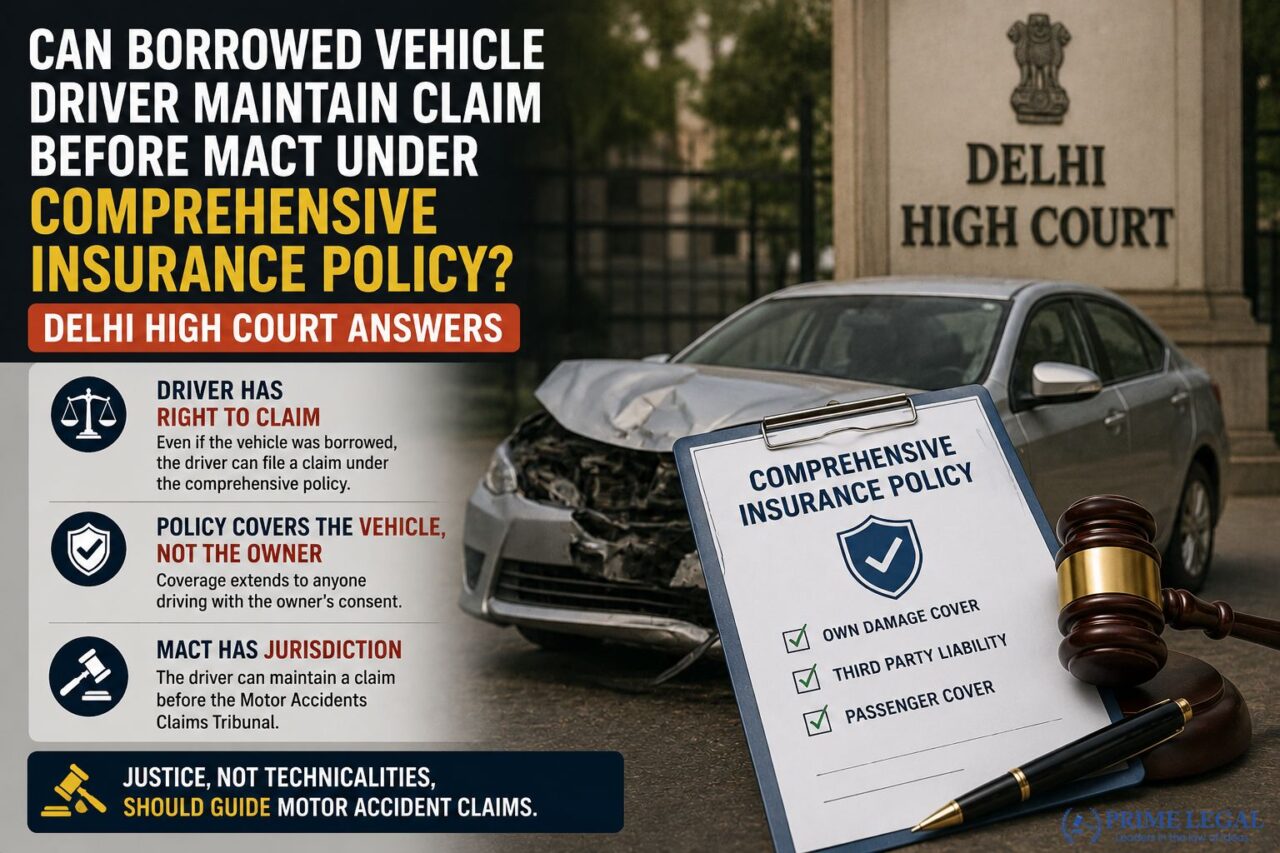
CASE NAME: Simbal Singh vs. Amarjit Singh & Anr.
CITATION: 2026: DHC:5195
CASE NUMBER: MAC.APP. 532/2025
COURT: High Court of Delhi
DATE OF JUDGMENT: 1st July, 2026
QUORUM: Hon’ble Mr. Justice Anish Dayal
FACTS
Simbal Singh (Appellant) filed an appeal against the impugned judgment dated 19th April, 2025 issued by Motor Accident Claims Tribunal (MACT), New Delhi, in dismissal of her claim petition. The deceased Udey Singh who suffered fatal injuries was driving an Innova and passed away in a motor vehicle accident on 2nd January, 2022 and the claimant was the mother of the deceased. Amarjit Singh was the registered owner of the vehicle, who was husband of the claimant and father of the deceased, the same person referred to as Respondent No.1.
The collision took place when a truck overtook the Innova car at high speed and hit it on its rear right side. Because of the impact, the Innova car first hit an Alto car and then dashed against a wall on the service road. Thereafter, the claimant filed a petition under Section 166 of the Motor Vehicles Act, 1988 (MV Act) against Respondent No. 2 (the insurer of the Innova car) contending that the car was insured under a Package Policy with an additional premium and that the deceased was entitled to be paid as a third-party occupant or personal accident cover. The Appeal was filed after the MACT dismissed the petition, holding that contractual obligations are outside the scope of the statute.
ISSUES
- If there is a Package Policy in place, whether the insurer is responsible if the driver of the vehicle is not a paid driver or an owner, but is a family member who borrowed the vehicle.
- Whether a claim under Section 166 of the MV Act can be maintained by legal heirs of a driver, where an external tortfeasor cannot be identified or established as negligent.
- Whether contractual obligations for extra PA insurance policies are within the ‘specialised jurisdiction’ of the MACT, or before civil courts/courts of consumers.
LEGAL PROVISIONS
- Sections 145, 146, 147, 149 (Post-Amendment Section 150), 163-A, and 166 of the Motor Vehicles Act, 1988.
- The Workers’ Compensation Act, 1923.
The following cases were referred:
- National Insurance Company Ltd. v. Balakrishnan & Anr.
- New India Assurance Co. Ltd. v. Sadanand Mukhi & Ors.
- Ningamma & Anr. v. United India Insurance Co. Ltd.
- Oriental Insurance Company Ltd. v. Meena Variyal and Ors.
- Minu B. Mehta v. Balkrishna Ramchandra Nayan.
- Cholamandalam MS General Insurance Company Limited v. Ramesh Babu.
ARGUMENTS
APPELLANT
The counsel for the appellant contended that the MACT did not understand the basic difference between a Basic Act Only Policy and a Comprehensive / Package Policy. It was argued that the owner had paid an extra premium for a personal accident cover and third-party occupant liability, thus covering the risk that the decedent driver would be involved in a personal accident claim. The appellant also contended that the claim was filed under Section 166 of the MV Act and not Section 163-A, hence the principle of “stepping into the shoes of the owner” was inapplicable and the deceased should be considered a “third party occupant” who could seek compensation.
RESPONDENT
Counsel for Respondent No. 2 countered that the personal accident cover of the insurance policy was limited to the owner-driver and that the deceased son was not covered under the policy. The insurer agreed that the MACT would not be a competent forum for handling disputes which arise only out of a contract.
In a strongly worded statement, Dr. Amit George, the appointed Amicus Curiae, indicated that there was a need to be very careful against “fetishization” and over-extension of specialised jurisdictions such as the MACT.
He pointed out that the concept of statutory third-party insurance provided under Chapter XI of the MV Act was never intended to cover a driver who borrows a vehicle for permissive use, since he or she then assumes the rights of the owner. He said statutory liability is an obligation imposed on him by the MV Act, but the additional liability which is a result of additional premiums is an obligation which is contractual and can only be heard in a consumer protection forum or a civil court.
ANALYSIS
The High Court said that the action under Section 166 of the MV Act is based merely on the tort of negligence and that fault of the tortfeasor has to be established. In this instance, there was no negligence to be proven against the offending truck as it could not be traced. So, the only other driver whose driving could be analysed was the driver himself, which is the absurd equivalent of the legal representatives of the driver suing for his own negligence.
The Court defined that under the MV Act, insurers would only be liable for third party risks if the insured, first, was legally liable to a third party. Where a borrower drives a vehicle, he is not cut off from the owner and therefore not strictly liable, as a third party, for the acts of the owner.
A Personal Accident benefit may be offered under a Package Policy, but this is just a contractual link. The Court stated that the jurisdiction of specialised tribunals has to be limited to the scope of the enabling legislation. If the MACT’s resolution of disputes was limited to cases solely between itself and the insurance company, it would be acting as a usurper of the jurisdiction of civil and consumer courts.
JUDGEMENT
The Delhi High Court rejected the appeal in favour of the order passed by MACT rejecting the claim petition. The Court has indicated that it would still be open to the claimants to directly approach the insurer to press their claim under the personal accident cover and, if that claim is unsuccessful, they can approach a competent consumer forum or civil court.
CONCLUSION
The judgement confirms that the MACT has no jurisdiction over claims that are purely contractual insurance claims or claims under a personal accident under policies that do not cover statutory third-party risks. It makes it clear that a driver of a loaned vehicle has no action as a third party under Section 166 MV Act against the insurance company of the vehicle if there is no obvious third-party wrongdoer.
“PRIME LEGAL is a National Award-winning law firm with over two decades of experience across diverse legal sectors. We are dedicated to setting the standard for legal excellence in civil, criminal, and family law.”
WRITTEN BY: SHEEN.
Read the judgment copy below:

