
CASE NAME: Puja Hari vs. State of West Bengal and Anr
CITATION: 2026 SCC OnLine Cal 7184
CASE NUMBER: CRR 4810 of 2025 IA No. CRAN 1 of 2026
COURT: In the High Court of Calcutta
DATE OF JUDGMENT: 23rd June, 2026
QUORUM: Hon’ble Justice Hon’ble Dr. Ajoy Kumar Mukherjee.
FACTS
In this case, the Petitioner Puja Hari had challenged an order dated 24th September, 2025 passed by the Chief Judicial Magistrate, Howrah. In the challenged order, the lower court applied Section 107 of the Bharatiya Nagarik Suraksha Sanhita, 2023 (BNSS) to garnish three properties which were jointly owned by Puja Hari and her husband, who is an accused named Bikash Hari, and also two properties owned only by Puja Hari.
Thereafter Mr. Manoj Agarwal of Utkarsh India Limited lodged a written Complaint dated 20th May, 2025 before Sakrail P.S. against Shree Shyam Road Safety. It is said that the ledger has discrepancies from 16th April, 2022 to 22nd February, 2024. The aforementioned filed case was registered as Sakrail P.S. case no. 433/2025 against the said Bikash Hari and other employees under the sections 420/426/120B/34 IPC.
In the process of investigation, the investigating officer made an application for an order of forfeiture of property under Section 107 of BNSS dated 10th July, 2025, which was declined by the court initially. The court, however, granted the attachment of the properties after the arrest of the accused on 24th September, 2025. Puja Hari was not accused in the matter and found the impugned order only on 11th October 2025 when a notice was pasted on her property to vacate.
ISSUES
- Whether the Trial Court was wrong in attaching the properties without giving a mandatory notice under Section 107(2) and (3) of the BNSS to the owner.
- Whether the Magistrate was correct in denying Petitioner the right of audience on the mistaken premise that she was an absconding accused.
- Whether the investigating agency and the court satisfied the “reason to believe” standard under Section 107 of the BNSS to attach properties.
LEGAL PROVISIONS
- Section 107 of the Bharatiya Nagarik Suraksha Sanhita, 2023 (BNSS).
- Section 176 of the Bharatiya Nagarik Suraksha Sanhita, 2023 (BNSS).
- Indian Constitution- Article 300-A
- Indian Constitution- Article 14.
Precedents referred to:
- Arvind Kejriwal v. Directorate of Enforcenement, (2025) 2 SCC 248.
- N. Padmamma v. S. Ramkrishan Reddy, (2008) 15 SCC 517.
- Vijay Madanlal Choudhary v. Union of India, (2023) 12 SCC 1.
- M. Ravindran v. Directorate of Revenue Intelligence, (2021) 2 SCC 485.
- Hindustan Petroleum Corpn. Ltd. v. Darius Shapur Chenai, (2005) 7 SCC 627.
ARGUMENTS
APPELLANT
The Petitioner had informed that she was never taken up as an accused in the case and was the victim of the impugned attachment order. She contended that she was the owner of the attached properties and therefore entitled to a notice under the mandatory provisions of Section 107(2) and (3) of the BNSS but this was done in secret. In addition, the Petitioner pointed out that the Magistrate’s finding that she was an absconding person was misconceived since she was not mentioned in the FIR nor added as an accused in the case
RESPONDENT
The State and the investigating agency followed up the premise that the property was derived from criminal activity and thus the investigating officer filed a prayer for forfeiture pursuant to Section 107 of the BNSS. The Trial Court has upheld this and has found that the notice sent to the accused husband Bikash Hari was enough to comply with the condition of Section 107, treating the Petitioner’s purchase as a benam purchase and wrongly calling her an absconding accused.
ANALYSIS
The High Court highlighted that there are four strict conditions that must be met before an attachment order can be issued under Section 107(2) of the BNSS namely issuing a notice to the owner of the property, giving a 14-day time period, allowing a reasonable opportunity to be heard and ensuring that the properties are concluded to be proceeds of crime. The Court pointed out that the Trial Court had totally ignored this requirement by not intimating the Petitioner and wrongly termed her as an absconding accused.
The Court also emphasized that the power of attachment contained in Section 107 should not be exercised indiscriminately because it has an impact on the constitutional “right to property”. The officer investigating may only seek approval for attachment if there is a recorded reason to believe that the property is related to an offence.
The Court cited to the Supreme Court precedents and held that the orders of attachment passed ex parte under Section 107(5) should be issued only in exceptional cases where the notice would serve no purpose of attachment and should be issued after careful consideration of the court and with materials.
JUDGEMENT
The High Court of Calcutta allowed the application and set aside the impugned order dated 24th September, 2025 passed by the Chief Judicial Magistrate, Howrah. The Court clarified that it does not bar the investigating authority from reopening the proceedings in accordance with the BNSS, Section 107, within four weeks.
CONCLUSION
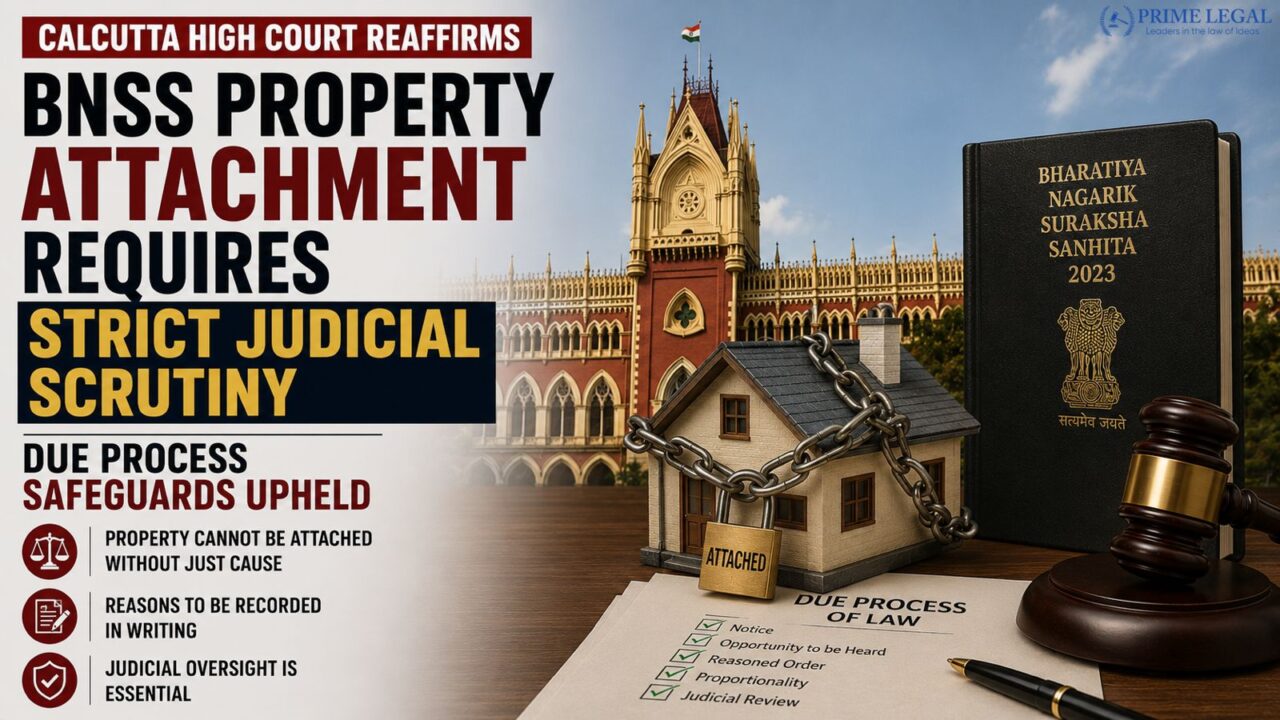
The judgment reiterates the requirement for procedural safeguards provided in the Section 107 of the BNSS. The ruling also reinforces the rule that property attachments may only be issued on good cause and on the basis of reasonable assumptions, thus safeguarding a citizen’s constitutional right to property against arbitrary executive action.
“PRIME LEGAL is a National Award-winning law firm with over two decades of experience across diverse legal sectors. We are dedicated to setting the standard for legal excellence in civil, criminal, and family law.”
WRITTEN BY: SHEEN.
Read the judgment copy below:
Puja Hari Versus The State of West Bengal & Another (1)

