
CASE NAME: Israfil @ Pappu @ Naimuddin Khan v. State Of Madhya Pradesh
CITATION: 2026 INSC 654
CASE NUMBER: Criminal Appeal No. 3081 Of 2026
COURT: The Supreme Court of India
DATE OF JUDGMENT: 23rd JUNE, 2026.
QUORUM: Justice Prashant Kumar Mishra and Justice N.V. Anjaria
FACTS:
The appellant “Naimuddin Khan” also known as Israfil @ Pappu produced before the Court of the Judicial Magistrate First Class, Rewaa, a Bhu Adhikar Rin Pustika (Land Rights and Loan Book) for the purpose of furnishing surety/bail on behalf of an accused namely Mukesh Dahiya. Later, during scrutiny of the said document, the learned Judicial Magistrate noticed certain irregularities in the land rights documents, particularly with regard to the sequence and pagination of its pages, thereby creating suspicion regarding the genuineness of the document. Subsequently an FIR was registered under Sections 420, 467, 468 and 471 of the Indian Penal Code, 1860. During the course of investigation, the disputed document was found to be forged and was being knowingly used in judicial proceedings. The Trial Court, by a judgment dated 06.01.2024, convicted the appellant under Sections 420, 467, 468 and 471 of the IPC and sentenced him to undergo rigorous imprisonment for five years along with fine. Aggrieved thereby, the appellant preferred Criminal Appeal No. 653 of 2024 before the High Court. The High Court, however, dismissed the appeal and affirmed the conviction and sentence imposed by the Trial Court. Before the Supreme Court, notice was issued only on the question of quantum of sentence, and the conviction itself was not under challenge.
ISSUES:
- Whether the sentence imposed upon the appellant was disproportionate according to the facts and circumstances of the case?
- Whether the presence of mitigating factors like prolonged judicial proceedings, absence of criminal antecedents and period already undergone in custody justify reduction in sentence.
LEGAL PROVISIONS:
- Section 420 of Indian Penal Code, 1860– Cheating and dishonestly inducing delivery of property.
- Section 467 of Indian Penal Code, 1860 – Forgery of valuable security, will, or authority to adopt.
- Section 468 of Indian Penal Code, 1860 – Forgery for the purpose of cheating.
- Section 471 of Indian Penal Code, 1860 – Using a forged document as genuine.
- Section 374(2), Code of Criminal Procedure, 1973 – Appeal against conviction before the High Court.
CASE LAWS Referred:
Padum Kumar vs. State of Uttar Pradesh [(2020) 3 SCC 35]
ARGUMENTS:
Appellant:
It was argued that the occurrence happened in 2014 and since then, the appellant has faced criminal proceedings for more than a decade. Further the appellant is not a habitual offender and no subsequent criminal antecedents have been thereafter recorded. Though the conviction was not under consideration, it was urged that the substantive sentence of rigorous imprisonment for five years imposed upon the appellant deserved reconsideration in the peculiar facts and circumstances of the case.
Respondent:
It was argued that the offence was of a serious nature involving the use of forged revenue documents before a Court of law for the purpose of securing bail. It was further contended that such offences strike at the purity of the administration of justice and, therefore, do not warrant undue leniency.
ANALYSIS:
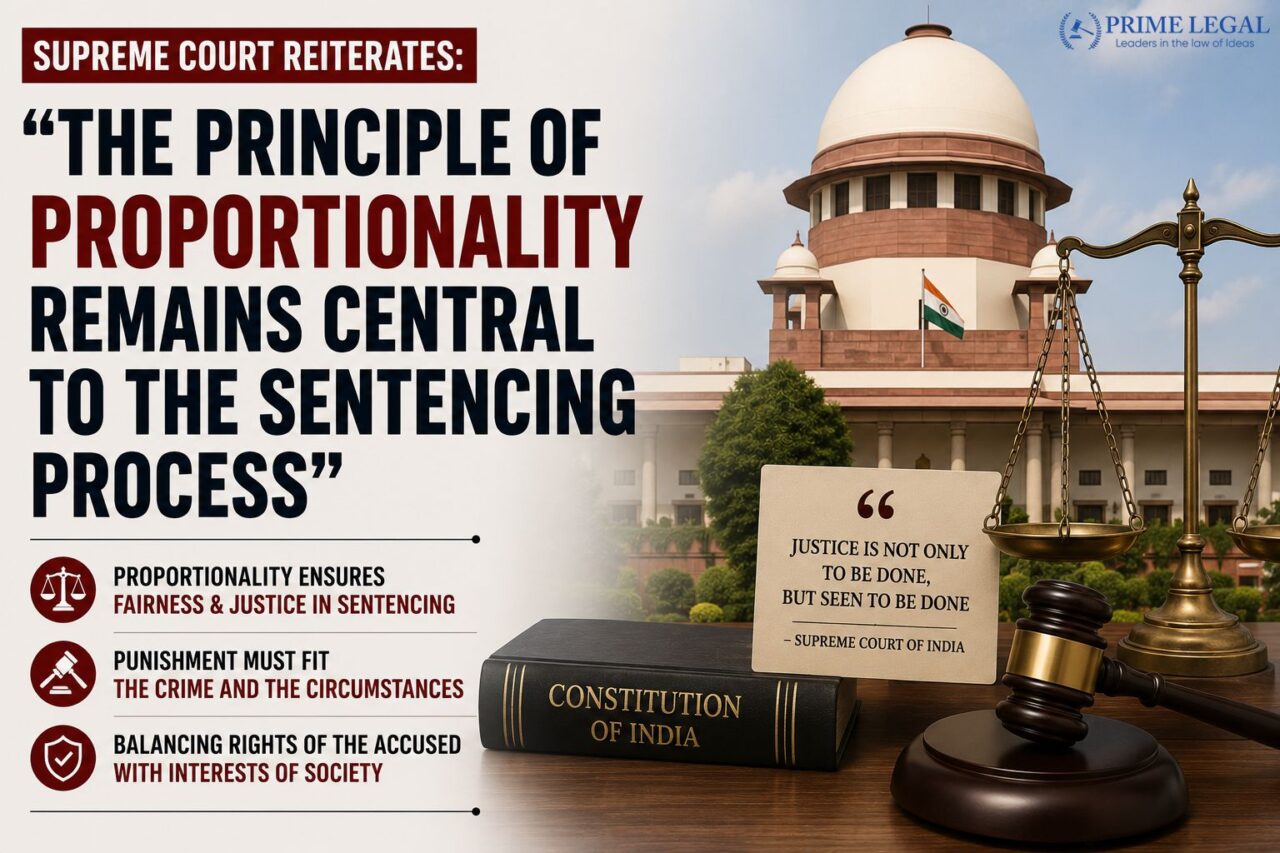
The apex court observed that offences involving forgery and the use of forged documents in a judicial proceeding are of extremely serious nature. However, sentencing for the same cannot “be reduced to a purely retributive exercise divorced from the factual matrix of the case and the overall circumstances of the offender”. The principle of proportionality must be followed throughout the sentencing process.
The Court while addressing the issue of mitigating factors referred to the case of Padum Kumar vs. State of Uttar Pradesh, where while upholding conviction, had exercised its discretion and had reduced the substantive sentence considering long passage of time, absence of criminal antecedents and other mitigating circumstances.
Further, it was discussed that the period of custody already undergone is also a relevant consideration. Therefore, all the factors including prolonged judicial proceedings, absence of criminal antecedents and period already undergone in custody must be kept in mind while sentencing.
JUDGEMENT:
The Supreme Court while maintaining the conviction of the appellant for offences punishable under Sections 420, 467, 468 and 471 of the IPC, reduced the substantive sentence to the period already undergone. The fine imposed by the Trial Court, as affirmed by the High Court, remained unaltered. The court directed the appellant to be released forthwith.
CONCLUSION:
The judgement reaffirms the principle of proportionality in criminal sentencing and places a critical balance between penalising serious offences and addressing mitigating factors. Specific circumstances like prolonged judicial proceedings, absence of criminal antecedents and period already undergone in custody play a critical role in determining proportionality.
“PRIME LEGAL is a National Award-winning law firm with over two decades of experience across diverse legal sectors. We are dedicated to setting the standard for legal excellence in civil, criminal, and family law.”
WRITTEN BY: SOMSUTA PAUL
Read the judgment copy below:
Israfil @ Pappu @ Naimuddin Khan vs. State of Madhya Pradesh

