
INTRODUCTION
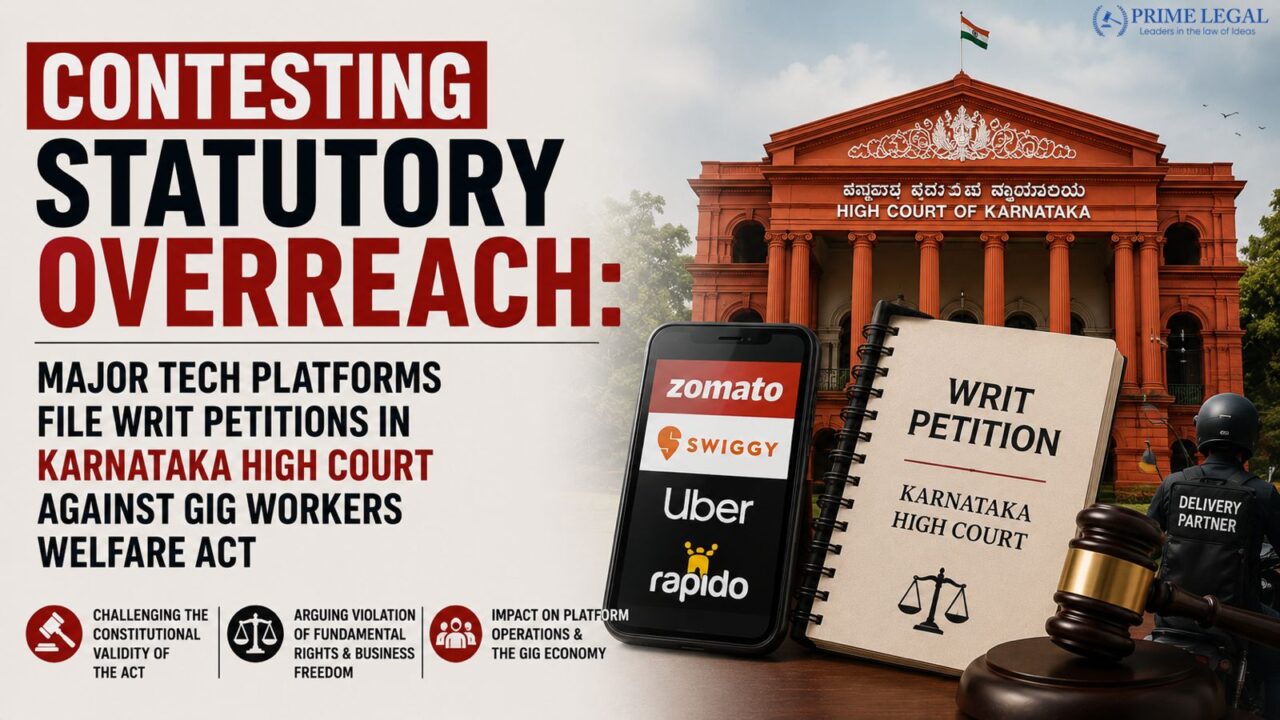
The petitioners who constitute a group of major technology aggregators, as well as their industry body, filed a writ petition on 29th June 2026 in the Karnataka High Court against the constitutional validity of the Karnataka Platform Based Gig Workers (Social Security and Welfare) Act, 2025. It is a petition by the Internet and Mobile Association of India (IAMAI), Eternal Ltd., Zepto, Swiggy and Urban Company and Valmo Transportation. The matter is yet to be listed for hearing.
BACKGROUND
The Karnataka Act creates a Gig Workers Welfare Board, empowers platforms to have Internal Dispute Resolution Committees (IDRCs), will require reasons for deactivating workers, and will limit the welfare fee charged per transaction to 1% with a maximum limit of Rs. 0.50 food + grocery delivery. Platforms need to file quarterly returns through Payment Welfare Fee Verification System (PWFVS) and defaulted payment must result in interest to be paid at the rate of Rs. Repeat violations are penalized at the rate of Rs. per annum while 12% per annum is applied for repeated violations. 1 lakh. The case indicated by petitioners as the root of the problem of the petition is the deadline of July 5, 2026 to pay the first ever welfare fee under Section 20, which has been contended by petitioners that they are not legally liable to pay.
KEY POINTS
- The core argument is that the State Act vis-a-vis the Code on Social Security, 2020 (CoSS) which is the national framework for the welfare of gig workers and contributions by aggregators is repugnant to reason.
- If two laws are made on the same matter, one of the Central laws will be superior to other state law, according to Article 254.
- The petition attacks the notices dated 21st May, 2026 (IDRC constitution – Section 22) and show-cause notices dated 16th June, 2026 (warning of penal action) as well as notices with regard to welfare fee dated 22nd June, 2026 (to pay the fee by 5th July, 2026).
- Double Imposition Argument: Petitioners argue that the State welfare fee imposed on platforms results in double imposition of the fee in both Central and State schemes leading to additional expenses for platforms and legal uncertainty.
The Act and Rules are said to be arbitrary and infringe on the right to equality on the basis of Article 14 challenge. - Without adequately justifying this disproportionate burden on compliance the Act and Rules are alleged to be arbitrary, and thus infringe the right to equality.
- It is declared that the Act (along with the Rules and the Welfare Board notification and Government Order dated February 12, 2026) is unconstitutional, which means that all consequential notices (IDRC directions, show-cause notices, requests for welfare fee etc.) are also struck down.
- Workers’ Union Backlash: The TGPWU, IFAT and KAWU slammed the petition as social security is a fundamental right and wouldn’t let the platforms withdraw the challenge.
RECENT DEVELOPMENTS
While Karnataka is the first state to enact such legislation, Rajasthan had done so with its first such law back in 2023. But the Karnataka petition by some of India’s biggest consumer Internet firms is the most important constitutional challenge against the state-level gig worker laws so far and may create a precedent. The platforms have highlighted a strategic faux pas, in their efforts to fend off an operating State law which are repeatedly relying on the CoSS, a Central law that hasn’t been fully implemented yet, despite the impedance of rules.There is a strategic irony which will likely be pointed out before the Court: the platforms are referring to the CoSS, a Central law whose gig-worker provisions have yet to be implemented, before an operating State law. Additionally, workers’ groups have pointed out that the number of gig-workers today is estimated at 7.7 million and will see a 23.5-million increase by 2030, a result of waiting for lawsuits to be decided before implementing welfare protections imposes real, current human costs.
CONCLUSION
The Appeal petition before the Karnataka High Court will resolve an issue of national consequences, can the Central law, which remains unapplied yet, be used to challenge the State law which is already applied? The Court’s ruling in favor of the Act will encourage other states to pass laws of the kind intended by the Act. If it strikes it down, then it becomes the responsibility of the Centre to implement the provisions of the CoSS gig-workers. In either case, it will determine the future of gig worker rights in India for the next few years.
“PRIME LEGAL is a National Award-winning law firm with over two decades of experience across diverse legal sectors. We are dedicated to setting the standard for legal excellence in civil, criminal, and family law.”
WRITTEN BY: ARNAV NAIK

