
INTRODUCTION
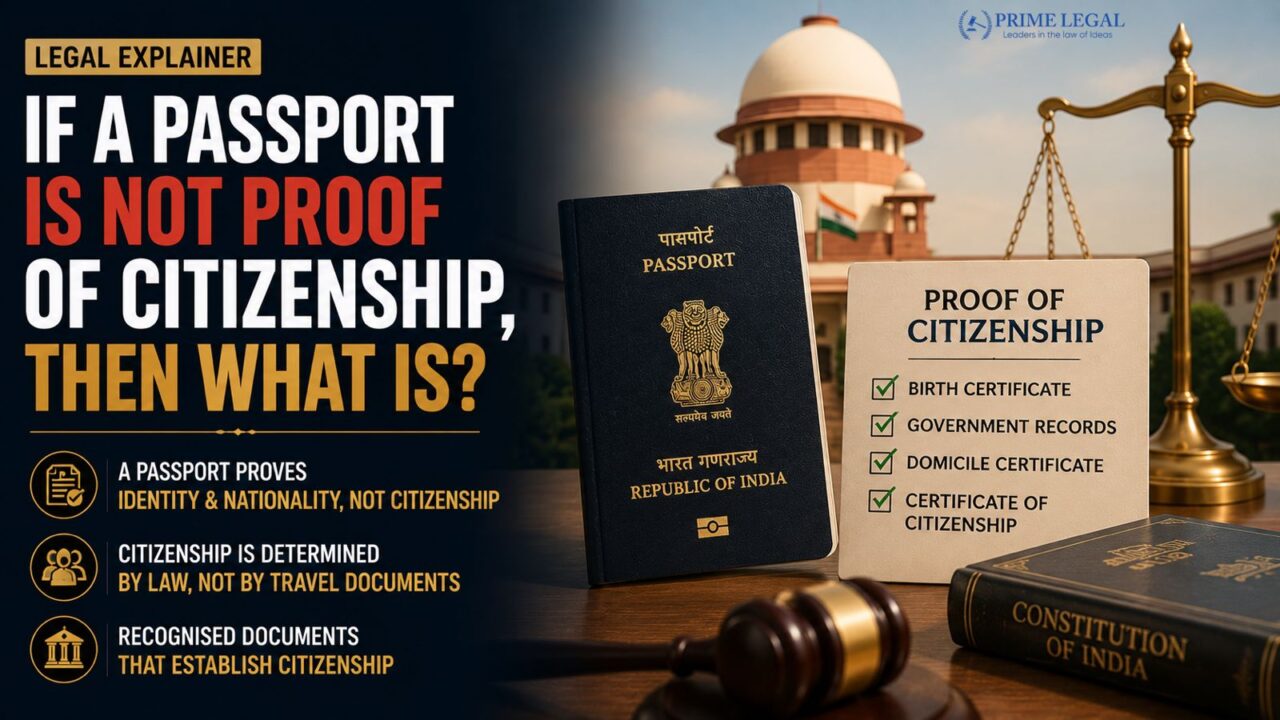
There has been a great deal of discussion, debate and some political criticism regarding the recent clarifying statement made by the Ministry of External Affairs (MEA), which confirms that an Indian passport is primarily an instrument for travelling outside the country; it does not constitute definite proof of citizenship. The clarification from the MEA, however, reiterates what has always been the established legal position regarding citizenship in India. The framework that determines Citizenship in India is laid out under the provisions of the Indian Citizenship Act, 1955. Under the provisions of the Act, citizenship in India is a legal entity status created by the Act, not an acquired legal entity that can be proved by one or more identification documents. This article will provide a detailed look at the legal framework for citizenship in India, including why a passport does not qualify as definitive proof thereof, and how citizenship is acquired.
BACKGROUND
The 14th Passport Seva Divas in June 2026 sparked a controversy after an MEA official claimed that a passport is “just” a travel document, which led to confusion because passports are some of India’s most highly validated documents. The government has since clarified that this is not a new policy and has its legal foundation under Section 20 of the Passports Act, 1967, which empowers the Central Government to issue a passport or document of travel to a “non-citizen” in certain circumstances, including “in the public interest”. Therefore, the passport itself cannot be viewed as an unequivocal form of establishment of Indian citizenship because it may be issued by law, in certain limited situations, to an individual who is not a citizen of India.
KEY POINTS
- According to the Passports Act, 1967, an individual must have a valid passport to leave India. An acceptance of citizenship is governed by the Citizenship Act, 1955.
- In 2013, in response to a challenge to citizenship made under the Indian law, the Bombay High Court ruled that holding a document (e.g., a birth certificate or an Aadhaar card) is insufficient to establish that an individual is a citizen of India.
- The Supreme Court of India has regularly indicated that identification and residency documents (e.g., Aadhaar cards, Voter IDs and ration cards) do not confer upon the holder the rights associated with Indian citizenship.
- The Citizenship Act of 1955 defines citizenship as a legal status that can be derived from facts, including birth, descent, registration, naturalisation or incorporation of territory.
- Citizenship is dependent on the nationality of one’s parents for post-certain cut-off dates of birth, such as on or after 1 July 1987 and requires extremely complex documentary proof, not just a birth certificate, to establish one’s citizenship.
- The Supreme Court’s ruling in the Sarbananda Sonowal matter clearly sets out that the burden of proof to prove citizenship ultimately rests upon the individual claiming citizenship and not on the State.
RECENT DEVELOPMENTS
The more pronounced emphasis on citizenship documentation correlates with the mounting opposition to the Special Intensive Revision (SIR) process for the electoral roll. As such, many states have reaffirmed similar legal stands since the MEA has made its position known. Take, for example, just recently, the Registration Department in Uttar Pradesh issued a notice, clarifying that an Aadhaar card is evidence only of one’s identity but does not serve as evidence of family relations. Continuing, legal experts have raised questions regarding the inconsistency between various provisions of Indian laws relating to citizenship and the many certificates that exist proving a person to be a citizen through cumulative documents such as electoral rolls, school certificate(s) and birth certificate(s), etc vs. none of these certificates definitively serving as the single proof of citizenship for most persons.
CONCLUSION
For many people, having a passport does not mean you are a citizen. This could be quite disturbing to most, and they may have thought otherwise. But with the MEA’s statement on what has happened in India, it shows once again how much of a complicated issue citizenship really is (I think that many people see that citizenship isn’t just something you can carry with you or put into something). As the courts (including the Supreme Court) will continue to interpret the interaction of the two, that is, documents issued to identify who someone is, and the Citizenship Act and come to a conclusion based upon the documents presented as evidence, the current legal status is clear: documents serve as proof of eligibility, but citizenship is created and granted through compliance with statutory requirements. Until we are given a single certificate of citizenship, we will continue to have to rely on multiple civil documents to support our claim of being a citizen of India.
“PRIME LEGAL is a National Award-winning law firm with over two decades of experience across diverse legal sectors. We are dedicated to setting the standard for legal excellence in civil, criminal, and family law.”
WRITTEN BY: VINEET SEERVI

