
INTRODUCTION
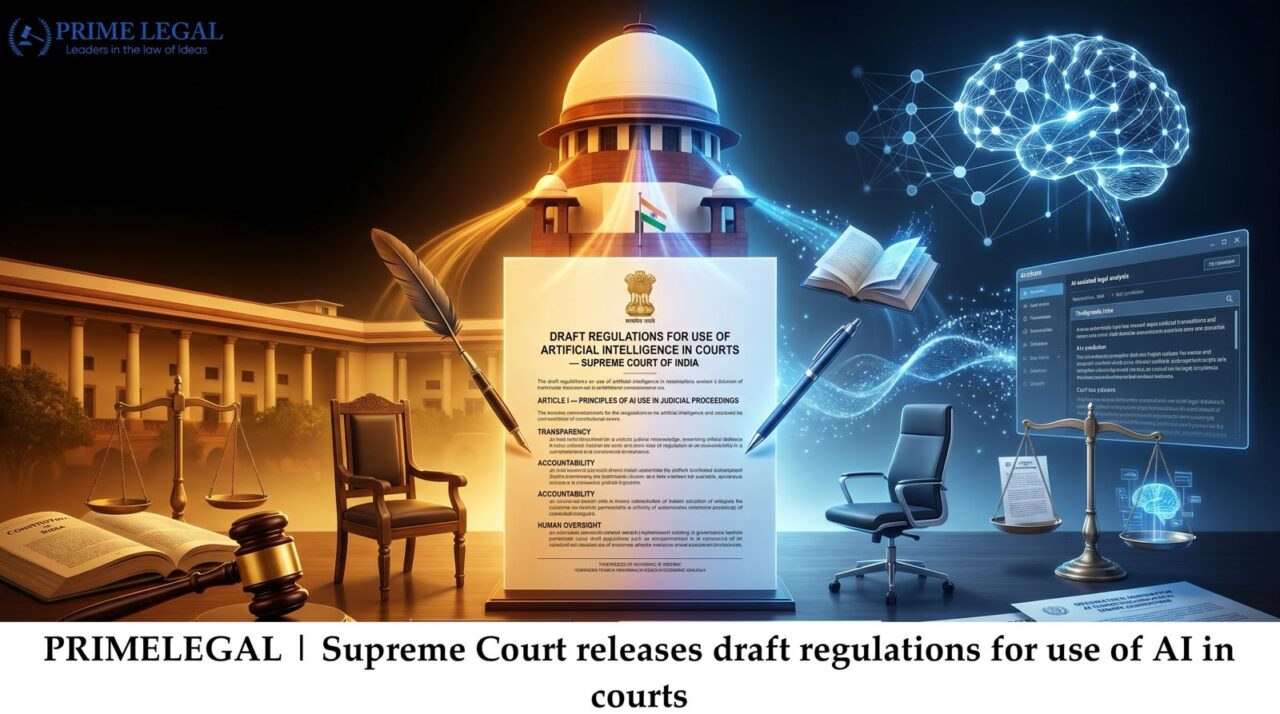
The Supreme Court of India on 3rd June, 2026, issued a landmark draft set of regulations titled “Regulations for Use of Artificial Intelligence (AI) in Courts, 2026” for the first time to regulate the use of AI in the Indian judiciary system. A draft prepared by the AI Committee of the Supreme Court has been made public for comments and suggestions till June 20, 2026. Comments have been invited from stakeholders, lawyers, technologists and the general public at office.regcc@sci.nic.in. The underlying message of the framework: AI can support the judiciary, but it can never take its place.
BACKGROUND
India’s judiciary is one of the worst hit with case backlogs in the world, having millions of cases pending across various courts across all levels. Meanwhile, the legal profession has seen a surge of AI tools, presenting both opportunities and risks. In the last year, Indian courts have battled with AI-generated fake case citations in filings and also tried to enhance efficiency with the help of AI for transcription and translation.
KEY POINTS
- The most important principle in the draft is an absolute ban: no AI system should be used for adjudicating or sentencing. Any and all artificial intelligence tools used in the court system should be in an assisting capacity only, and should not replace or undermine the free exercise of judicial discretion. At all times, guilt, liability, bail, or sentence must be a human choice.
- Regulation 19 explicitly provides for the use of AI in several instances where it can be demonstrated to offer a tangible benefit in case management, scheduling, preparing cause-lists, transcription, translation, legal research and administrative work generally, without affecting the substantive issues.
- The lawyers and parties using AI for preparing pleadings, written submissions, or other documents must declare this in the pleadings, written submissions, or filing. In addition, the use of AI-generated content in a court should be considered as advice and steps should be taken to make sure it is correct and free of bias before using it. This directly tackles the issue of AI hallucinated citations that has dogged courts around the world.
- In another significant move, Draft Regulation 20 prohibits using AI to keep a watch on judicial officers, advocates, litigants or any other individual who may appear in any judicial proceedings, a vital measure to ensure judicial independence and the right to privacy for all concerned.
- A proposal for a permanent Apex Body at the Supreme Court to oversee, regulate and promote the judicious use of AI in the judiciary process is being considered. It would establish standards, certify, and centrally manage the use of AI tools in the court space, notify High Courts, monitor compliance, and provide annual reports on the management of court AI.
- If the right of affected persons to receive any other remedy foreseen by the existing law in the event of harm caused by the use of AI in court proceedings is retained it is suggested that a grievance redressal mechanism is included.
RECENT DEVELOPMENTS
The draft regulations come at an opportune time for the legal-technology scene in India. The country has been making concerted efforts to create a more robust regulatory structure for AI, including plans to draft laws that will cover more of the country’s AI applications. With the Supreme Court leading the way, the judiciary is now in the driver’s seat in the tech world, and not at its whim.
The debate around the use of AI in courts is gaining momentum around the globe. The UK High Court has previously addressed the issue of AI hallucinations and unverifiable submissions before it, and has recently taken a firmer stance on it, placing the burden on a solicitor to ensure that the AI is correct and the information it submits is not hallucinatory. The United States, along with some European jurisdictions, has guidance for lawyers in the use of generative AI. If enacted, the proposed law will be among the most comprehensive judicial AI governance laws in the world.
CONCLUSION
The Supreme Court in the draft AI Regulations for Courts, 2026, has adopted a measured and judicious approach towards one of the most imminent concerns of the judiciary today – the balance between handling cases efficiently and maintaining the human touch in case adjudications.
“PRIME LEGAL is a National Award-winning law firm with over two decades of experience across diverse legal sectors. We are dedicated to setting the standard for legal excellence in civil, criminal, and family law.”
WRITTEN BY: ARNAV NAIK

