
CASE NAME: Pramod Shroff v. Mohan Singh Chopra
CASE NUMBER: Civil Appeal of 2026 arising out of SLP (C) No. 20779/2025
COURT: Supreme Court of India
DATE: 27 April, 2026
CORAM: JUSTICE SANJAY KAROL & JUSTICE AUGUSTINE GEORGE MASIH
Facts
The Respondent (Mohan Singh Chopra) signed a sales agreement in 1977 to sell Flat No. 61 at Shalimar Apartments which is located at 42-B Shakespeare Sarani in Kolkata to the Appellant (Pramod Shroff) for a price of ₹95,000. The first payment of ₹90,000 was made before registration while the remaining ₹5,000 was scheduled to be paid at the time of registration. The buyer received the original title deeds together with all rights to the property. The Respondent refused to accept payment of the outstanding amount after multiple attempts to contact him, and he also failed to sign the Conveyance Deed which would have transferred property rights to the Appellant. The Appellant had to take legal action in 2007 because he had no other ways to obtain specific performance of the agreement to sell. The trial court dismissed the lawsuit in 2017 because the Appellant failed to prove the Respondent owned the property in question which had never been established as a legal issue during the court process. The Calcutta High Court in 2025 upheld the trial court decision which dismissed the case but did not correct the procedural mistakes made during the trial. The Appellant then approached the Supreme Court.
Issues
- Whether the absence of formal framing of issues vitiates ex parte civil proceedings?
- Whether a court can dismiss a suit on a ground (title of Respondent) that was never raised as an issue or put to the parties for evidence?
- Whether the judgments of the courts below satisfied the requirements of a valid judgment under the CPC?
Legal Provisions
- Section 2(9) CPC: Defines “judgment” as a statement of grounds for a decree or order.
- Section 2(2) CPC: Defines “decree” as a conclusive determination of rights in controversy.
- Order XIV Rule 1(6) CPC: Framing of issues is not required where the defendant makes no defense at first hearing.
- Order XX Rule 4(2) CPC: Judgments must contain a concise statement of the case, points for determination, decision, and reasons.
- Order XX Rule 5 CPC: Court shall state findings with reasons on each separate issue framed.
- Order VIII Rule 10 CPC: Procedure when no written statement is filed.
Arguments
Appellant’s Side: No issue regarding the Respondent’s title was ever framed; hence the Appellant was never put on notice to prove it. Only parties with disputed issues must prove their facts which exist beyond their identified conflicts. Both courts below violated mandatory procedural requirements under Order XX Rule 4(2) by not determining “points for determination.”
All three essentials for specific performance includes a valid contract, breach, and readiness to perform the duties of the contract and these were duly proven.
Respondent’s Side: The Respondent remained unrepresented throughout despite being served notice. The opposing party failed to present any significant counter-arguments. The Amicus provided the Court with procedural law support which helped achieve equitable judgment.
Analysis
The procedure of issue framing serves as a protective mechanism for legal proceedings because Order XIV Rule 1(6) allows parties to suspend issue framing in ex parte hearings but Supreme Court decisions require courts to identify essential case points through Order XX Rule 4(2) which requires them to determine these points. The trial process receives limitations through the development of issues which assist both parties in understanding their respective proof requirements. The judicial system needs to examine evidence about court procedures for ex parte proceedings according to Maya Devi v. Lalta Prasad (2015) 5 SCC 588 and Ramesh Chand Ardawatiya v. Anil Panjwani (2003) 7 SCC 350 because these cases established that courts need to assess all documents and evidence before deciding a case. A default decree without reasoning is a “material irregularity.” The court used the prejudice test from Nagubai Ammal v. B. Shama Rao (1956) 1 SCC 698 to determine that a trial becomes invalid when the party does not know about the issue because they did not get the chance to present evidence. The Appellant could not argue about the title because it had never been presented as a point of dispute. The court decided that a judgment requires complete documentation which includes details about the case and the reasoning behind the decision according to Balraj Taneja v. Sunil Madan (1999) 8 SCC 396. The case applies to all situations including ex parte proceedings and default cases. The three elements of specific performance needed to be proven after the Man Kaur v. Hartar Singh Sangha (2010) 10 SCC 512 case because the plaintiff had proved that there existed a legal contract and the defendant had breached it and he was prepared to proceed with the case. Dismissal on a ground never raised was therefore legally impermissible.
Judgment
The Supreme Court annulled both the trial court judgment and the Calcutta High Court ruling. The trial court received instructions to start a new examination of the case. The Appellant needed to report for court on 04.05.2026. The trial court received instructions to issue notice and finish the pleadings and create formal issues and let both sides present evidence before making a quick decision because the lawsuit began in 2007. The court decided to deny all expenses in this case.
Conclusion
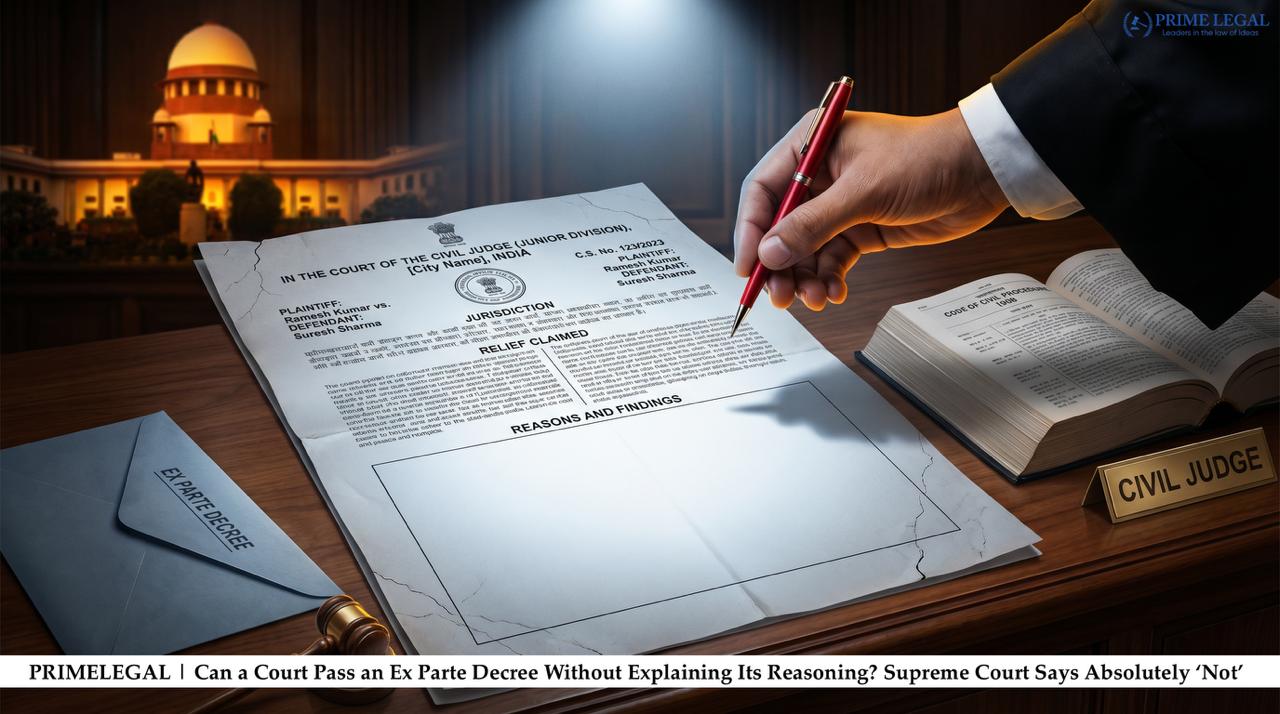
The judgment establishes that procedural requirements under the CPC must be followed because they create the base which supports just legal proceedings. Courts need to evaluate evidence and reach conclusions about cases even when there is no opposing defendant. A suit gets dismissed when a judge needs to decide on an issue that has not been officially presented or documented in court because this process prevents the plaintiff from obtaining proper legal representation. The ruling serves as an important reminder that ex-parte proceedings do not dilute judicial responsibility, they demand heightened care.
“PRIME LEGAL is a National Award-winning law firm with over two decades of experience across diverse legal sectors. We are dedicated to setting the standard for legal excellence in civil, criminal, and family law.”
WRITTEN BY: PRANAVI KOLLU
Read the judgement copy here:
Pramod Shroff vs. Mohan Singh Chopra

