
CASE NAME: Antony Samy K v. State of Karnataka & Another
CASE NUMBER: NC: 2026: KHC:17065 | WP No. 6910 of 2026
COURT: High Court of Karnataka at Bengaluru
DATE: 22 April, 2026
CORAM: HON’BLE MR. JUSTICE SACHIN SHANKAR MAGADUM
FACTS OF THE CASE
The petitioner, Mr. Antony Samy K, was the absolute owner of a scheduled property in Bengaluru. Mallikarjun, the developer who serves as a Managing Partner of the M/s Matrix Infra approached him in the month of July 2024 regarding the developing property through a contract of Joint Development Agreement (JDA). By relying, petitioner placed his trust in the developer through his execution of a registered Joint Development Agreement and General Power of Attorney document on 22nd July 2024. But the developer failed to meet his contractual responsibilities which he ought to do because he did not begin the construction work or obtain necessary government permits. Additionally, the developer did not respond to petitioners who had sent the written reminders during the months of May and June 2025. The Commercial Court issued a ruling on October 9 2025 which declared both the JDA and GPA as legally void after the developer failed to attend the Court hearing. The petitioner then went to the Sub-Registrar office to request official documentation that would show the cancellation of the documents from both the Encumbrance Certificate and the corresponding registers. The Sub-Registrar rejected the request through an endorsement on 02.02.2026 which stated that no direct communication from the court had been received. The petitioner went to the Sub-Registrar office after the decree to obtain an update about the Encumbrance Certificate together with all connected registers. The Sub-Registrar rejected the request through an endorsement on 02.02.2026 which stated that no direct communication from the court had been received. This led the petitioner to file the present writ petition.
ISSUES
- Whether the Sub-Registrar acted properly when he rejected a competent civil court decree because there had been no direct court notification of the decree to the registration office?
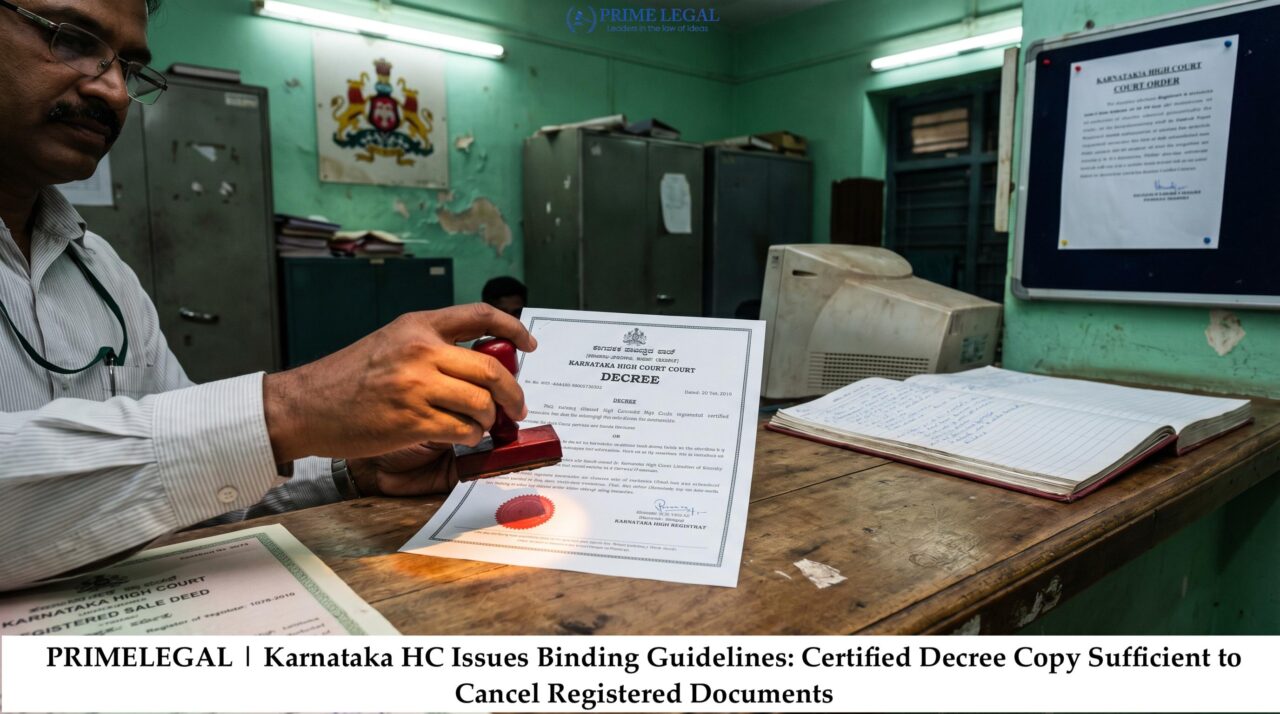
- Whether presentation of the certified decree copy by the decree-holder enables the registration agency to proceed with cancellation of records?
- Whether the civil courts and Sub-Registrars receive official guidelines to stop similar situations from happening again?
LEGAL PROVISIONS
Section 31(2), Specific Relief Act, 1963, Rule 123, Karnataka Registration Rules, 1965.
ARGUMENTS
Petitioner
The petitioner showed that the Commercial Court had already declared the JDA and GPA cancelled through its valid decree which it issued on 09.10.2025. The Sub-Registrar received a certified copy of the decree which he needed to process. The denial of the request to proceed with it represented an unjust decision which violated the established legal requirements. The Sub-Registrar must record the cancellation according to the Specific Relief Act Section 31(2) and the 1965 Rules Rule 123. The Sub-Registrar performs only administrative tasks which prevent him from making decisions about judicial rulings.
Respondents
The Sub-Registrar argued that he needed to wait for official notification from the Commercial Court before he could proceed with his duties on the decree. He claimed that the court needed to send the decree to the registration office through established procedures because records could not be updated without this official communication.
ANALYSIS
- Ministerial Nature of Sub-Registrar’s Function: The Court established that the Sub-Registrar functions as a ministerial officer when he records court-ordered cancellations. A registering authority has no power to question or evaluate the correctness of a court decree. The Sub-Registrar must update the records according to the civil court decision which cancels the registered document.
- Statutory Obligation Under Section 31(2): The combined reading of Section 31(2) of the Specific Relief Act, 1963 and Rule 123 of the Karnataka Registration Rules, 1965 establishes that registered instruments which judges cancel must be properly entered into the register and indexed by the registering authority. The registration authority must register all instruments which judges cancel according to the requirements of Section 31-2 of the Specific Relief Act and Rule 123 of the Karnataka Registration Rules 1965. The certified copy of a court decree carries statutory authenticity and must be treated as conclusive proof.
-
- Sub-Registrar’s Refusal Was Unlawful: The Court established that the Sub-Registrar had refused his request in an arbitrary manner while he violated his legal responsibilities. The court ruling should always maintain its full effectiveness but this would create an administrative barrier which registration offices could use to control its enforcement.
- Need for Systemic Guidelines: The Court identified this problem as a common issue which occurs throughout the entire State. The lack of proper communication systems between civil courts and Sub-Registrar offices results in excessive writ petitions which overwhelm the High Court because they deal with basic administrative issues.
- The Hon’ble Court Directed to all the Sub-Registrars to adhere these guidelines:
- Whenever a decree cancelling a registered document is communicated by a civil court, the Sub- Registrar shall make the required entries in the relevant register and indexes within four weeks of receipt of such communication.
- Even in cases where no formal communication is received from the Court, if a party produces a certified copy of the judgment and decree declaring the registered instrument as cancelled or void, the Sub-Registrar shall not refuse to act upon the decree.
- In such cases, the Sub-Registrar shall verify the authenticity of the certified copy and thereafter record the cancellation in the relevant registers and indexes in accordance with the Rule 123 of the 1965 Rules.
- The registering authority shall not insist upon separate orders of the High Court or any other authority once a competent civil court has declared the document to be void or cancelled.
- The role of the Sub-Registrar in such cases being ministerial, the authority shall not adjudicate upon the correctness or validity of the decree.
JUDGMENT
The court granted approval to the writ petition. The court annulled the endorsement which was dated 02.02.2026. The Sub-Registrar received instructions to record the JDA and GPA cancellation after four weeks of obtaining the certified copy of this order in accordance with Rule 123 of the Karnataka Registration Regulations. All civil courts and Sub-Registrars throughout Karnataka received guidelines which required them to notify and execute registered instrument cancellation decrees without delay.
CONCLUSION
The judgment establishes that judicial decrees remain in effect despite administrative bodies failing to execute their duties. A Sub-Registrar cannot demand separate High Court directions when a valid civil court decree already exists. The guidelines established by the Court eliminate an essential procedure deficiency which safeguards decree-holders rights and decreases unnecessary court cases in constitutional courts.
“PRIME LEGAL is a National Award-winning law firm with over two decades of experience across diverse legal sectors. We are dedicated to setting the standard for legal excellence in civil, criminal, and family law.”
WRITTEN BY: PRANAVI KOLLU
Read the judgement copy here:
Mr Antony Samy K v. The State of Karnataka & Another

