
ABSTRACT
Enshrined under Articles 82 and 170 of the Indian Constitution delimitation forms the backbone of Indian democracy. It is the process of redrawing electoral constituencies and the Parliament is under intense heat because of its latest decision to bring in some landmark changes before the 2029 general elections. While the Constitutional provisions are laid down to ensure equal representation based on changes in the population, a constitutional freeze has been implemented on these provisions since 1976 till 2026 as delimitation had raised concerns of federal equality and democratic fairness. This article analyses the constitutional framework, federal tensions, recent legislative developments, and the urgent need for reform in India’s delimitation process.
Keywords
Delimitation, Federalism, Article 82, Article 170, Electoral Reforms, Lok Sabha, Women’s Representation.
INTRODUCTION
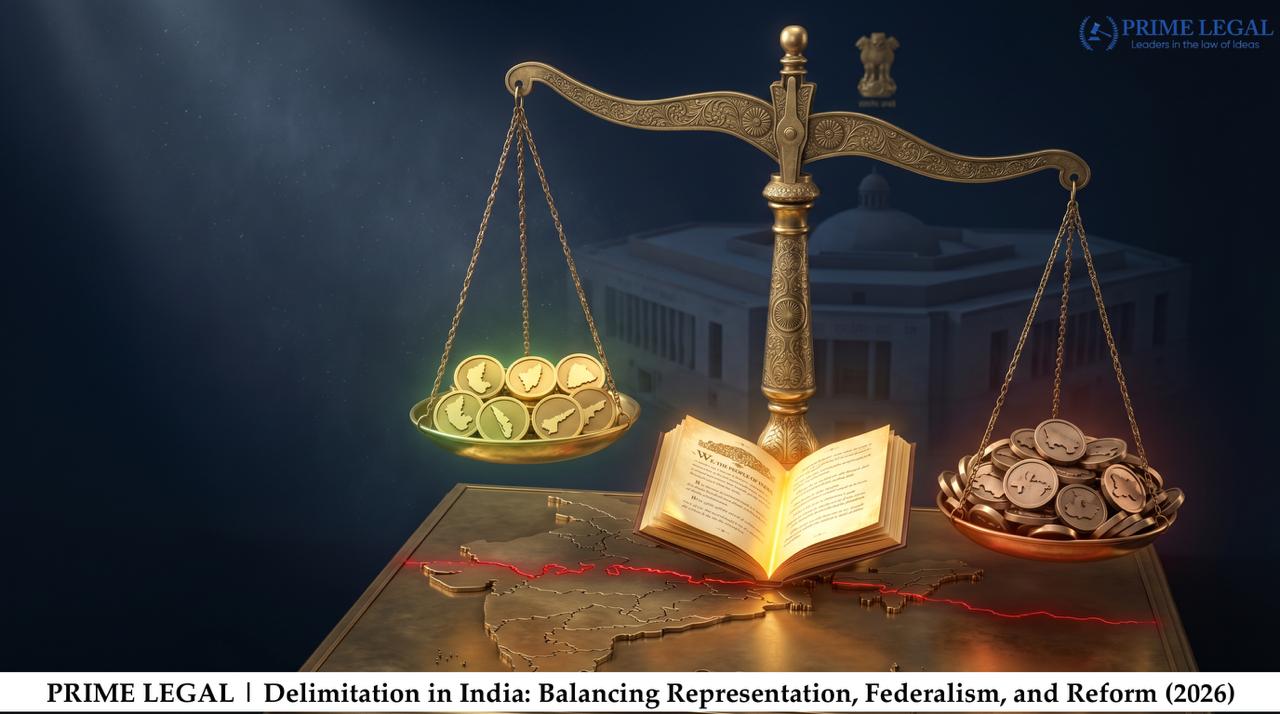
In a country with nearly a billion eligible voters, delimitation is not merely redrawing some imaginary boundaries, it is much more complex and important than that. Delimitation is a political and democratic necessity, it redefines federalism, democracy and constitutional design.
One person, one vote, one value is not just a principle. It requires the constituencies to reflect changes over the time. The freezing of delimitation proceedings till 2026 has created representational disparities across the states over the past few decades. With the freeze period coming to an end this year, the country finds itself in a crucial juncture. The questions on how to evolve democratic representation in a federal democracy like India have only intensified with the recent failure of Delimitation and Women’s Reservation Bills in the Parliament this month.
The Constitution
The founders of the Constitution laid down the foundation for delimitation under Articles 82 and 170, which mandated readjustment of constituent boundaries of Parliament and State Assembly after every Census. The decision(s) of the Delimitation Commission formed by the Parliament is final and cannot be challenged is a principle already affirmed in Meghraj Kothari v. Delimitation Commission (1967 AIR 669).
Delimitation is an exercise which was done throughout the years of 1952, 1963, 1973 and 2002. However, with the 42nd Constitutional Amendment Act, 1976, this exercise was frozen in order to encourage population control. This was further extended to until after the first Census post 2026 by way of 84th Constitutional Amendment Act, 2001. Though this policy had achieved demographic objectives, it resulted in unequal representation among states.
The post 2026 delimitation holds much more significance than one allows oneself to believe; as it will not only redraw the boundaries but also redefine the distribution of constitutional power.
2026 Parliamentary Debates
The Union government introduced three new Bills in the Parliament in April 2026; the Delimitation Bill alongside the One Hundred and Thirty First Constitution Amendment Bill. The proposed Bill seeks to provide one by third reservation for women in legislatures, thus, aiming to restructure parliamentary representations.
The Bills were severely contested when the opposition pointed out the linkage between women’s reservation and delimitation. According to the provisions of the reservation Bill, reservation provisions could only be implemented upon the completion of delimitation exercise, making it contingent on the latter. This was widely criticised and opposed by politicians and experts alike. Due to this the Women’s Reservation Bill failed to get a two-thirds majority in the Lok Sabha, and this resulted in the shelving of the Delimitation Bill as well.
The North-South divide
Soon after independence India was faced with a big problem, population explosion. The population was already in millions and the resources available were scarce, and the only solution? Reduce population. And this became one of the top priority national policies. The Southern states in India successfully managed to control their population growth compared to their Northern counterparts, whose population has only increased over the decades.
This created a constitutional paradox; the constitutional principles mandates equal representation based on population, whereas, federal principles demand states should not be penalised for their effective management and governance of their states. Thus, if the delimitation exercise is carried on then it will be like giving more political power and influence to the states who have effectively failed in keeping up with their end of the deal.
However, even with all this said, proponents hold that deviating from population based representation will undermine electoral equality.
Representation, Reservation, and Structural Challenges: The Heart of Delimitation
The delimitation process will not only affect the women’s reservation but will also affect the reservations of constituencies for Scheduled Castes and Scheduled Tribes under Articles 330 and 332 of the Constitution.
The expansion of Lok Sabha seats has also raised concerns of governance efficiency and administrative feasibility.
Delimitation has also raised several structural challenges as well, some of them being lack of transparency, little to no public participation etc.
All these have shed light to one thing, which is, India needs a more developed, nuanced and balanced approach to delimitation.
A potential solution is increasing the overall seats to the Lok Sabha to accommodate the population representation without penalising the other states.
However, no solution will be good enough or effective unless the government becomes more transparent with its actions and increases public participation, along with including other factors such as administration, social and geography as a criteria for delimitation.
CONCLUSION
The 2026 delimitation is not merely an act of redrawing some boundaries, rather it is going to be an act of redefining the federal and democratic balance of equality. The recent failure of two important Bills in the Lok Sabha in itself is a clear indicator of how complex the issue is and how urgent it is to take a census driven reform. Though it is true that the Constitution has laid down the provisions for delimitation and altering the representations to the Lok Sabha, it is the duty of the political leadership of this country to take a decision that balances the competing interests.
As some argue delimitation is necessary for ensuring adequate representation from all states and regions, it should not come as a step to punish states who have managed to successfully implement national policies such as reducing population.
Delimitation, thus, in our current position is a two edged sword; if implemented with proper care and foresight it can help reinforce democratic legitimacy in the country, however, if misused and mishandled, it will deepen the existing problems that we spent decades to solve.
“PRIME LEGAL is a full-service law firm that has won a National Award and has more than 20 years of experience in an array of sectors and practice areas. Prime legal falls into the category of best law firm, best lawyer, best family lawyer, best divorce lawyer, best divorce law firm, best criminal lawyer, best criminal law firm, best consumer lawyer, best civil lawyer.”
WRITTEN BY: AARSHITHA UNNIKRISHNAN

