
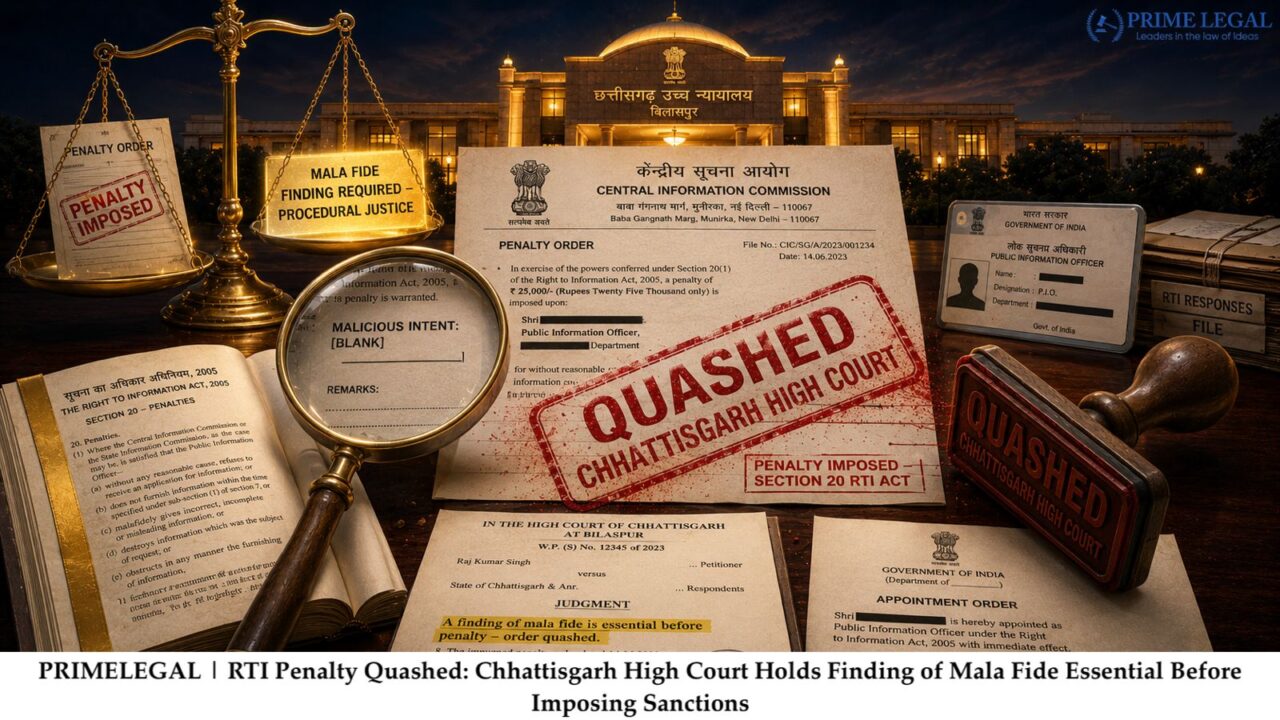
CASE NAME: T.A. Khan v. State of Chhattisgarh & Ors.
CASE NUMBER: WPC No. 3610 of 2022
COURT: High Court of Chhattisgarh
DATE: 05 May 2026
QUORUM: Hon’ble Mr. Justice Amitendra Kishore Prasad
FACTS
The petitioner T.A.Khan was working as Public Information Officer (PIO) in the office of Chief Conservator of Forests (CCF), Durg of Chhattisgarh. On receipt of this application for RTI on 10.04.2019, he immediately transferred the same to the Audit and Store sections where the information was stored. The Audit Section provided 12 pages of available information which it duly provided to the RTI applicant (Respondent No.4). The Store Section, however, stated that the information was not on record. No.4 who was not satisfied filed a first appeal. No finding of deliberate lapse was recorded by the First Appellate Authority and he simply instructed that if any further information could be traced then the same be supplied or the application be transferred to the appropriate Authority. Next Respondent No.4 appealed to the State Information Commission (SIC) alleging for penalty and for the commencement of departmental proceedings.
The SIC had imposed a penalty of Rs.25, 000/- under the doctrine of Section 20(1) of the RTI, 2005 on the petitioner for the failure to supply information in a timely and complete manner. The petitioner had already been transferred to SDO Forest, Dongargarh as PIO by this time and therefore had no control over the compliance proves thereafter. Petitioner challenged the penalty order by writ petition before the HC of Chhattisgarh.
ISSUES
- Whether the penalty imposed under Section 20(1) of the RTI Act was legally sustainable in the absence of a specific finding of malafide intent or unreasonable delay without sufficient cause.
- Whether transferring an RTI application to the concerned custodian sections and supplying available information constitutes sufficient compliance absolving the PIO of penal liability.
- Whether the State Information Commission violated the principles of natural justice by failing to afford an effective opportunity of hearing to the petitioner before imposing penalty.
LEGAL PROVISIONS
- Section 6(3) of the RTI Act 2005 – Duty of PIO to transfer application to the concerned authority if information is not held by them.
- Section 19 of the RTI Act 2005 – Procedure for filing appeals before First Appellate Authority and State Information Commission .
- Section 20(1) of the RTI Act 2005 – Power of the Information Commission to impose penalty on the PIO for failure to comply without reasonable cause .
- Case Laws: Nitin Singhvi v State of Chhattisgarh State Information Commission, 2024 CGHC 9168 (2024) (India) ; Manohar v State of Maharashtra & Anr., (2012) 13 SCC 14 (India).
ARGUMENTS
APPELLANT:
The petitioner contended that he had fulfilled the requirement of the RTI Act by referring the petitioner’s application to the Audit and Store Sections since they had the information sought. The Audit Section provided information that was available, and the Store Section reported there were no records of relevance. He argued that a PIO should not be held accountable for information that the public authority doesn’t have. It was also indeed argued that there had been no finding of deliberate lapse and the penalty under Section 20(1) should be based on malafide conduct or unreasonable delay.
RESPONDENT:
The State argued that the SIC had heard and considered the record before it made the order. It was suggested that handing over an application will not necessarily result in complete and timely disclosure being released from responsibility on the PIO. Respondent No. 2 also argued that lack of complete and timely submission of information by the petitioner also indicated that petitioner failed to fulfil his obligations under Section 6(3).
ANALYSIS
The Court considered Section 20(1) of the RTI Act keeping in mind Nitin Singhvi and Manohar. It believed that the penalties imposed under the RTI Act must not be mechanical because they are quasi-criminal. The Commission shall impose a penalty only after finding the PIO has failed to provide information for no reasonable cause, delays the information for an undue period of time, or acts with malice aforethought.
The Court noted that the SIC had not given due consideration to the petitioner’s explanation that the application was transferred to the relevant sections and the necessary information was provided. Most significantly, the Commission failed to make any mention about the presence of malafide intent or lack of reasonable cause. This is a requirement that must be made before levying a civil penalty.
However, the Court reiterated, relying on Manohar, at times negligence is not enough to bring Section 20(1) into operation. The petitioner’s explanation did not appear to be contradicted and there was no evidence of any obstruction by him, the penalty was considered unsustainable. The SIC’s use of power was then said to be mechanical and legally incorrect.
JUDGEMENT
The petition was allowed. The High Court set aside the order issued by the SIC dated 09.05.2022 and any subsequent proceedings for recovery. An order as to costs was not made.
CONCLUSION
The decision confirms that the penalties imposed under section 20(1) are none automatic and need a proper judgment of the malafide conduct or delay occurring unprovoked. It is also a reminder that Information Commissions will be bound by rules of Natural Justice and that they are required to state reasons for imposing liability on a Public Information Officer.
“PRIME LEGAL is a National Award-winning law firm with over two decades of experience across diverse legal sectors. We are dedicated to setting the standard for legal excellence in civil, criminal, and family law.”
WRITTEN BY : ARNAV NAIK
Read the full judgement here: T.A. Khan Versus State Of Chhattisgarh

