
INTRODUCTION:
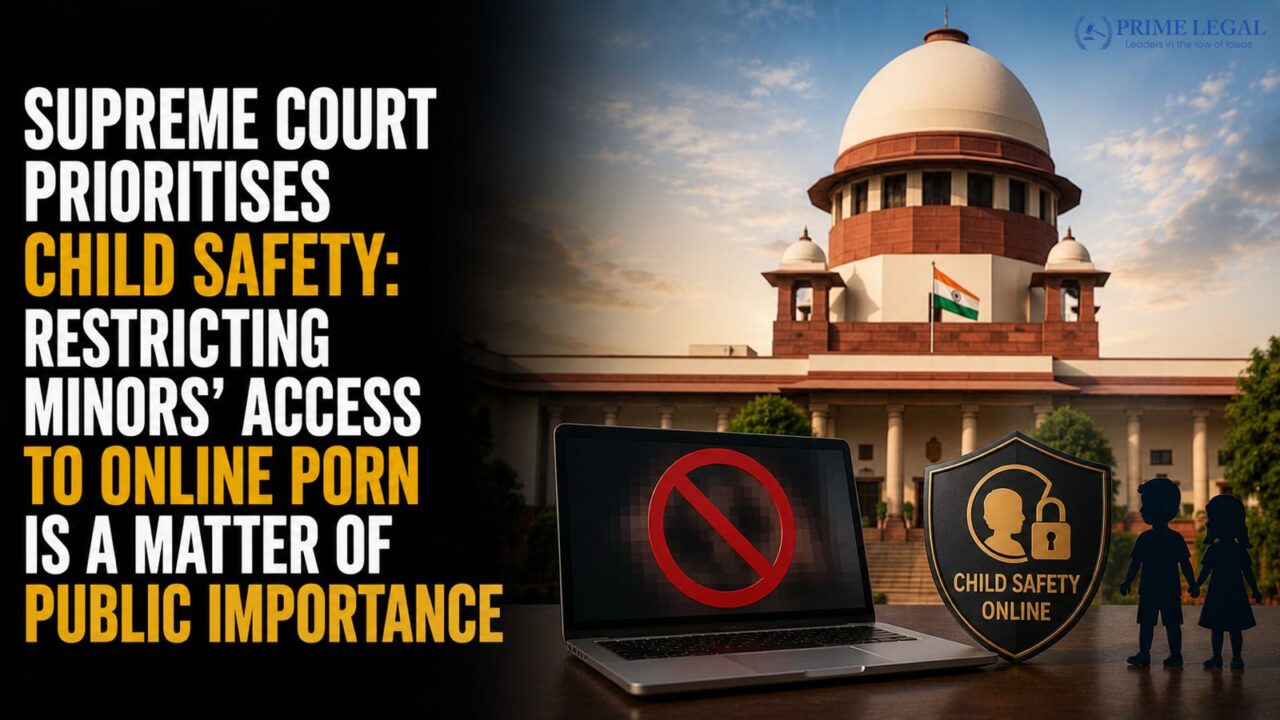
In a recent matter concerning children’s safety and internet regulation, the Supreme Court commented that regulating the access to online pornographic material especially to minors is a matter of immense public significance that requires attention. While dealing with a Public Interest Litigation (PIL), the Bench composed of the Chief Justice of India (CJI) Surya Kant and Justice Joymalya Bagchi remarked that this issue includes a child’s wellbeing and overall development. The Court addressed the fact that post covid-19 pandemic and requirement of online classes, many children may have got access to the internet. However, this has led to an increase in viewing pornographic content especially by minors.
BACKGROUND:
A Public Interest Litigation was filed in the Supreme Court by Advocate BL Jain, requesting enhancements in the safety measures against children accessing pornographic content. The petitioner contented that despite existing statutes like, Protection of Children from Sexual Offences Act and the Information Technology Act, children are still accessing pornographic content due to the lack of strict verification of age and implementation. It was argued that the unrestricted exposure to pornographic content leads to adverse effects on children’s mental health, their perception of sexuality and their consent.
The Supreme Court noted the gravity of the issue and regarded it to be a “ policy issue of paramount importance”. The court sought inputs from the government ministries like the Ministry of Electronics and Information Technology (MeitY) regarding the present laws on the issue and safeguards being taken by it.
KEY POINTS:
- The Supreme Court noted the issue of accessing online pornography by minors as one of public importance.
- The petitioner argued the existence of loopholes in laws, leading to such an issue.
- The matter relates to child safety, the liability of intermediaries, and digital governance.
ANALYSIS:
The situation balances the Constitutional provisions guaranteeing freedom of speech under Article 19(1) against the constitutional obligation of the State to safeguard children as mandated by Article 15(3) of the Constitution. While adult citizens are free to consume content that is permissible under Article 19(2) of the Constitution, the State must ensure proper growth of children by protecting them from harm.
The policy is already reflected an several statutory provisions. The POCSO Act, 2012 along with Sections 67, 67A, and 67B of the Information Technology Act, 2000, the Information Technology (Intermediary Guidelines and Digital Media Ethics Code) Rules, 2021 include provisions regarding obscenity and child sexual abuse materials and place due diligence liability on the intermediaries. However, the present system exposes a gap in regulation in that, while child sexual abuse content has become an offence, nothing seems to exist to prevent minors from accessing such content.
CONCLUSION:
The Supreme Court’s observations represent a significant matter in the developing digital rights jurisprudence of India. The Court made it clear that the minors’ accessibility of online pornography is of public significance. It has so stated that protecting children in the cyber world is a responsibility of the state. The eventual result is likely to have an impact on age-verification, intermediary liability, and child protection measures in India and reiterates that the ‘welfare of the child is of utmost importance’.
“PRIME LEGAL is a National Award-winning law firm with over two decades of experience across diverse legal sectors. We are dedicated to setting the standard for legal excellence in civil, criminal, and family law.”
WRITTEN BY: SOMSUTA PAUL

