
ABSTRACT:
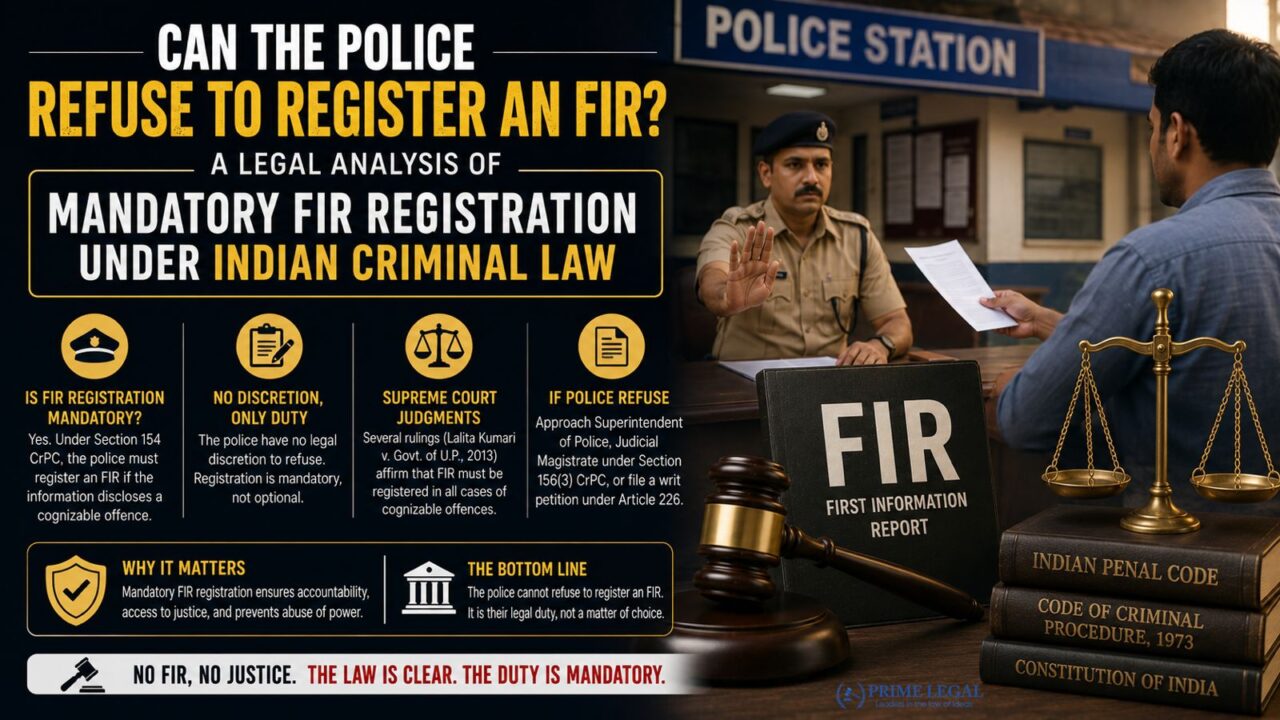
The registration of an FIR marks the commencement of criminal procedure in India. The legality of a police officer’s refusal in registering an FIR has widespread implications on access to justice for citizens. The author in this article discusses the statutory obligation of the police to register an FIR as under Section 173 of the Bharatiya Nagarik Suraksha Sanhita, 2023 (BNSS) Act [ formerly Section 154 of the Code of Criminal Procedure, 1973 (CrPC)] read with the Bharatiya Nyaya Sanhita, 2023 (BNS) Act and the Bharatiya Sakshya Adhiniyam, 2023 (BSA) Act. Further, the article explains the foundational concept of cognizable and non-cognizable offences followed by the landmark judgement of Lalita Kumari v. Government of Uttar Pradesh (2014) and recent Supreme Court decisions on the exception of “preliminary enquiry” as enshrined under BNSS. Finally, the article brings light to the legal recourse available to a citizen in case of unlawful denial of FIR registration.
INTRODUCTION:
Most criminal prosecutions in India usually start with the filing of an FIR. While Section 154 of CrPC used the word “shall” indicating a mandatory and unconditional obligation of registering information about the commission of a cognizable offence, it was a common practice for the police officers to refuse registration on various grounds like lack of jurisdiction, need for verification etc. The Supreme Court in 2014 sought to curb this menace. Almost a decade later, CRPC was substituted with BNSS and provisions for FIR registration were modified.
CLASSIFICATION OF OFFENCES AS CONFIGIZABLE AND NON-COGNIZABLE
The division of offenses into cognizable or non-cognizable forms the basis for FIR registration and further investigation. In case of a cognizable offense, the police have power to arrest and conduct investigations without a warrant and without prior permission from a magistrate. According to the BNS, serious offences like murder, rape, robbery, dowry deaths etc. come under the category of cognizable offenses.
In case of a cognizable offense, Section 173(1) of BNSS states that a FIR should be mandatorily registered immediately after receipt of information about such an offense. However, in case of receiving information regarding any non-cognizable offense, like simple hurt or defamation, the police officers are required only to record the same in the Police diary and advise the informant/victim to approach the magistrate for investigation. Police cannot start an investigation in a non-cognizable offence without the prior permission of a judicial magistrate. If a complaint contains both non-cognizable and cognizable offenses, FIR registration is mandatory.
STATUTORY FRAMEWORK:
While Section 173(1) BNSS carries forward the key requirement that each FIR reporting a cognizable offence must be registered, it comes with several changes from the CRPC. The provisions of the Zero FIR system have been included that states that registration of FIR in case of cognizable offence can take place in any police station regardless of jurisdiction. It also incorporates provisions for electronic communication and registration. The major change comes through Section 173(3), which does not appear in the CrPC is that, where an offence carries a maximum punishment of three to seven years imprisonment, police with the permission of an officer not below the rank of the Deputy Superintendent of Police may undertake a preliminary enquiry within fourteen days to determine whether there exists a ‘prima facie’ case for registration. The BNS provides the classification of offences as cognizable or non-cognizable, whereas the BSA deals with the evidentiary value of an FIR.
JUDICIAL INTERVENTION AND INTERPRETATION OF PROVISIONS:
In the landmark case of Lalita Kumari v. Government of Uttar Pradesh MANU/SC/1166/2013 The Supreme Court held that FIR registration is mandatory and unconditional once a cognizable offence is reported, and only a limited period of preliminary enquiry is allowed in specific areas of matrimonial dispute, business dispute, medical negligence, corruption, and abnormal delay in reporting offences. However, in Imran Pratapgarhi v. State of Gujarat 2025 INSC 410 The court held that when charges relate to speech, expression or art work and fall in the defined category of offences punishable by three to seven years of imprisonment, a preliminary enquiry would be preferred to prevent the chilling effect of automatic FIR registration on free expression.
REMEDIES AVAILABLE AGAINST OF NON-REGISTRATION OF FIR:
In the event where police officers unlawfully deny registration of FIR in case of cognizable offences, the law lays down several steps of remedy:
- Reporting the Superintendent of Police (SP): Similar to Section 154(3) of CrPC, any aggrieved person is allowed to send their complaint in writing or via post to the Superintendent of Police, who is obliged to take up the investigation himself or through any junior officer of his choice.
- Report to the Magistrate: In case where the cognizable offense hasn’t been registered and investigated even after information about it has been communicated to the Superintendent of Police, an application can be filed by the aggrieved under Section 173 (4) of the above-stated Code for its registration and investigation.
- Criminal Liability of an officer: The Punishment for a public servant whose duties include the duty to file an FIR and who fails to file as needed especially in the case of offences committed against women and children is specified in Section 199 of the BNS.
- Departmental Enquiry: Complaints can be filed with higher officers of police and the State Police Complaints Authority.
- Constitutional Remedy: Concerns regarding the refusal to file an FIR in case of cognizable offences, especially where urgent actions are necessary, may be taken up with the High Court under Article 226 for the issue of a mandamus or the Human Rights Commission where fundamental rights violation is concerned.
- Documentation: Written complaint acknowledgment slips, CCTNS (Crime and Criminal Tracking Network & Systems) entry, and Right to Information Act, 2005 information requests can serve as evidence of refusal.
CONCLUSION:
As clearly highlighted, the registration of an FIR relating to a cognizable offence is mandatory and not left at the discretion of police officers. However, under the BNSS, Section 173(3) creates an exception for a particular type of offence, which must be monitored continuously by the courts to prevent abuse. In case of failure to register FIR in cognizable cases, there is a hierarchical system of remedies, both administrative, punitive, departmental, and constitutional in nature available to citizens.
“PRIME LEGAL is a National Award-winning law firm with over two decades of experience across diverse legal sectors. We are dedicated to setting the standard for legal excellence in civil, criminal, and family law.”
WRITTEN BY: SOMSUTA PAUL

