
INTRODUCTION:
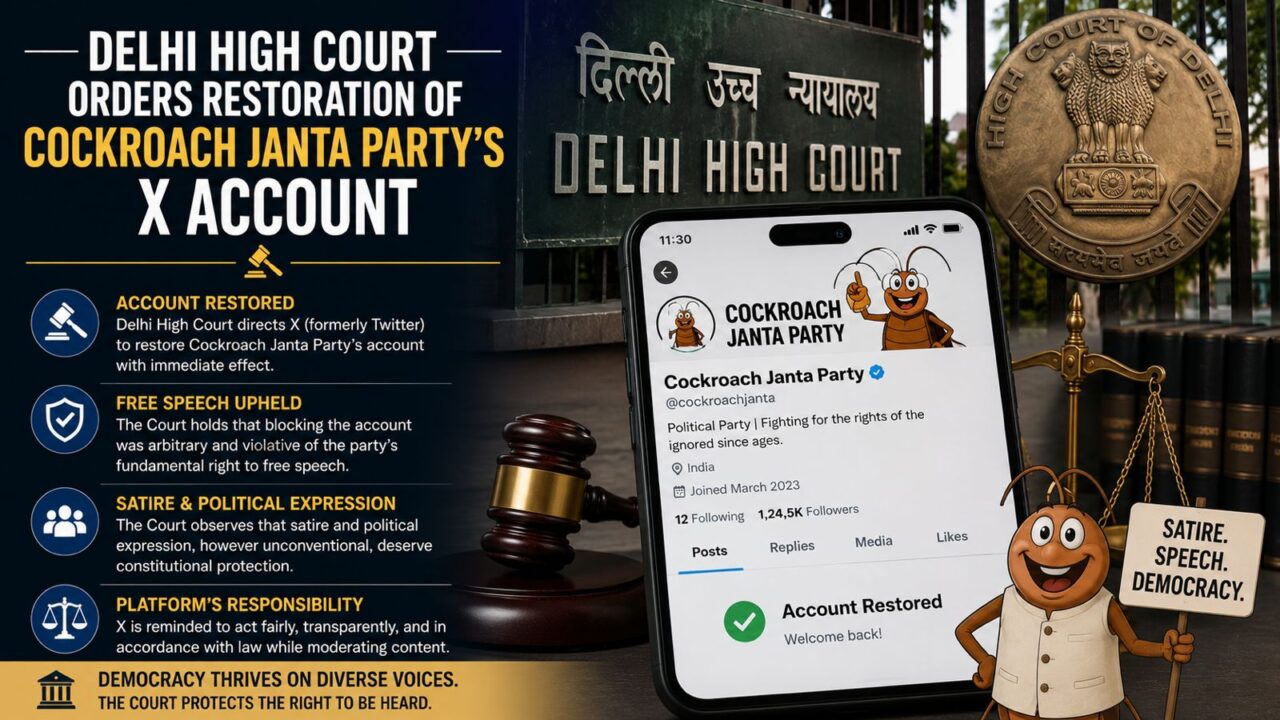
The Delhi High Court has ordered the restoration of the X (formerly Twitter) account of the Cockroach Janta Party (CJP) and the Union Government has informed the Court that there is no longer an opposition to unblock the account. The account had been withheld in the wake of the NEET examination as the authorities were concerned about chaos among students and public order disruption. Justice Swarana Kanta Sharma remarked that the reasons for blocking the account came to an end as the examination was over, thus making the continued restriction unnecessary. The decision reinstates the principle that restriction on online speech must be temporary and reasonable.
BACKGROUND:
The Cockroach Janta Party, a satirical social media movement was founded by Abhijeet Dipke, in response to a comment made by the Chief Justice of India where he equated unemployed youth attacking systems as ‘cockroaches’. The CJI later clarified that he was referring to persons with fake degrees. The social media account gained immense popularity across the nation within hours of its creation.
Soon after the official X account gained a large following, the Central Government ordered the account to be withheld in India, concerning that it could cause confusion and unrest among students before the NEET examination.
While the matter first appeared in the Delhi High Court in the case of Abhijit Dipke v. Union of India, the Court did not order immediate restoration of the account. Instead, it asked the Government to review the blocking order. During a later hearing, the Solicitor General confirmed that the Government no longer opposed restoration as the NEET examination had ended and the reasons for blocking no longer existed.
KEY POINTS:
- The ‘Cockroach Janta Party’ s X account (formerly Twitter) has been ordered to be restored by the Delhi High Court.
- The restriction was justified by the Union Government, stating that there was a threat to the public order in the wake of NEET examination.
- The Court stated that the reasons for blocking the account have ceased as the exam has ended. Thus, enforcing the right to free speech under Article 19(1)(a) of the Indian Constitution.
- The ruling emphasizes the principle of proportionality and periodic review of government orders.
ANALYSIS:
The case addresses the safeguarding of the fundamental right to free speech in the age of technology. Article 19 (1)(a) of the Indian Constitution provides for the right to freedom of speech and expression and this includes freedom of expression through the digital medium. However, Article 19 (2) does allow for certain reasonable restrictions on the grounds of public order, security of the State, friendly relations with Foreign States, decency or morality, and also with respect to contempt of court, defamation, or incitement to an offence. The Supreme Court in the landmark judgement of Shreya Singhal v. Union of India AIR 2015 SUPREME COURT 1523 emphasized that restrictions on online speech must meet the standards of legality, necessity, and proportionality.
The Delhi High Court’s reasoning is a reinstatement of the constitutional principle of proportionality. The Government informed the court that the main reason for withholding the account, concerning disruption during the NEET examination, has ended as the examination has concluded. Thus, continuing the blocking order would not be proportional as restrictions should be temporary and should remain in place only till they fulfil a legitimate purpose.
The ruling highlights the role of courts in reviewing government orders relating to online content management, including powers given under the Information Technology Act, 2000. Although the Government has the authority to block online content when certain legal conditions apply, such orders are subject to judicial review.
CONCLUSION:
The Delhi High Court’s order to restore the Cockroach Janta Party’s X account is a reinstatement of the principle of proportionality and the constitutional protection for online speech. By restoring the account, the Court highlighted that government orders restricting online content cannot last longer than the intended purpose.
“PRIME LEGAL is a National Award-winning law firm with over two decades of experience across diverse legal sectors. We are dedicated to setting the standard for legal excellence in civil, criminal, and family law.”
WRITTEN BY: SOMSUTA PAUL

