
INTRODUCTION
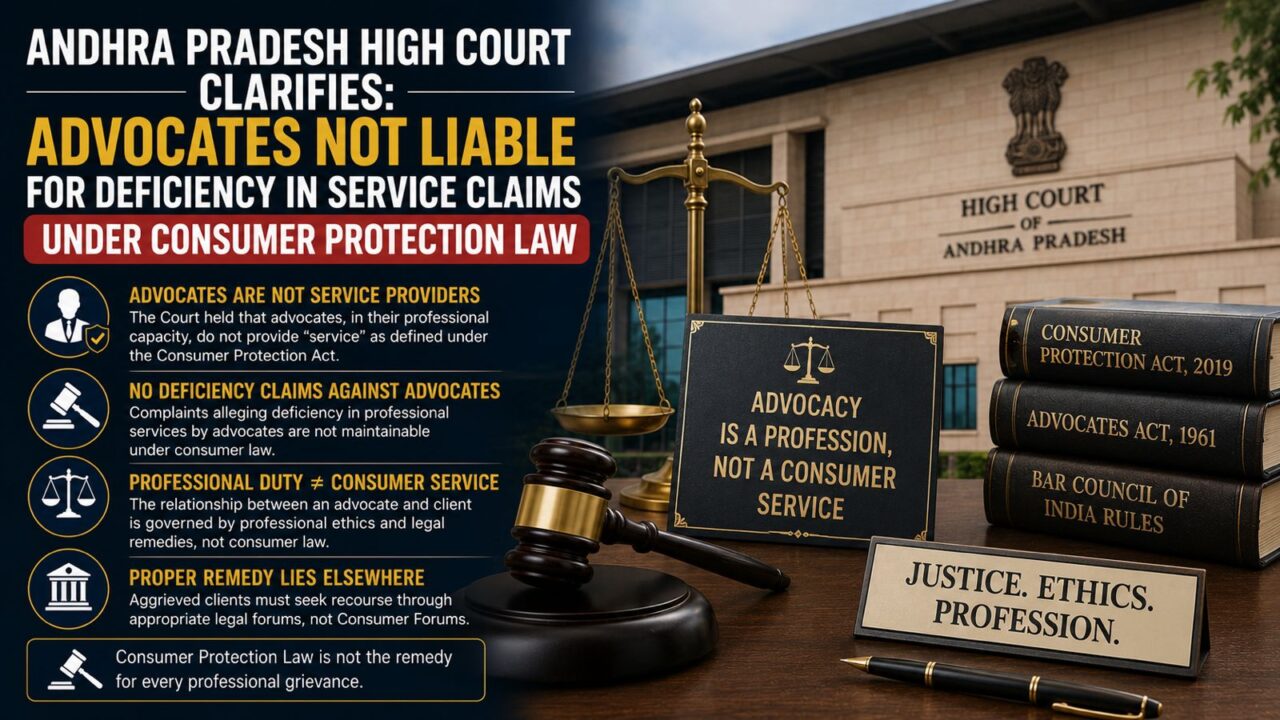
In the case of A.S.S.K. Durga Prasad vs. National Consumer Disputes Redressal Commission & Ors, the Andhra Pradesh High Court reaffirmed that an advocate cannot be held responsible for any ‘deficiency in service’ as defined under the Consumer Protection Act, 2019.
This was clarified by the Division Bench comprising Hon’ble Justice Ravi Nath Tilhari and Hon’ble Justice Subhendu Samanta, who stated that the services provided by lawyers fell outside the ambit of the Consumer Protection Law and the clients couldn’t approach Consumer Forums for the alleged failure of their lawyers in providing services.
BACKGROUND
The controversy had started when the petitioner had filed a complaint as a consumer before the District Consumer Disputes Redressal Commission in the city of Visakhapatnam against his advocate for deficiency of service in a civil case filed on his behalf.
The petitioner filed a complaint with the District Commission which was rejected on its merits in March 2022 and then challenged the order before the Andhra Pradesh State Consumer Disputes Redressal Commission and later a Revision Petition before the National Consumer Disputes Redressal Commission (NCDRC).
He went to both commissions whose cases he dismissed. Finally, the petitioner presented a writ petition in the consumer forums in Andhra Pradesh before the high Court in the state.
KEY POINTS
- The Andhra Pradesh High Court in its recent order stated that complaints against a lawyer for failure to provide adequate legal representation are not maintainable under the Consumer Protection Act.
- The Court had cited the Supreme Court precedent in Bar of Indian Lawyers v. D.K. Gandhi PS National Institute of Communicable Diseases to conclude that the legal profession is “sui generis” or unique in nature.
- The definition of “service” under Section 2(42) of the Consumer Protection Act, 2019 excludes legal services which are regarded as a “contract of personal service.
- The Court held that an advocate is a “fiduciary” and is expected to treat the client with care and respect so that the client is not treated as “a typical commercial transaction or service provider.
- Although lawyers are immune from liability under the Consumer Protection Act, it has created a precedent that they are not immune from liability at common law of negligence for their professional conduct.
- The consumer forums’ previous orders were upheld by the High Court, which rejected the writ petition on the grounds that they found no merit in the petition.
ANALYSIS
The judgment of the HC is quite consistent with the Supreme Court’s reasoning that legal advocacy is not a commercial service.
The judiciary, by defining the lawyer-client relationship as a contract of personal service, makes it possible for the advocate to work without the fear of a lawsuit from the consumer, which may make it tough to get a job done and be independent as well as represent your clients with bravery.
Consumer forums are intended for quick resolution of consumer complaints, but to use summary trial to complex legal manoeuvres would be ill-advised.
The judgment defines the scope of the Consumer Protection Act, so that when it comes to professional accountability for lawyers, the Advocates Act is in play, as are disciplinary tribunals such as the Bar Council, and normal civil courts for negligence claims.
CONCLUSION
It is a stark reminder of the distinctness of the legal field by the High Court of Andhra Pradesh dismissing the writ petition in Andhra Pradesh. The legal system shields advocates from claims in consumer courts from their clients, allowing the relationship to have a specialized and fiduciary nature.
Finally, the court pointed out that consumers’ remedies are available for actual negligence, a remedy that is available in either a civil proceeding or a disciplinary proceeding, but that consumer protection policies apply only to standard services and commercial goods, not to law practice.
“PRIME LEGAL is a National Award-winning law firm with over two decades of experience across diverse legal sectors. We are dedicated to setting the standard for legal excellence in civil, criminal, and family law.”
WRITTEN BY: SHEEN

