
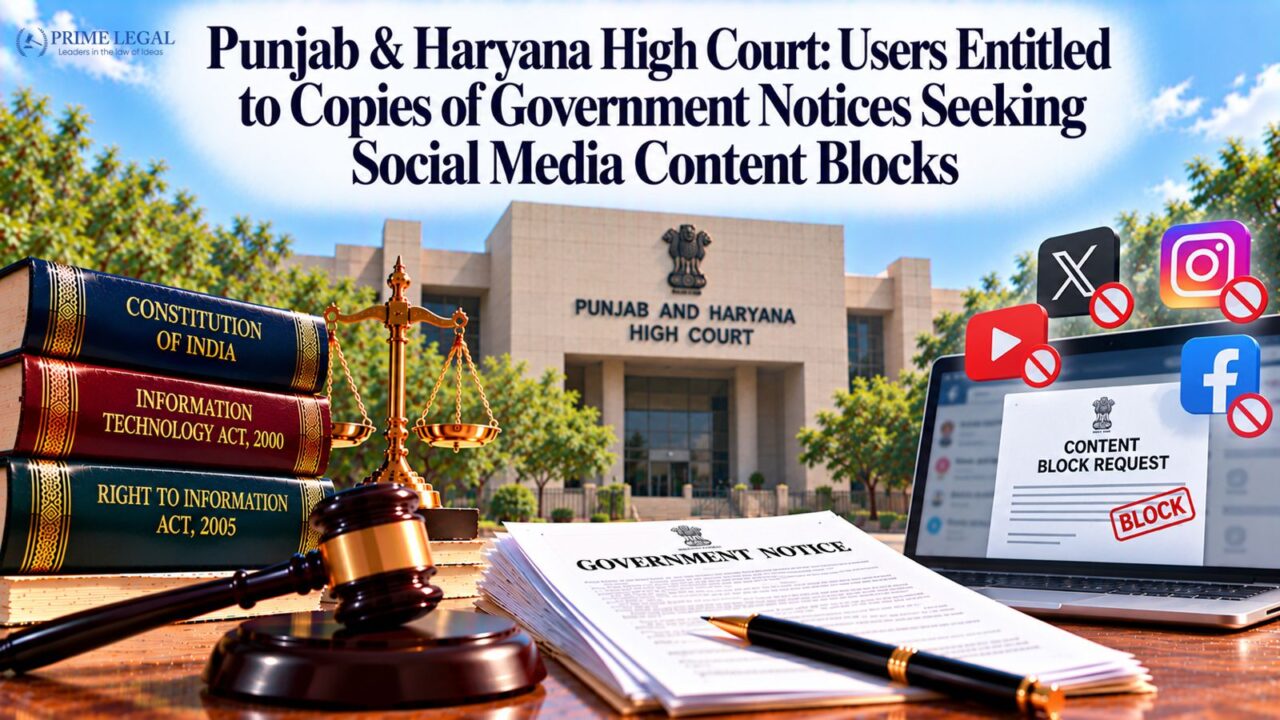
Case Name: Haryana 24 News Network Private Limited versus Union of India and others
Case Number: CWP No.30190 of 2026
Date: Monday, 5th October, 2026
Court: High Court of Punjab & Haryana at Chandigarh
Quorum: Hon’ble Mr Justice Tribhuvan Dahiya
FACTS
The Haryana 24 News Network Private Limited filed a petition for a writ of certiorari to cancel an order made by the government respondents to the sixth respondent, Meta Platforms Inc. (the respondent). It was based on this order that the petitioner’s verified Facebook account was blocked in India on August 21, 2026. The petitioner claimed it was not given any prior notification and has learnt of the ban only through a general notification on the platform. The State submitted that one of the directors of the petitioner, namely, Mohit Verma, was a suspect under the FIR made under Section 308(2) of the Bharatiya Nyaya Sanhita, 2023 and was misusing his Facebook page to upload videos of harassment against the complainant and witnesses. Hence, the blocking notice was issued by the Superintendent of Police, Yamuna Nagar.
LEGAL ISSUES
- To find out if it is legal for a SP to send a notification to block a social media profile in accordance with Rule 3(1)(d) of the Information Technology Act of 2021.
- To check if not providing the user with a copy of the blocking notification goes against natural justice principles and the right to a fair hearing.
- To find out if the petitioner should be sent to the intermediary’s grievance redressal process instead of filing the writ petition.
LEGAL PROVISIONS
- Information Technology Act, 2000: Section 79(3)(b) (Immunity from the liability of intermediaries and ensuring prompt action from intermediaries in case of government directions).
- The Rules of Information Technology (Guidelines for Intermediaries and Digital Media Ethics Code), 2021 specify Rule 3(1)(d), which requires the intimation to the police to be performed by an officer at least of the level of Deputy Inspector General of Police; alongside that, Rule 3(2) is the grievance mechanism of the intermediaries.
- The Bharatiya Nyaya Sanhita, 2023 states that section 308(2) refers to an FIR filed against the director of the applicant.
- The Constitution of India ensures equality and the right to life and personal liberty in its Articles 14 and 21 along with the procedure of due process involved.
ARGUMENTS
PETITIONER – According to the petitioner, the closure of its Facebook account without prior information and without receipt of a notification caused considerable business losses and harmed its brand image. The petitioner noted that pursuant to the rules adopted in 2021, only an officer authorised by the law and possessing the rank of the Deputy Inspector General of Police (DIGP) could give orders to internet intermediaries to block any content. Hence, the required procedure was not followed.
RESPONDENT – The Superintendent of Police effectively carried out the responsibilities of the delegate designated by the State Government to give a notification as per Section 79 of the IT Act along with the 2021 Regulations with an objective to avoid harassment of witnesses. The State also stated that the one who has filed this petition should have availed of the internal grievance mechanism of the intermediary under Rule 3(2) of the 2021 Regulations prior to approaching the court.
ANALYSIS
Through investigating Rule 3(1)(d) of the 2021 Rules, the High Court came to the conclusion that the blocking intimation from police administration has to be issued by an officer not below the rank of DIGP. Court dismissed the State’s delegation argument, stating that if statutory rules require a particular rank, delegating that power to third parties is not acceptable in law. Therefore, the Superintendent of Police acted beyond his authority and acted arbitrarily without jurisdiction in this case. Court has also mentioned that there was no mandatory monthly review by the Government Secretary assessing the necessity and proportionality of the blocking order.
To refute the argument regarding alternative remedies, the Court took resort to the Supreme Court judgment delivered in Madhyamam Broadcasting Ltd. v. Union of India, 2023 SCC OnLine SC 366, which held that procedures should not infringe the basic principles of natural justice, in particular, the right to a fair hearing. The Court concluded that requiring a user to approach the Grievance Officer without the knowledge of the basis or reasons for the intimation would defeat the purpose of having such a defence. The Court directed that the duty to provide a copy of the intimation to the user should be read into the Rules so as to ensure constitutional compliance.
JUDGEMENT
Because there was no jurisdiction, the High Court annulled the blocking notice dated August 21, 2026. The court issued a writ of certiorari instructing the Superintendent of Police to direct Meta Platforms Inc. to restore the petitioner’s Facebook account to its original status within 24 hours. The court also ordered that any subsequent legitimate blocking notices should be sent to the petitioner at once.
CONCLUSION
The Punjab & Haryana High Court has reaffirmed the stringent procedural protections provided in the Information Technology Rules, 2021. It banned unauthorised delegation and required that users be informed prior to blocking to create a balance between law enforcement powers of the State and constitutional rights of natural justice.
“PRIME LEGAL is a National Award-winning law firm with over two decades of experience across diverse legal sectors. We are dedicated to setting the standard for legal excellence in civil, criminal, and family law.”
WRITTEN BY: SWETHA DUTTA
Read the Judgment copy below : HARYANA 24 NEWS NETWORK PRIVATE LIMITED Versus UNION OF INDIA AND OTHERS

