
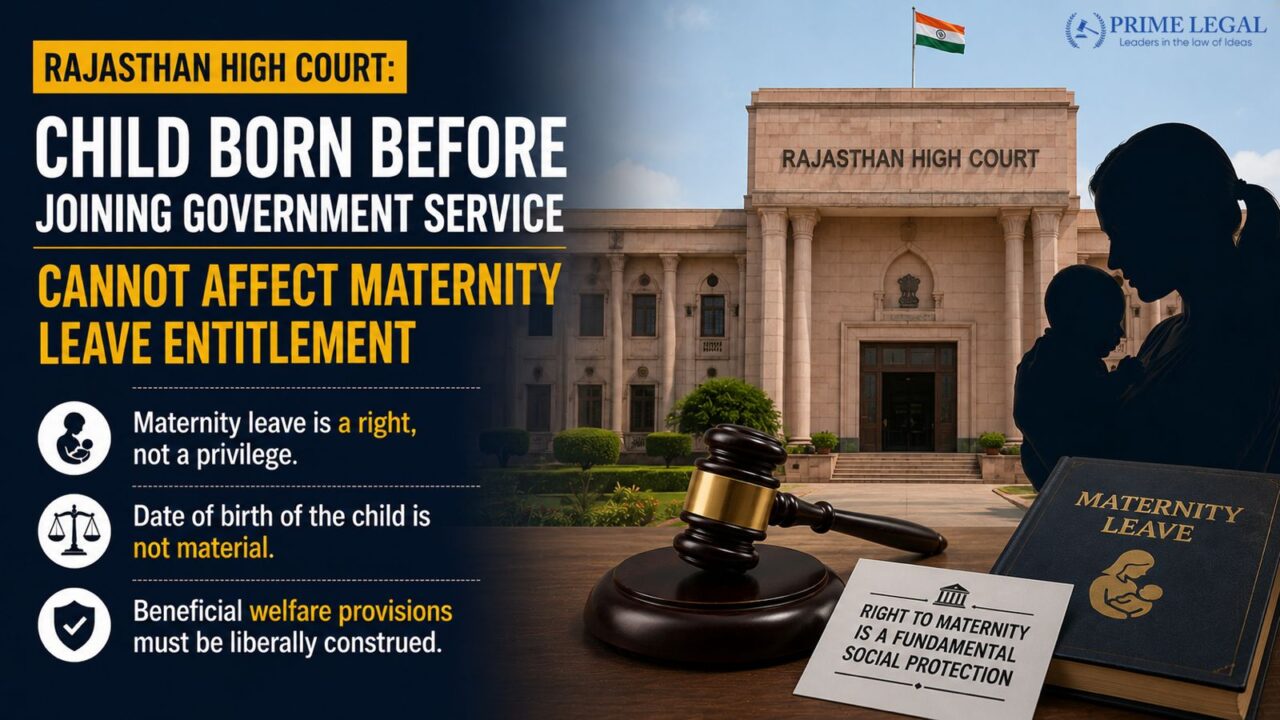
CASE NAME: Chandra Kanta Pahariya Alias Chandrakanta Khinchi v. State of Rajasthan & Ors. [2026:RJ-JP:29647]
CASE NUMBER: S.B. Civil Writ Petition No. 13746/2026
COURT: High Court of Judicature for Rajasthan, Bench at Jaipur
DATE: 30 July, 2026
QUORUM: Hon’ble Ms. Justice Rekha Borana
FACTS
The petitioner, Chandra Kanta Pahariya, married in 1999 and gave birth to her first child in 2000, prior to joining government service. She was appointed as a teacher in 2005 and gave birth to her second child the same year, availing her first maternity leave. She divorced her husband in 2015 and solemnized a second marriage on 07.12.2023, giving birth to a child from this wedlock on 20.06.2026. When she applied for her second maternity leave, the respondent Department declined the request on the ground that the child was her third biological child and that her service record already reflected two earlier children. Aggrieved, the petitioner filed the present writ petition before the High Court of Judicature for Rajasthan.
ISSUES
- Whether a female Government employee, who has availed maternity leave only once during her service tenure, can be denied a second maternity leave merely because the concerned child is her third biological child, born out of a second marriage.
- Whether Rules 103 and 103C of the Rajasthan Service Rules, 1951 entitle such an employee to avail maternity leave for the second time in these circumstances.
LEGAL PROVISIONS.
- Rules 103 (Maternity Leave) and 103C (Child Care Leave) of the Rajasthan Service Rules, 1951.
- Case Law: K. Umadevi v. Government of Tamil Nadu & Ors., (2025) 8 SCC 263.
ARGUMENTS
PETITIONER:
The petitioner argued that she is entitled to the leave applied for since it was only the second leave for maternity which she had applied in her service career in the Government, Rule 103 of the Rules of 1951 allowing leave once in a while to a female Government servant. She submitted that the child being her third child, from her second marriage, could not detract from her rights and in K. Umadevi v. Government of Tamil Nadu & Ors., (2025) 8 SCC 263, the Supreme Court held that childbirth is a natural incident of life and provisions for maternity will be interpreted purposively.
RESPONDENTS:
The respondent Department stated that the child born on 20.06.2026 was the third child of the petitioner and the details of the first two children were already present in the service record of the petitioner and rejected the second application for maternity leave on this ground.
ANALYSIS
The Court, after a conjoint reading of Rules 1951, 103 and Rule 1951, 103C read that a female Government employee is entitled to get 103 days off twice in her career for maternity and that the underlying intention of the law was in keeping with the policy of the State of population control.Relying on K. Umadevi v. Government of Tamil Nadu & Ors., (2025) 8 SCC 263, where the Apex Court held that a spouse’s two biological children from an earlier marriage could not impinge upon the employee’s entitlement to maternity leave for her sole biological child, the Court reasoned that the objectives of population control and maternity benefit are not mutually exclusive and must be harmonised purposively. It was an admitted fact that the leave presently sought was only the second one claimed by the petitioner, notwithstanding that the child was biologically her third. The Court clarified that the position would have differed had the petitioner already availed maternity leave twice for children of her first marriage and thereafter sought a third leave for the child of her second marriage; since that was not the case, her entitlement to the second maternity leave could not be denied.
JUDGMENT
The High Court allowed the writ petition and directed the respondent Department to pass appropriate orders granting the maternity leave prayed for by the petitioner, in accordance with law, within a period of one week from the date of receipt of the copy of the order. The stay petition and pending applications, if any, were disposed of.
CONCLUSION
The judgment clarifies that entitlement to maternity leave under Rule 103 of the Rajasthan Service Rules, 1951 is to be assessed by the number of times such leave has actually been availed by the employee during her service tenure, and not merely by the biological count of children, including one born from a subsequent marriage. Following K. Umadevi v. Government of Tamil Nadu & Ors., (2025) 8 SCC 263, the Court reaffirmed that maternity leave provisions must be interpreted purposively, treating childbirth as a natural incident of life, so as to harmonise the State’s population control objectives with the welfare-oriented purpose of maternity benefits for women employees.
“PRIME LEGAL is a National Award-winning law firm with over two decades of experience across diverse legal sectors. We are dedicated to setting the standard for legal excellence in civil, criminal, and family law.”
WRITTEN BY: GAURAV VIBHU RANJAN
Read the Judgement copy below:

