
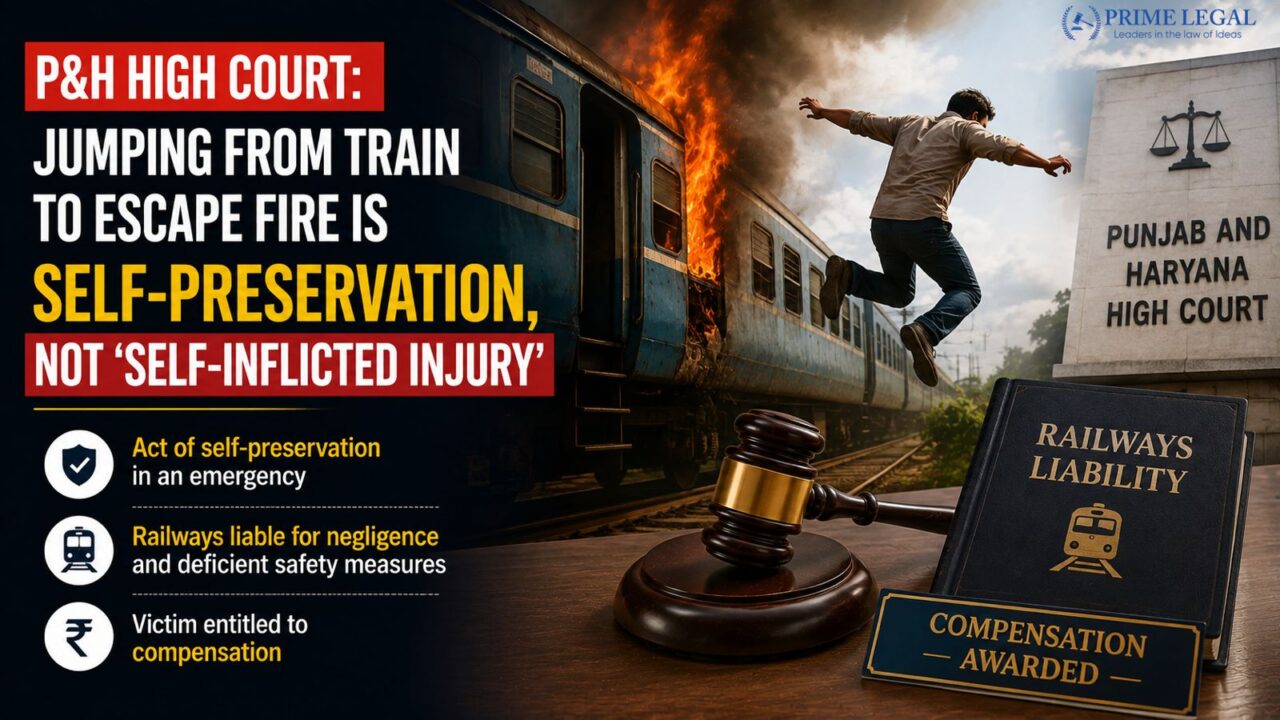
CASE NAME: Meena and another v. Union of India
CASE NUMBER: FAO-856-2026 (O&M)
COURT: High Court of Punjab and Haryana at Chandigarh
DATE: 17 July, 2026
QUORUM: Hon’ble Mr. Justice Harkesh Manuja
FACTS
The deceased, son of the appellants, Mayank, was travelling from Aurangabad to Karnal through the Sachkhand Express train, having purchased the requisite ticket following his participation in a Jagran. On nearing the Harsana Kalan Railway Station, rumours were rife about fire breaking out in the train, leading to panic and the jumping out of many passengers, including the deceased, to save themselves when the train stopped after the pulling of an alarm chain. The deceased was run over by another train running along the other parallel track and got killed. The deceased’s dependent parents filed for compensation for death pursuant to Section 124-A of the Railways Act, 1989. While deciding that the deceased was a bonafide ticket-holding passenger, the Railway Claims Tribunal, Chandigarh Bench found that he no longer qualified as a “passenger” after jumping off, and that his jumping off and getting hit was a self-inflicted injury and his negligent act, covered by the exceptions under the proviso to Section 124-A.
ISSUE
Whether the death that has resulted from the jump taken by a passenger from a stationary train out of fear, and being hit by another train during his attempt to save himself is an “untoward incident” under Section 123(c) together with Section 124-A of the Railways Act, or whether it falls under any of the exceptions to the above-mentioned Act.
LEGAL PROVISIONS
- Sections 123(c) and 124-A, Railways Act, 1989, including clauses (b) and (c) of the proviso to Section 124-A
- Case Laws:
Union of India v. Prabhakaran Vijaya Kumar, (2008) 9 SCC 527;
Jameela and others v. Union of India, (2010) 12 SCC 443;
Union of India v. Rina Devi, (2019) 3 SCC 572;
Dhaneshwar Rajak and another v. Union of India, 2023 (4) AIR BomR 577
ARGUMENTS
APPELLANTS: The argument was that the Tribunal was wrong in regarding the getting down of the deceased as the end of his being a passenger, and that the natural reaction of jumping off to save himself from what he thought was a fire should not have been treated as an act of self-injury or any criminal act. The claim was that the trip had not been completed and that the case definitely came under Section 124-A.
RESPONDENT: The Railways took refuge in the decision of the Tribunal that the death was caused as a result of the deceased ceasing to be a passenger on disembarking from the train and that he had voluntarily jumped into the line and was hit by another train.
ANALYSIS
The Court held that the Tribunal’s finding that the deceased was a bona fide passenger had attained finality, narrowing the dispute to whether the exceptions applied. It held that a contract of carriage does not terminate merely because a passenger is compelled to alight midway due to circumstances beyond his control, and that Section 123(c) must be given a liberal, purposive construction consistent with Prabhakaran Vijaya Kumar’s characterisation of Chapter XIII as welfare legislation. Relying on Jameela and Rina Devi, the Court reiterated that compensation under Section 124-A rests on strict, not fault, liability, that contributory negligence has no place in such proceedings, and that the burden lies on the Railways to prove a statutory exception applies. It found “self-inflicted injury” requires a deliberate, intentional act, which an instinctive act of self-preservation under a bona fide belief of danger is not, and found no evidence at all of any criminal act by the deceased. The Court also faulted the Tribunal for discounting the co-passenger’s unshaken eyewitness testimony of panic in favour of the Loco Pilot’s testimony, which could not speak to conditions inside the compartment, and drew persuasive support from Dhaneshwar Rajak, where a materially similar panic-driven deboarding was held to fall outside the Section 124-A exceptions.
JUDGMENT
The High Court set aside the Tribunal’s judgment, allowed the claim petition, and awarded the appellants statutory compensation of Rs. 8,00,000 with 6% annual interest from the date of filing, to be deposited by the Railways within eight weeks.
CONCLUSION
The status of the passenger according to the Railways Act will not terminate simply because he is forced to leave a stationary train during panic, and such an act of jumping out of the train to escape a perceived danger cannot be categorized either as self-infliction of injury or as criminal behaviour, and hence Section 124-A compensation will continue to be one of strict liability.
“PRIME LEGAL is a National Award-winning law firm with over two decades of experience across diverse legal sectors. We are dedicated to setting the standard for legal excellence in civil, criminal, and family law.”
WRITTEN BY: DRISHTITA BANIK
Read the Judgement copy below:
Meena and another v. Union of India

