
INTRODUCTION
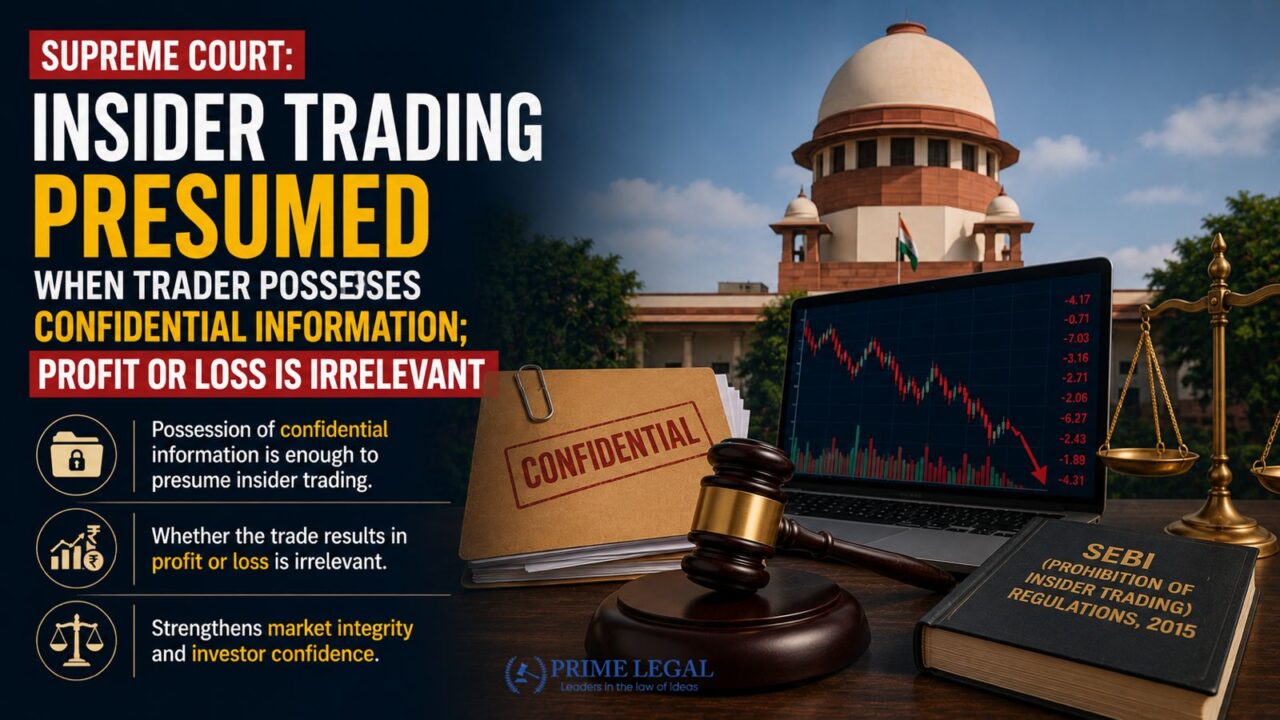
On 11 August 2026, the Supreme Court, in Securities and Exchange Board of India v. Rajeev Vasant Sheth and others, 2026 LiveLaw (SC) 787, set aside an order of the Securities Appellate Tribunal (SAT) and restored SEBI’s finding of insider trading against the promoters of Tara Jewels Limited. The bench of Justice Sanjay Karol and Justice Augustine George Masih held that mere possession of Unpublished Price Sensitive Information (UPSI), coupled with trading in the company’s securities while that information remained undisclosed, is by itself sufficient to attract the presumption of insider trading under the SEBI (Prohibition of Insider Trading) Regulations, 2015. The Court clarified that whether the trade actually resulted in profit, and what the trader did with the proceeds, has no bearing on whether the offence is made out.
BACKGROUND
The case arose from trades executed between 2 October and 29 November 2017 by the Chairman and Managing Director of Tara Jewels Limited, along with two other promoter-directors. During this window, the promoters held adverse UPSI about the company, including a quarterly loss of Rs. 166.80 crore and a steep decline in sales, disclosed to the market only on 29 November 2017. Before that disclosure, the promoters sold large portions of their shareholding; two offloaded their entire holding. SEBI found that the timing let them avoid losses of approximately Rs. 1.38 crore they would otherwise have suffered once the bad news became public, and initiated insider trading proceedings. On appeal, the SAT exonerated the promoters, accepting their explanation that the sales supported financial restructuring and avoided classification of certain loans as non-performing assets, and noting only a marginal price difference before and after disclosure. SEBI then appealed to the Supreme Court.
KEY POINTS
- A note attached to Regulation 4(1) of the SEBI (Prohibition of Insider Trading) Regulations, 2015 assumes that a trade carried out when an individual has UPSI was driven by that information.
- If possession of UPSI and trading during the relevant period are proved, the question cannot be altered to whether the insider had a well-intentioned or commercially justified cause for the transaction.
- Once the presumption is triggered it does not legally matter how the sale proceeds are applied e.g. debt payments or restructuring.
- The Court differentiated its prior ruling in SEBI v. Abhijit Rajan, 2022 LiveLaw (SC) 787 observing that the said decision was made according to previous 1992 Regulations which did not include similar prohibition to take into consideration the purpose behind the sale.
- The Court held that less or no profit is of no consequence, making clear that actual monetary gain is not an ingredient of the offence, only the act of trading while possessing UPSI.
RECENT DEVELOPMENTS
In restoring SEBI’s order, the Supreme Court reinstated the regulator’s directions restraining the promoters from accessing the securities market for the prescribed period and requiring disgorgement of the avoided losses with interest. It did modify the SAT’s order on one count, reducing the penalty on the principal promoter from Rs. 25 lakh to Rs. 10 lakh. The ruling arrives as SEBI has been visibly tightening enforcement across the securities market, and is likely to be read by compliance teams as confirmation that the post-2015 framework leaves little room for a good faith or no profit defence once possession and trading are shown.
CONCLUSION
The judgment draws a sharp line between the regulatory position under the 1992 Regulations and the tighter, presumption based framework introduced in 2015. Where Abhijit Rajan had left some room to examine an insider’s motive, the Court has now made clear that the 2015 Regulations do not permit that inquiry at all. For anyone holding UPSI, the safest course under this ruling is simply not to trade during the sensitive window, since neither an honest business reason nor the absence of actual profit will offer a defence once possession and trading are established. The Court has effectively pushed insider trading liability under the 2015 framework closer to a strict liability standard on intent, a shift compliance teams across listed companies will need to account for.
“PRIME LEGAL is a National Award-winning law firm with over two decades of experience across diverse legal sectors. We are dedicated to setting the standard for legal excellence in civil, criminal, and family law.”
WRITTEN BY: GAURAV VIBHU RANJAN

