
INTRODUCTION
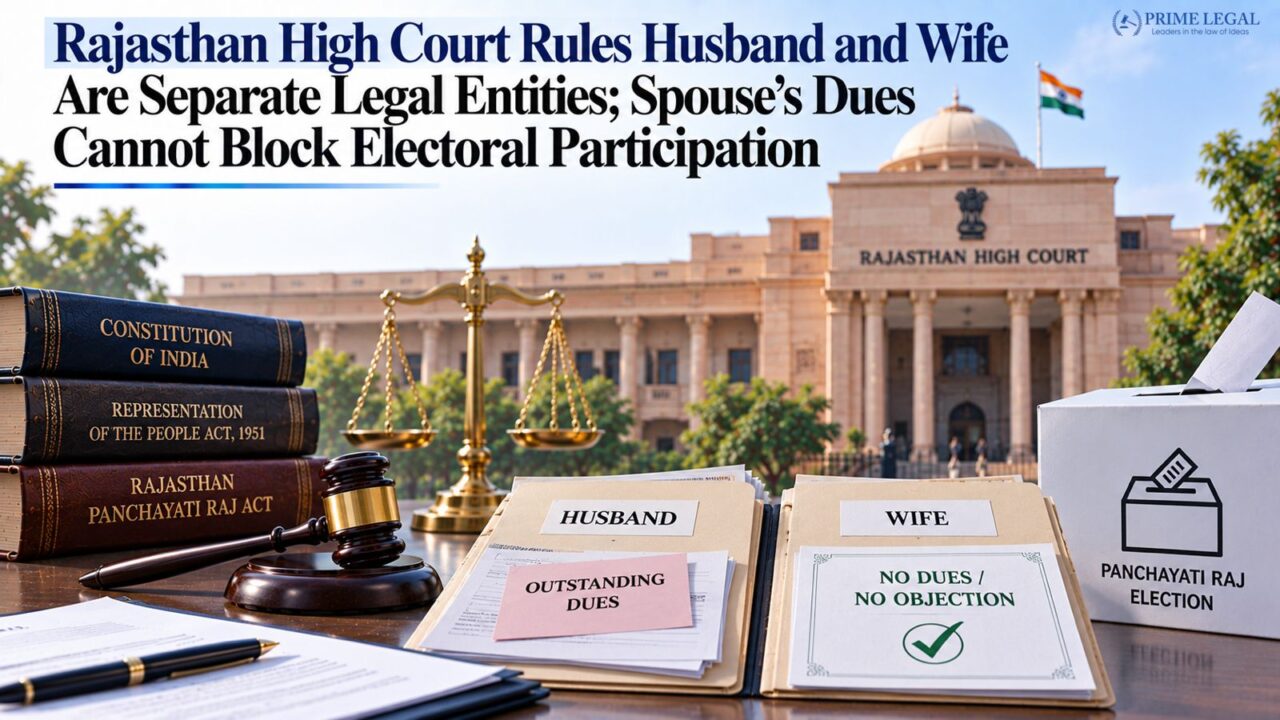
In the case of Ramlaxman Meena v. State of Rajasthan, it was decided by the Rajasthan High Court that a person cannot be debarred from contesting the Panchayati Raj elections on the ground that his or her spouse has some pending recoveries due to misconduct of his or her wife during his or her term as a public representative. It is a matter of law that both husband and wife are different persons in their own capacity.
The decision came on 2 September 2026 in S.B. Civil Writ Petition No. 11020/2026 before the Rajasthan High Court delivered by Hon’ble Justice Anoop Kumar Dhand.
BACKGROUND
The Petitioner wanted to contest the election which is due to be held for the position of Sarpanch of the Gram Panchayat Falenda and desired to obtain a No-Dues Certificate from the authorities. The wife of the Petitioner was the Sarpanch of that Gram Panchayat for the period between 1995 and 2000. After inquiry regarding certain works of the Panchayat, the amount was directed to be recovered from her. Since she did not deposit the amount, recovery proceedings, including attachment and auction of her property, were initiated.
The wife of the petitioner approached the High Court regarding these proceedings, since the court had already made an interim order dated 16 September 2009 preventing the authorities from auctioning her property. Later when the petitioner tried to seek a No Dues certificate to fight his election, the authorities refused to provide it since his wife’s dues were still outstanding. The petitioner came to the High Court in accordance with Article 226 of the Constitution and stated that his wife’s dues could not stop him from contesting the election.
KEY POINTS
- Separate legal personalities: The Court stressed the fact that a husband and wife are separate legal persons. It is impossible in general terms for one spouse to become liable for the acts or liabilities of the other.
- No automatic assumption of liability: The petitioner was neither the surety nor guarantor of the dues payable by his wife.
- Need of statutory provisions: Neither the Rajasthan Panchayati Raj Act, 1994 nor the Rajasthan Panchayati Raj Rules, 1996 contained any provision for recovery of dues from the relations of a Sarpanch merely by reason of their relations.
- Personal accountability of public representatives: A public representative is personally accountable for the misconduct committed by him/her. The authorities cannot proceed against his/her spouse or other relations.
- Restrictions on participation in the election process must not be indirect: It is not permissible to make payment of outstanding dues of the wife a prerequisite to issue the certificate in favor of the petitioner.
- An exception when participation is independent of influence from elsewhere: The Court explained that the situation could have been different if it was found through an enquiry that the petitioner himself was involved in the misconduct concerning the Panchayat works.
- Relief provided: The petition filed in the High Court was accepted and directions were given to the authorities to issue the required certificate.
RECENT DEVELOPMENTS
The judgment was delivered on 2 September 2026 and was reported in SCC Times on 22 September 2026. This particular judgment discusses the issue of eligibility for participation in Panchayati Raj elections in Rajasthan, and also deals with the impact of recovery dues from the person who used to be a Sarpanch.
The important legal development in this judgment is that the Court did not accept the effort of the authorities in making the financial liability of a former public representative extend to her spouse without any statutory backing or proof of the involvement of the spouse.
This decision thus confirms the principle that the qualification to vote must be decided not just on the grounds of the failure by the candidate to pay his/her outstanding dues, but on grounds of his/her own legal accountability.
CONCLUSION
The Rajasthan High Court case of Ramlaxman Meena v. State of Rajasthan ruled that past due amounts of a previous Sarpanch will not alone be sufficient to disqualify the spouse of a Sarpanch from filing their candidature. Since there is no statute which states that the spouse will be personally liable for the same, nor is there any proof of involvement on the part of the spouse in the wrongful act, no such obligation can be imposed.
In this way, the judgment serves to uphold the principle of individual responsibility in law and not punish one individual on the basis of the acts or liabilities of another individual.
“PRIME LEGAL is a National Award-winning law firm with over two decades of experience across diverse legal sectors. We are dedicated to setting the standard for legal excellence in civil, criminal, and family law.”
WRITTEN BY: KHWAISH SACHDEVA

