
ABSTRACT
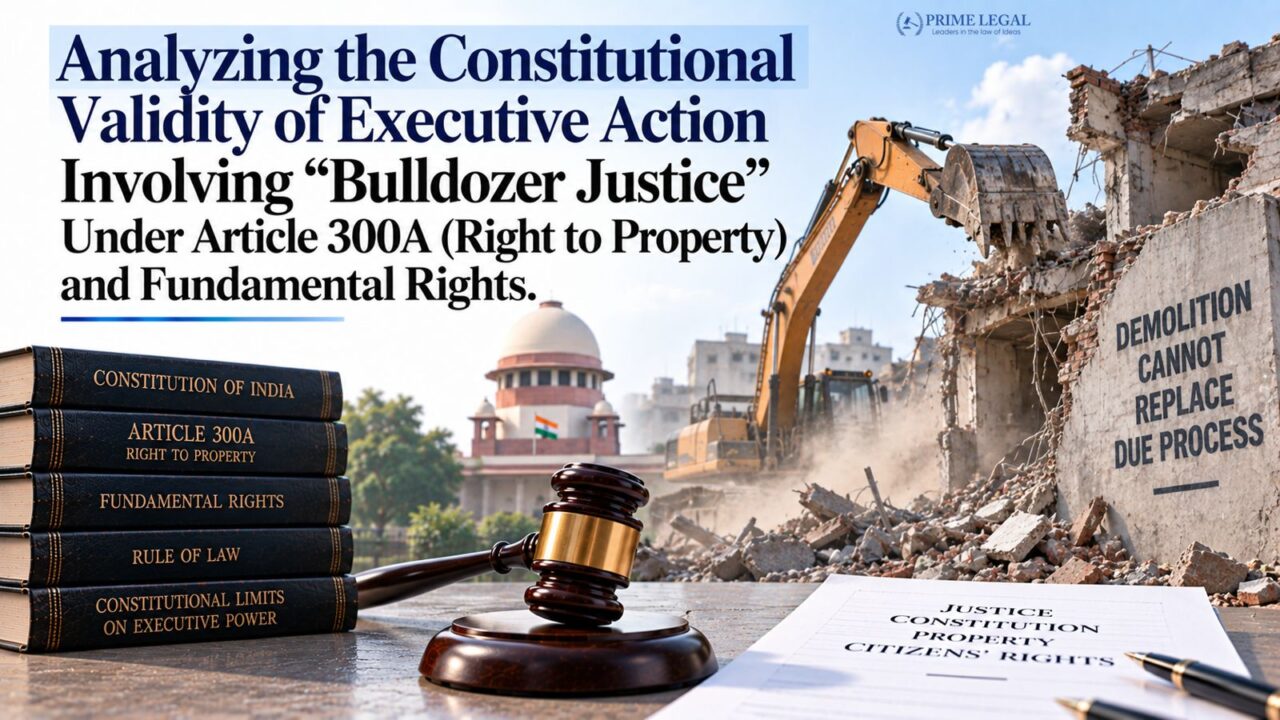
This article examines whether punitive demolition of private property by executive authorities, popularly termed “bulldozer justice”, is constitutionally valid. It argues that the practice fails on three counts. First, Article 300A permits deprivation of property only by authority of law, and an executive decision to punish an accused is not law. Second, demolition without notice or hearing violates Articles 14, 19 and 21, since it is arbitrary, selective and destructive of shelter and livelihood. Third, the practice merges the roles of accuser, judge and enforcer, contrary to separation of powers and the presumption of innocence. Relying on the Supreme Court’s directions of 13 November 2024 in In Re: Directions in the matter of demolition of structures, the article concludes that mandatory notice, hearing, reasoned orders and personal accountability of officials must bind the executive without exception.
KEYWORDS- Constitutional law; Due process; Right to property; Natural justice; Separation of powers; Arbitrary State action
INTRODUCTION
In recent years, several Indian States have responded to allegations of crime, communal violence and public disorder by demolishing the houses and shops of the accused, usually within days and often citing unauthorised construction. This practice, styled “bulldozer justice”, presents a striking legal problem. The State’s police powers legitimately extend to regulating land use and removing illegal structures under municipal and town-planning statutes. Yet the timing, selectivity and public messaging of these demolitions suggest that the real object is punishment, not regulation. Notices are often issued only after the arrest of the accused, and the affected family, which may include tenants and relatives who committed no offence, is left without shelter before any court has examined the allegations. Punishment is a judicial function, reserved for courts after trial. When the executive assumes it, the criminal process is bypassed altogether, and the presumption of innocence is reduced to a formality. The issue therefore goes beyond building regulation; it concerns who may lawfully decide guilt and impose a penalty. This article tests the practice against Article 300A, Articles 14, 19 and 21, and the principles of natural justice, and evaluates the judicial response.
THE CONTOURS OF ARTICLE 300A: “PROCEDURE ESTABLISHED BY LAW” VS. ARBITRARY DEMOLITIONS
Article 300A provides that no person shall be deprived of property save by authority of law. It was inserted by the Constitution (Forty-fourth Amendment) Act, 1978, which removed the fundamental right to property from Part III. The phrase “procedure established by law” belongs strictly to Article 21, but both provisions operate together in demolition cases, because a home is both property and the seat of life and liberty. The Supreme Court has held that Article 300A remains a constitutional right, and in Vidya Devi v. State of Himachal Pradesh (2020) 2 SCC 569 it described property as a human right. In K.T. Plantation v. State of Karnataka (2011) 9 SCC 1, the Court held that deprivation must rest on a valid law, that public purpose is inherent in acquisition, and that the law must not be arbitrary. A demolition ordered because the owner is accused of an offence rest on no such foundation. No statute authorises razing a house as a penalty for alleged crime, and municipal enactments ordinarily permit removal only of structures violating building rules, after notice.
INFRINGEMENT OF FUNDAMENTAL RIGHTS: INTERSECTING ARTICLES 14, 19, AND 21
Article 14 forbids arbitrariness. In E.P. Royappa v. State of Tamil Nadu (1974) 4 SCC 3, the Court held that arbitrariness is the antithesis of equality, and Shayara Bano v. Union of India (2017) 9 SCC 1 recognised manifest arbitrariness as a ground to strike down State action. Selective demolition of the properties of accused persons, when identical violations by others go unnoticed, is a clear instance of discriminatory enforcement. It also imposes collective punishment, since families and tenants who have committed no offence lose their shelter. With regard to Article 21 Maneka Gandhi v. Union of India (1978) 1 SCC 248 specifies that any procedure for depriving a person of his life or personal liberty must be fair, just and reasonable. In Olga Tellis v. Bombay Municipal Corporation (1985) 3 SCC 545 the court read right to livelihood into Article 21 and permitted the eviction of pavement dwellers only by a fair procedure. Shelter is included in the right to life, as held in Chameli Singh v. State of Uttar Pradesh (1996) 2 SCC 549. Destruction of a business engages Article 19(1)(g), and loss of a residence affects the freedom to reside and settle under Article 19(1)(e). Demolition without a hearing fails each of these standards.
EXECUTIVE OVERREACH AND THE EVISCERATION OF DUE PROCESS
The principle of audi alteram partem requires that no person be condemned unheard. It is applicable to administrative action with civil consequences as was held in A.K. Kraipak v. Union of India (1969) 2 SCC 262 wherein the distinction between administrative and quasi-judicial functions was blurred. This defect cannot be remedied by post demolition remedies as it is an irreparable harm, and Mohinder Singh Gill v. Chief Election Commissioner (1978) 1 SCC 405 has held that an order must be based on the reasons given in the order and not on post hoc explanations. Beyond natural justice, bulldozer action breaches separation of powers. Investigation belongs to the police and adjudication to the courts; the executive cannot appropriate the second function. The presumption of innocence, an essential element of a fair criminal process, is displaced by administrative assumption of guilt. Where notices are backdated, or served only hours before demolition, the procedure becomes a pretext, and the stated ground of illegality conceals a punitive motive.
JUDICIAL RESPONSE AND THE FRAMEWORK OF ACCOUNTABILITY
The Supreme Court addressed the practice directly in In Re: Directions in the matter of demolition of structures (decided 13 November 2024), after an interim order of 17 September 2024 had restrained such demolitions across the country without its permission. Exercising power under Article 142, the bench of Justices B.R. Gavai and K.V. Viswanathan held that the executive cannot act as judge and punish an accused by demolishing property, and that guilt is for the courts alone. The Court’s binding directions bar demolition without a prior show-cause notice, served by registered post and affixed on the structure, giving the owner fifteen days, or any longer period under local law, to respond. The notice must state the nature of the violation, the grounds for demolition and the date of a personal hearing. The authority must then pass a reasoned final order, and the owner must be given fifteen days to challenge it or remove the structure voluntarily. The demolition itself must be videographed, and a report prepared. Officials who breach these directions face contempt proceedings and prosecution, and must restore the structure at personal cost, with damages. The directions exclude unauthorised structures on public land such as roads, footpaths, railway lines and water bodies, and cases where a court has ordered demolition. The judgment converts principle into enforceable procedure; its success now depends on vigilant enforcement.
CONCLUSION
Bulldozer justice fails every constitutional test applied to it. It lacks the authority of law demanded by Article 300A, since no statute permits the demolition of a home as a penalty for alleged crime. It offends the guarantees of equality, livelihood and shelter under Articles 14, 19 and 21, because it operates selectively, punishes families who have committed no offence, and destroys property before any forum has heard the owner. It also violates the hearing rule that governs all administrative action with civil consequences. More gravely, it replaces adjudication with force. When the executive investigates, accuses, decides and executes in a single act, the separation of powers collapses and the presumption of innocence loses its meaning. That is the deepest threat to the Rule of Law: the State punishes first and proves later, if at all.
The Supreme Court’s directions of 13 November 2024 restore the constitutional balance by tying every demolition to prior notice, a personal hearing, a reasoned order, a waiting period for challenge and the personal accountability of erring officials. These safeguards do not weaken the State’s genuine power to remove illegal structures. They make sure that the power is exercised in a legal way and not as a means of retribution. Whether they will succeed or not will be determined by the administrators who enforce them and the Courts who supervise them. No government under the law can go outside the law in the name of administration and efficiency.
“PRIME LEGAL is a National Award-winning law firm with over two decades of experience across diverse legal sectors. We are dedicated to setting the standard for legal excellence in civil, criminal, and family law.”
WRITTEN BY: HARSHMEET KAUR SUDAN

