
INTRODUCTION
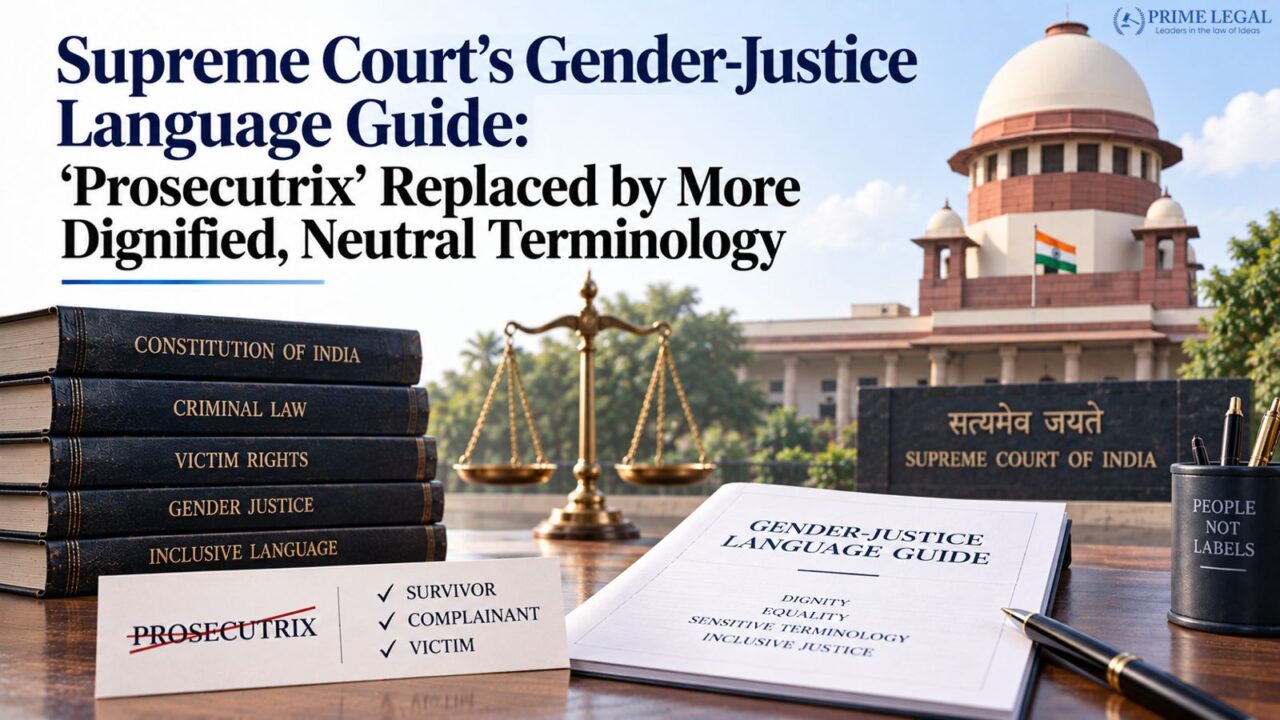
The Supreme Court of India has recently brought out a handbook entitled “Judgments and Gender: Sensitivity and Compassion in Writing Judgments”. This is one major milestone on the journey towards creating gender sensitive justice. Published in August 2026, the new handbook attempts not only to modify the language of the judges but also the way survivors of sexual crimes and other vulnerable people are dealt with in the process of administration of justice. One of the significant suggestions of the new handbook is to use the word “victim”, “survivor” or “complainant” in place of “prosecutrix”, a procedure-based and impersonal term that lacks proper consideration of the dignity of the individual approaching the courts of law.
The initiative shows that the Supreme Court understands that language that is used in courtrooms is not only about vocabulary and etiquette but that it has an impact on the thinking of judges and reinforces certain stereotypes which also impacts on the dignity of people who come before the court seeking justice.
BACKGROUND
The Supreme Court had previously released the “Handbook on Combating Gender Stereotypes” for the year 2023, which was supposed to identify gender-stereotypical statements and use different words for the judges and lawyers. The statements identified were those that might perpetuate patriarchal notions and guidance was provided on how to use language that does not have stereotypes about women while judging.
However, in 2026, the Supreme Court decided to take a more practical stance on the issue. There was an urgent requirement for such a framework due to the issues related to the conduct of sexual offense cases and the existence of insensitivity in judicial reasoning. In this regard, the Supreme Court ordered the National Judicial Academy to frame practical guidelines that would ensure sensitivity and compassion in judicial process where women, children, and others were concerned. The report was prepared by a committee led by a retired Supreme Court judge Justice Aniruddha Bose. The committee went through 125 trial court judgments and consulted various stakeholders before making their recommendations.
The new guidebook, thus, is about more than just substituting words considered offensive. It is an attempt to consider how the treatment of the survivor should be handled starting from the reporting of the crime up to the investigation and the verdict. It stresses the fact that the court process should not cause secondary victimization.
KEY POINTS
- Alternative Terminology to “Prosecutrix”: It has been recommended by the Supreme Court that the word “prosecutrix” should be replaced by more respectful and appropriate alternatives such as “victim,” “survivor,” or “complainant.”
- Gender-Sensitive Language: The courts are being advised not to use language which relies on stereotyping regarding chastity, morality, character, family honor, or helplessness in respect of women in general and sexual offenses in particular.
- Justice for Traumatised Victims: The guide stresses that there is no uniform response of the victim to trauma. Delayed reporting, small inconsistencies in statements, or absence of injuries should not be taken to be indicative of untruthfulness on their part.
- Dignity and Confidentiality: The guidelines stress respectful courtroom treatment, protection of survivors’ identities and avoidance of unnecessary or humiliating questioning, promoting a more survivor-sensitive justice process.
- Protection of Minors: The handbook also addresses the language used for children involved in sexual-offence cases. It discourages expressions such as “poor helpless minor girl” and encourages the use of neutral and dignified terminology such as “minor victim” or “child survivor.” This reflects the Court’s emphasis on protecting the dignity, privacy and rights of children and avoiding language that portrays them merely through helplessness or pity.
RECENT DEVELOPMENTS
This new way of doing things in the Supreme Court has also been expanded from the language used in the judgements. The Court has instructed that the handbook be provided throughout the judiciary, with its suggestions meant to direct courts and other relevant institutions handling cases of sexual offences and vulnerable people. This new way of doing things also involves more training for judges since it is the recognition by the Court that mere change of language will not bring about sensitivity but understanding of trauma and gender stereotyping is needed.
It is even more significant in light of the precedent that has been established based on previous judgments of the Supreme Court. In the case of Aparna Bhat & Ors. v. State of Madhya Pradesh & Anr., (2021) 16 SCC 230, for example, the Court emphasized the need to be careful of gender stereotyping when making judicial orders. Similarly, Lillu @ Rajesh & Anr. v. State of Haryana, (2013) 14 SCC 643, an outdated practice such as the two-finger test was disapproved of, while in Joseph Shine v. Union of India, (2019) 3 SCC 39, outdated ideas regarding the chastity and honor of women were challenged.
The handbook is intended to reach beyond the judiciary. It has been made available through judicial institutions and is being disseminated more widely among legal institutions, including law schools and colleges, so that principles of gender sensitivity can be incorporated into legal education and professional training of professionals and law students from the beginning. This wider circulation seeks to ensure that future lawyers, judges and other legal professionals develop a more respectful and sensitive approach towards survivors and vulnerable persons.
This new manual thus signifies a major shift from a mere language reform to a survivor-centered approach in seeking justice. However, whether or not this manual will be successful is dependent on its implementation as well as the change in behavior and thinking within the courtroom.
CONCLUSION
The Supreme Court’s handbook “Judgments and Gender: Sensitivity and Compassion in Writing Judgments” marks a crucial move towards building a more dignified and respectful justice delivery mechanism. Though changing the use of “prosecutrix” by “victim”, “survivor” or “complainant” seems like a minor semantic shift, it carries within itself a much greater constitutional idea – a person who approaches the system should not be treated like a procedure or subjected to stereotyping through language.
What the handbook strives to ensure is that the judicial pronouncements remain grounded in evidence, bodily integrity and dignity, and the rule of law rather than morality, chastity or victim blaming. The greater significance of this move, however, is its recognition that justice for women is not just about gender sensitive laws, but gender sensitive institutions as well. If used properly, the handbook can be instrumental in enhancing public trust in the justice delivery system as well as ensuring that the courtrooms become places of justice without further humiliation of the survivor.
“PRIME LEGAL is a National Award-winning law firm with over two decades of experience across diverse legal sectors. We are dedicated to setting the standard for legal excellence in civil, criminal, and family law.”
WRITTEN BY: KHWAISH SACHDEVA

