
ABSTRACT
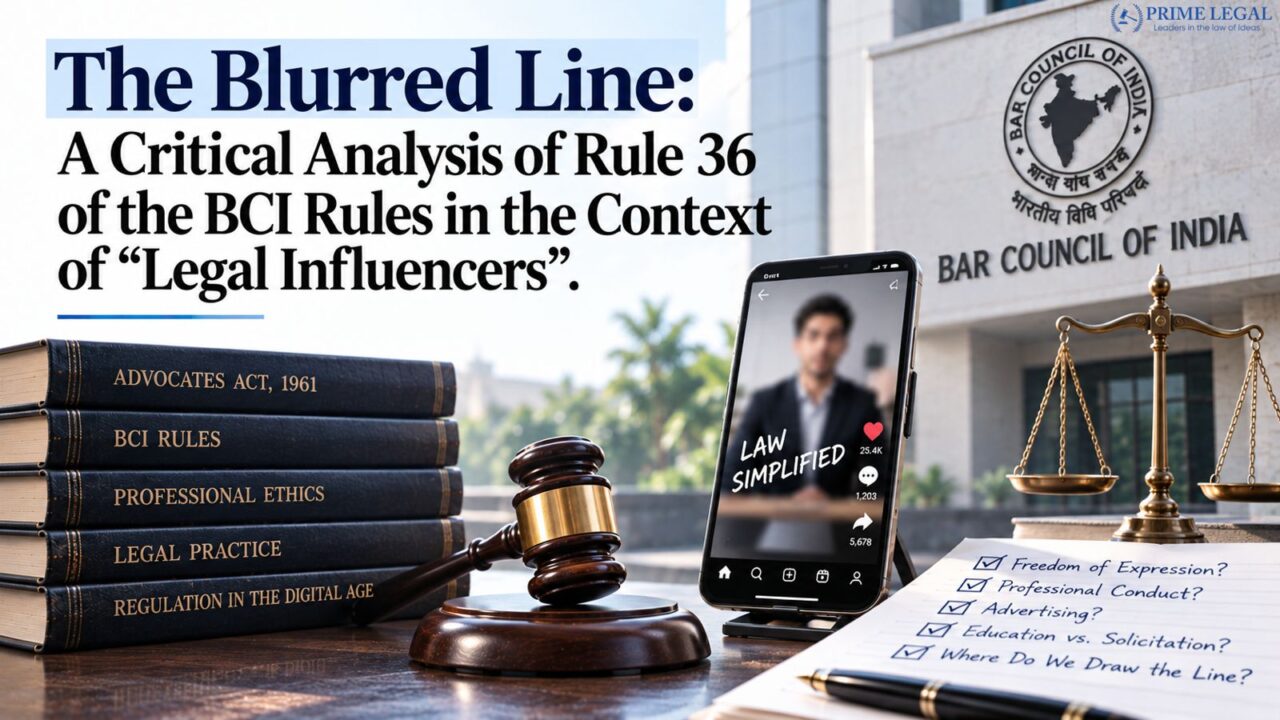
Under Section 49(1)(c) of the Advocates Act, 1961, the Rule 36 of Bar Council of India Rules have been framed which prohibits advocates from directly or indirectly advertising or soliciting work. This ban, intended for a period of print circulars and signboards, now faces a community of legal influencers who establish personal brands with “educational” content on Instagram, YouTube and LinkedIn. The article analyses whether such content is in the nature of disguised solicitation or protected speech under Article 19(1)(a) read with the professional autonomy guaranteed under Article 19(1)(g). Drawing on Dabholkar, V.B. Joshi and the BCI’s 2025 crackdown on celebrity-endorsed law firm content and its 2026 Social Media Circular, this article asserts that Rule 36 is theoretically constitutionally sustainable yet calls for standardised, content-based standards instead of a blanket suspicion of digital visibility.
KEYWORDS
Rule 36; Bar Council of India Rules; legal advertising; indirect solicitation; legal influencers; Article 19(1)(a)
INTRODUCTION
The Indian legal profession has historically resisted classification as a trade. Its regulatory architecture, built on the Advocates Act, 1961, rests on the premise that a lawyer’s relationship with a client is one of trust, not transaction, and that competitive self-promotion corrodes this trust by incentivizing volume over judgment. Rule 36 codifies this philosophy: it bars advocates from advertising, either directly through circulars and signboards or indirectly through touts, and restricts even the size and content of nameplates. For decades, the rule operated in a comparatively static professional environment where visibility was earned through court appearances, reported judgments, and word of mouth.
That environment no longer exists. A new class of practitioners has emerged who build audiences of hundreds of thousands through short explainer videos, LinkedIn commentary on judgments, and Instagram reels dissecting recent legal developments. Some of this content is genuinely pedagogical. Much of it also functions, whether by design or effect, as a continuous demonstration of the creator’s expertise, availability, and credibility – the very qualities a prospective client would weigh before engaging counsel. The line between teaching the public and marketing oneself to the public has become difficult to locate, and the events of 2025 and 2026 have forced the Bar Council of India to say so explicitly.
ANATOMY OF RULE 36 AND THE PROHIBITION ON ADVERTISING
Rule 36, in Chapter II, Part VI of the BCI Rules, derives from Section 49(1)(c) of the Advocates Act. It bars advertisement “whether directly or indirectly,” covering circulars, touting, personal communications, and the publication of photographs or endorsements tied to a case, and it confines nameplates and signboards to bare, unadorned particulars. A narrow proviso, permitting a website with limited factual information, name, enrolment number, contact details, was added only after judicial pressure and remains the sole carve-out to an otherwise near-total prohibition.
The rule’s underlying rationale, articulated across successive BCI resolutions, is that legal practice is a service obligation rather than a commercial enterprise, and that permitting advertisement would allow wealthier firms and more telegenic advocates to dominate public perception irrespective of competence. This is not a uniquely Indian anxiety; it echoes the American Bar Association’s historical resistance to lawyer advertising before Bates v. State Bar of Arizona 433 U.S. 350 (1977) recalibrated the position in the United States. In India, however, no equivalent recalibration has occurred at the level of the primary rule itself, even as enforcement has had to adapt to platforms Rule 36’s drafters could not have anticipated.
THE RISE OF THE LEGAL INFLUENCER: EDUCATION VS. INDIRECT SOLICITATION
The BCI’s latest crackdown was triggered by the Instagram reel of a leading law firm celebrating its twentieth year in March 2025, which featured a Bollywood star and cinematic production celebrating the firm’s reach. The Council’s response was blunt: immediate withdrawal of Rule 36-violating content, a ban on celebrity or influencer endorsement of legal services, and a warning to hosting platforms that they too could face proceedings.
The harder cases sit beyond celebrity-fronted promotions. A lawyer explaining the Puttaswamy privacy judgment or a GST circular is, on its face, performing public legal education, valuable given India’s access-to-justice gap. Yet the same content builds a personal brand and often closes with an invitation to “reach out for a consultation.” The BCI’s parallel concern, that uncredentialed influencers were misinforming the public on citizenship law, IP, and matrimonial disputes, compounds the solicitation problem with a competence problem. The distinction the Council draws, general public education versus creator-specific marketing, is conceptually sound but operationally unstable: nearly all educational content also builds its author’s reputation.
CONSTITUTIONAL CHECK: RECONCILING PROFESSIONAL ETHICS WITH ARTICLE 19
Rule 36’s validity turns on Article 19(1)(a), free speech, weighed against Article 19(1)(g), the freedom to practise a profession. The foundational position was given by the Bar Council of India v. M.V. Dabholkar (1975) 2 SCC 702: the legal profession is not a business and its practitioners are bound by an obligation of restraint that ordinary commercial actors do not, anchoring the reasonableness test of Article 19(6) in the public character of the profession.
V.B. Joshi v. Union of India (Writ Petition (Civil) no. 532 of 2000 (2001) eased this rigidity, instructing the BCI to allow advocate websites to display basic, verifiable information, name, qualifications, contact details. The Court acknowledged that total suppression of information had no ethical value and could be a negative to the public itself. The BCI gave effect to this direction through a 2008 amendment to Rule 36, permitting bare factual websites while continuing to prohibit photographs, testimonials, and comparative claims.
Read together, these cases permit restrictions on advertising only where reasonable, proportionate, and tied to the profession’s public-interest character, not as a categorical speech bar. Applied mechanically to every explanatory post, Rule 36 risks tipping from reasonable restriction into disproportionate suppression of protected expression.
COMPARATIVE OUTLOOK AND THE NEED FOR REGULATORY EVOLUTION
Other common law jurisdictions have already resolved versions of this problem. Bates v. State Bar of Arizona (1977) held that truthful, non-misleading lawyer advertising is protected commercial speech under the First Amendment, subject only to regulation against inaccuracy. The UK’s Solicitors Regulation Authority also allows solicitor advertising and digital marketing, as long as they are not misleading and offer transparent pricing information.
India remains closer to Dabholkar’s 1976 starting point than to this disclosure-based model. On 17 July 2026, the BCI issued Circular No. BCI:D:4657/2026, binding advocates, law students and interns within the context of a pending Supreme Court PIL on advocate conduct on the internet. The test is whether the content is used to exploit a court, client matter or professional reputation for personal or commercial gain, thereby bringing indirect solicitation back under Rule 36. The circular also mentions fabricated cause lists, fake judgements and judicial deepfakes as serious breaches, dealing with the misuse of AI via the existing framework instead of new legislation.
CONCLUSION
Rule 36 remains constitutionally defensible in its core purpose: preventing advocates from converting professional trust into a marketed commodity through touting, celebrity endorsement, and case-specific solicitation. The events of 2025, culminating in the BCI’s action against celebrity-fronted promotional content, and the 2026 Social Media Circular’s extension into synthetic media and platform conduct, confirm the Council’s willingness to enforce this principle against the most egregious commercial excesses. What the current framework has not yet achieved is a workable, content-based test separating genuine public legal education from personal-brand marketing dressed as education. The most coherent path forward is neither wholesale liberalization on the American model nor rigid enforcement of a blanket prohibition, but a BCI-issued interpretive guideline, developed under Rule 36 itself, that permits verified, credential-disclosed educational content while continuing to bar case-specific solicitation, client testimonials, celebrity endorsement, and any content structured around calls to engage the creator’s services. Such a framework would honor both Dabholkar‘s insistence on professional dignity and V.B. Joshi‘s recognition that informed public access to legal knowledge is itself a constitutional value worth protecting.
“PRIME LEGAL is a National Award-winning law firm with over two decades of experience across diverse legal sectors. We are dedicated to setting the standard for legal excellence in civil, criminal, and family law.”
WRITTEN BY: HARSHMEET KAUR SUDAN

