
INTRODUCTION
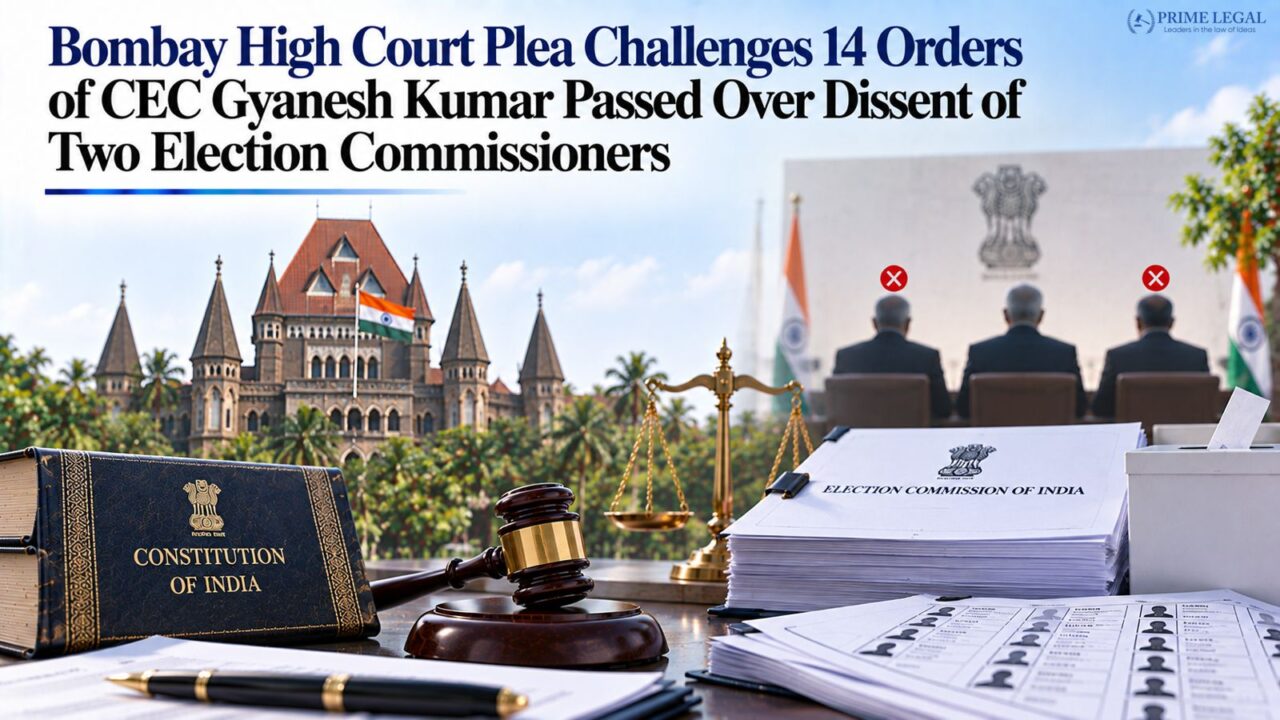
A writ petition has been filed at the Kolhapur Bench of the Bombay High Court against 14 administrative decisions/orders made by the Election Commission of India (ECI) and Chief Election Commissioner, Gyanesh Kumar. The issues raised in the petition basically revolve around the legitimacy of the decision-making processes of the ECI, especially when there have been recorded objections to such decisions by the two other members of the ECI, namely, Sukhbir Singh Sandhu and Vivek Joshi. The legal issue is related to the compilation and updating of the electoral rolls, voter registration, deletion, and restoration of voter names, modifications to Form 6, and the maintenance of the electoral roll database. The petitioners argue that these activities were carried out in contravention of the law applicable to the operation of a multi-member Election Commission.
BACKGROUND
The petition, which bears the title Prathamesh Gopal Gavankar v. Election Commission of India, has been raised regarding 14 decisions made during the past ten months concerning electoral roll management and the Special Intensive Revision process. One of the main aspects under discussion here is how to interpret and apply Section 18 of the Chief Election Commissioner and Other Election Commissioners (Appointment, Conditions of Service and Term of Office) Act, 2023, in which it is stated that the business of the Commission shall be transacted in the manner as per the majority when there is a difference of opinion. Petitioners claim that certain decisions have been made against the will of two Election Commissioners and that hence such decisions were not legally sanctioned.
KEY POINTS
-
- Collective workings of the Election Commission: The key question of law is whether it would be possible for the decisions taken about the constitutional functions of the Commission to be carried out when two out of the three Election Commissioners have objections. The basis of the petition is Section 18 of the 2023 Act on the grounds that the statutory system demands that the affairs of the Commission must be carried out collectively and when there is any dispute, it should be sorted out by means of the majority system. Furthermore, the petition makes reference to Supreme Court judgments on the working of an election commission comprising multiple members.
- Validity of amendment to Form 6: It has been argued that amendments were done to Form 6, which is utilized for the registration of new voters. There is a legal issue as to whether the said form can be amended to seek more information on the presence of the applicant or his family members in a previous electoral roll without following the procedure provided for in the electoral roll rules. The petition states that this kind of modification was not accepted by the Election Commissioners.
- Voters’ deletion and restoration: This petition questions the legality of the actions regarding the deletion and restoration of voters. It seeks restoration of voters who were said to have been deleted under the process of SIR and brings up the issue of procedures that ought to be followed before deleting a name from the electoral roll. The legal question here is on the exclusion of eligible voters from the electoral roll without following the necessary statutory procedure as well as proper notice and the chance to challenge the proposed deletion.
- Constitutional consequences under Articles 14 and 326: In this petition, the issues of Article 14 have been raised by arguing that there can be discrepancies in the management of the electoral roll and hence, there is a possibility of inequality between the voters and Article 326 providing for elections to the House of the People and State Legislative Assemblies based on adult suffrage. The petition thus links the lawfulness of electoral roll management to constitutional protection for election participation.
RECENT DEVELOPMENTS
Petition in the Bombay High Court has been filed seeking quashing of the 14 impugned orders, reinstatement of voters’ names removed from the rolls, and legal protections during the revision of the electoral roll. Further, an independent judicial committee has been sought to review the alleged removal of data and issues related to software concerning the SIR process. Another petition has been filed before the Principal Bench of the Bombay High Court regarding certain features of the SIR process in the state of Maharashtra and seeking the order, rationale, methodology, and legal validity of the exercise. Both the cases were scheduled to be heard by the respective benches on 28 September 2026. These are still mere allegations which require judicial determination; the filing of such petitions is not sufficient proof that the challenged acts are indeed illegal.
CONCLUSION
These issues involve primarily the statute and constitutional law in connection with the operation of the Election Commission and the validity of the process of administration of electoral rolls. The Bombay High Court could be called upon to determine if the contested actions were in accordance with Section 18 of the 2023 Act, if there had been compliance with the procedure for changing the registration criteria and deleting names from the electoral rolls, and if those actions meet the constitutional standards of equality and adult franchise provided for in Articles 14 and 326. It is possible that the proceedings might result in judicial interpretation of the law relating to the limits within which the ECI must collectively function and the rules applicable to electoral roll revision.
“PRIME LEGAL is a National Award-winning law firm with over two decades of experience across diverse legal sectors. We are dedicated to setting the standard for legal excellence in civil, criminal, and family law.”
WRITTEN BY: KHWAISH SACHDEVA

