
INTRODUCTION
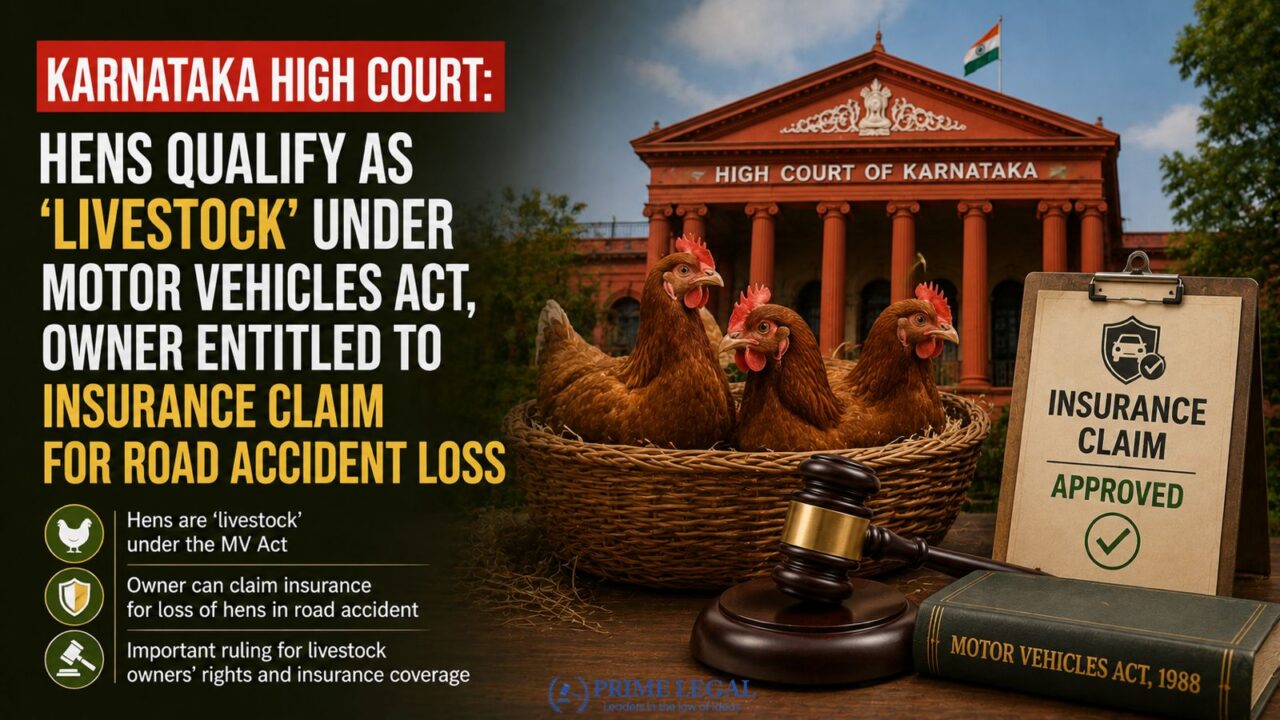
It was ruled by the High Court of Karnataka at Dharwad that “hens form part of livestock as per the Motor Vehicles Act, 1988 and therefore their death due to road accident falls under the ambit of damage to goods in the motor insurance policy.” A Bench of Justice Geetha K.B., delivering an oral judgment on 29 July 2026 in a batch of cross-appeals arising from a motor accident claim, rejected an insurer’s argument that hens could not be treated as livestock, while separately reducing the rate of interest awarded on the compensation.
BACKGROUND
This case was triggered by a MACT decision regarding an individual K. Veera Narayana Swamy, who had been carrying 2,250 broiler chickens bought from Challakere Poultry Farm to Tadapathri using an Eicher van until it overturned near Ayyagaralapalli village on 19th June 2013. Around 2,000 hens died in the accident and the remaining 250 were reportedly taken away by local residents. The claimant sought compensation of ₹5.90 lakh under Section 166 of the MV Act; Motor Accident Claims Tribunal-XII, Ballari, has awarded ₹4.51 lakh at 7 percent per annum interest. Both the appellant, claiming increase in the amount, and the insurance company, Reliance General Insurance Company, opposing liability and amount, have appealed to the High Court under Section 173(1) of the Act.
KEY POINTS
- The contention raised by the defendant was that the claimant had not proved that he was complying with the provisions of Rule 74 of the Karnataka Motor Vehicles Rules 1989 pertaining to carrying of “cattle” because hens are not cattle.
- The Court agreed that the Explanation to Rule 74 defines “cattle” to include goats, sheep, buffaloes, bulls, oxen, cows, deer, horses, ponies, mules, asses and pigs, expressly excluding hens.
- However, the Bench held that Section 2(13) of the Motor Vehicles Act, 1988, defines “goods” to include livestock, and that livestock “means the animals which are having life,” a category the Court found includes hens.
- The Court relied on police records, including the complaint, panchanama and charge-sheet, along with an invoice, bank statement and poultry-farm licence produced by the claimant, to hold that the accident and the ownership of the hens stood established.
- On the insurance policy, the Bench found the “limits of liability” clause covered damage to property other than the insured’s own, up to ₹7.5 lakh, and since the claimant was not the vehicle owner but merely transporting his livestock as goods, the loss was covered.
- The Tribunal’s compensation of ₹4.51 lakh was upheld as “just and reasonable,” while the claimant’s separate appeal seeking enhancement was dismissed for want of additional material.
RECENT DEVELOPMENTS
Having dismissed both the appeals together, MFA No. 101351 of 2016 brought by the claimant and MFA No. 102208 of 2016 brought by the insurer, the Court rejected the appeal brought by the claimant for enhancement while partly accepting the appeal brought by the insurer by reducing the rate of interest granted by the Tribunal from 7% to 6% per year. The rest of the grant remained unchanged and the insurer was ordered to pay the sum of compensation including interest before the Tribunal within eight weeks after obtaining the certified copy of the judgment.
CONCLUSION
This judgment provides clear guidance to claims tribunals handling cases of accidents involving motor vehicles, as well as to insurance companies, that poultry can be treated as insurable goods in a motor insurance policy, despite the limited meaning of “cattle” in other parts of the Karnataka Motor Vehicles Rules. Instead of basing the judgment on the limited definition of “cattle” in Rule 74, the court relied on the more expansive definition of “goods” in Section 2(13), thus indicating that transporters of animals other than cattle, like poultry, do not have to prove their fulfilment of the special requirements of transporting cattle to claim insurance in case of loss. However, this judgment has implications solely with regard to liability, as no enhancement or reduction was done with respect to compensation.
“PRIME LEGAL is a National Award-winning law firm with over two decades of experience across diverse legal sectors. We are dedicated to setting the standard for legal excellence in civil, criminal, and family law.”
WRITTEN BY: DRISHTITA BANIK

