
INTRODUCTION
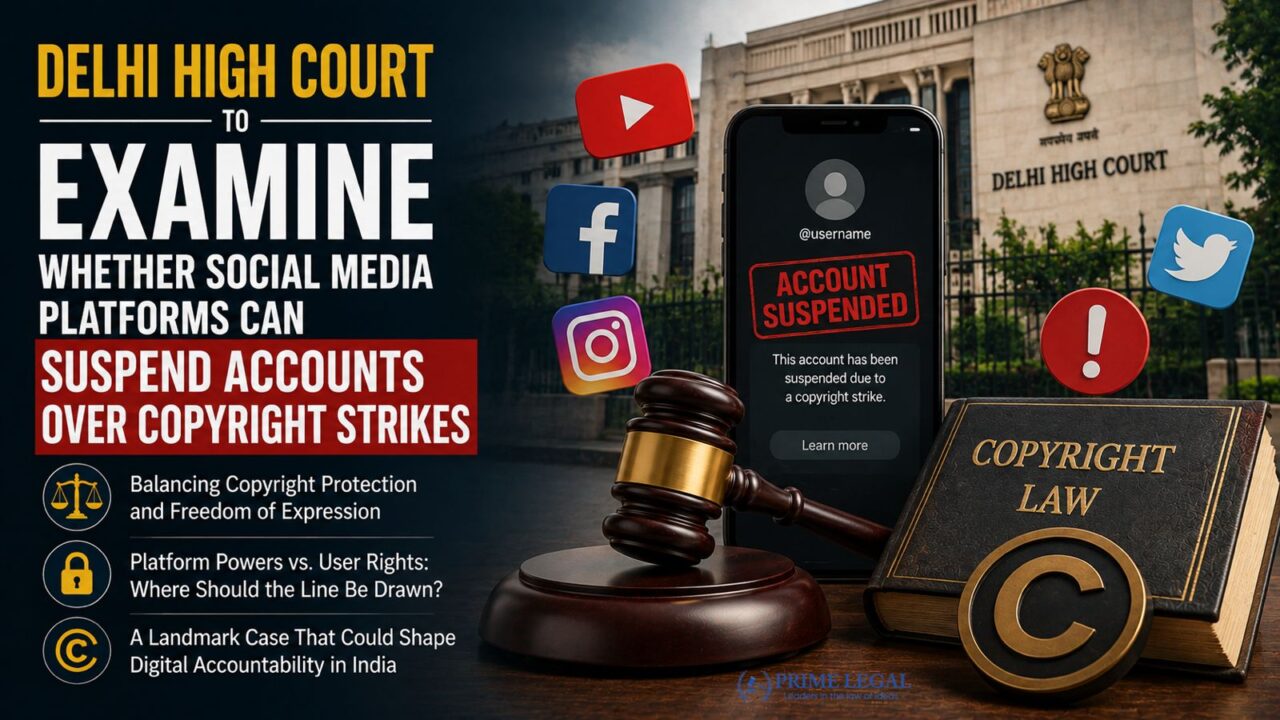
Any content creator active on Instagram or YouTube knows the fear of a copyright strike showing up out of nowhere, wiping out months of work and audience trust in one notification. What happens when those strikes are fake, though, filed by people who don’t even own the content they claim was stolen? The Delhi High Court is now stepping into that exact question. Justice Anup Jairam Bhambhani has framed a preliminary issue for examination: whether platforms suspending or deleting accounts purely on the basis of copyright strikes violates the principles the Supreme Court and Delhi High Court themselves laid down years ago on intermediary liability. Meta, Google and Telegram have all been asked to respond directly to this point.
BACKGROUND
The case comes from a suit filed by Saurabh Maurya, a digital content creator who runs the channel “IITian Trader.” Maurya’s Instagram account was suspended after a string of copyright strikes landed on his posts, strikes he said were fake, filed by people falsely claiming ownership over content that was actually his. He went to court not just seeking restoration of his own account, but also compensation from those he alleges are running an organised extortion racket built around abusing Meta’s copyright enforcement system. His counsel, Senior Advocate Diya Kapur, pushed the Court to look beyond his individual case and examine the mechanism itself, arguing that intermediaries are currently taking down accounts on the mere say-so of anyone who claims to be a copyright owner, without any real verification.
KEY POINTS
- The core question framed by the Court is whether suspending and eventually deleting an account, purely through a copyright strike system, breaches the principles set out in Shreya Singhal v. Union of India and My Space Inc. v. Super Cassettes Industries Limited.
- Kapur’s argument rests on the safe harbour provisions under the IT Act and Copyright Act; her position is that an intermediary cannot claim safe harbour protection while also exercising unchecked discretion to suspend accounts on nothing more than an unverified copyright claim.
- She specifically asked the Court to clarify the MySpace ruling, so that only a registered copyright owner, or someone the Court has actually recognised as one, can trigger a copyright strike in the first place.
- During the hearing, counsel for Meta conceded that 13 of the strikes against Maurya’s account were found to be fake, and that those strikes have since been reversed with the account restored.
- Meta has also given an interim assurance that Maurya’s content won’t be taken down over copyright strikes going forward, provided he can show material demonstrating a strike is fabricated.
- The matter is listed next for 24 September, when Meta, Google and Telegram are expected to respond specifically to the larger issue the Court has framed.
RECENT DEVELOPMENTS
Maurya’s case isn’t an isolated complaint; it’s landed at a time when Delhi High Court has been hearing a cluster of similar disputes over the same underlying problem. A separate PIL is pending before the Court seeking a Special Investigation Team probe into what’s being described as an organised cyber-extortion racket, where fabricated copyright complaints, filed through bot-operated accounts, are used to get creators’ accounts disabled and then extract money for restoration. Around the same time, the Court has also been dealing with another commercial suit alleging that a similar loophole in Meta’s content-editing features was being exploited to steal content and generate fake strikes against a different creator. Taken together, these cases point to a pattern that’s gone beyond individual disputes and into something closer to a systemic vulnerability in how platforms police copyright.
CONCLUSION
What makes this case worth watching isn’t just Maurya’s own account being restored, that part is already resolved. It’s the bigger question the Court has chosen to sit with: how far can a private platform’s internal enforcement mechanism go before it starts running into constitutional principles around fair process and safe harbour protection? If the Court does end up narrowing who can trigger a copyright strike, it could reshape how every major platform operating in India handles takedown requests going forward. For now, creators and platforms alike will be watching what Meta, Google and Telegram have to say when the matter returns on 24 September.
“PRIME LEGAL is a National Award-winning law firm with over two decades of experience across diverse legal sectors. We are dedicated to setting the standard for legal excellence in civil, criminal, and family law.”
WRITTEN BY: MAHFUZA FATHIMA

