
INTRODUCTION
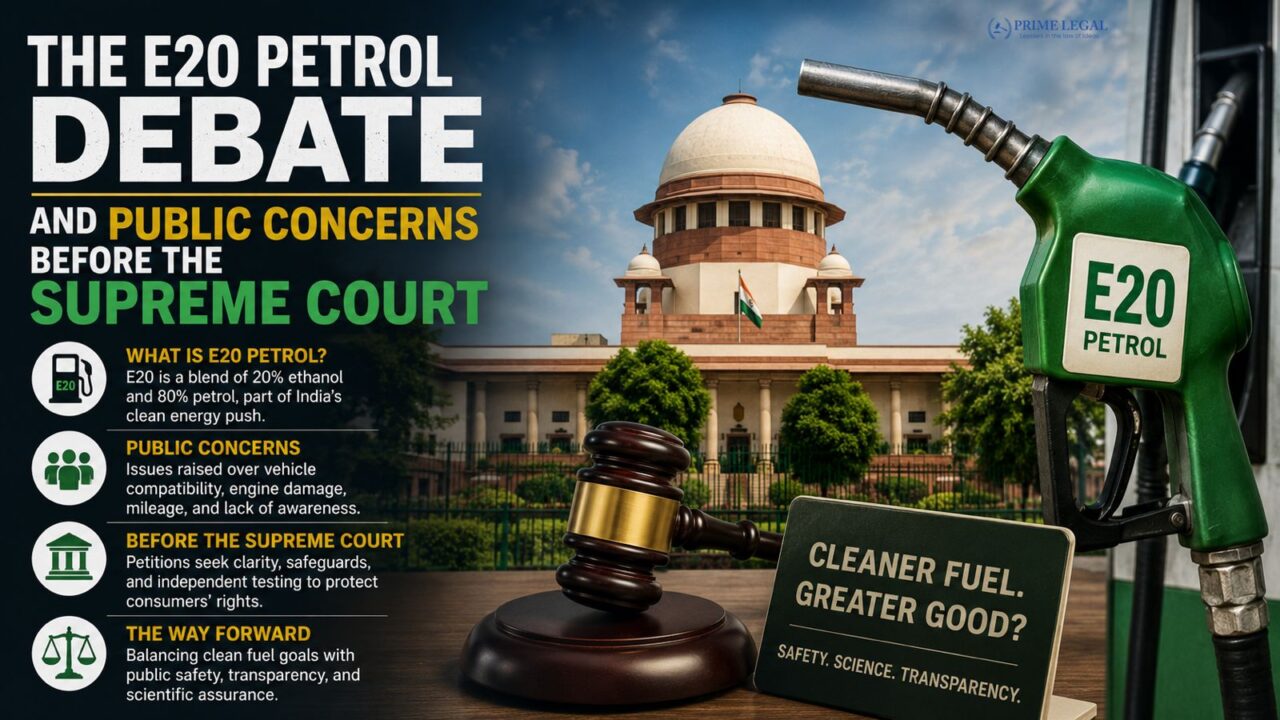
The Union Government’s decision to introduce E20 petrol (a mix of 80% petrol and 20% ethanol) as the standard fuel has raised a lot of questions from the auto community. The government has met its target of E20 in 2025, five years ahead of the initial 2030 target. But drivers have had concerns about whether their older cars built prior to 2023 will cope with ethanol-blended gasoline; whether the ethanol will harm parts; and whether it will decrease fuel efficiency.
BACKGROUND
In August 2025, Advocate Akshay Malhotra filed a Public Interest Litigation (PIL) in the Supreme Court to ensure that ethanol-free petrol is available for older cars. The petition pointed out that other nations such as the United States, Brazil and the European Union have alternatives to ethanol consumption, and have implemented labelling systems for consumers to be aware of the fuel blends that contain ethanol. The petitioner also referred to a 2021 report by NITI Aayog, which had stated that blended fuel prices shall be lowered as the calorific value of blended fuel is reduced, and had also highlighted the concern of Society of Indian Automobile Manufacturers (SIAM) regarding non-availability of E10 in the existing pool of vehicles.
KEY POINTS
- The Supreme Court, on September 1, 2025, dismissed a PIL request for parallel availability of ethanol-free petrol for older vehicles on a summary basis.
- Attorney General R Venkataramani had opposed the petition saying it was an attempt to spoil the government policy to promote the local produce and save foreign exchange.
- The matter came up again in May 2026 when the Centre announced plans of higher ethanol blends, and at the same time, a separate matter on ethanol procurement quotas was being heard by the Supreme Court.
- In the procurement case, a comment from the Attorney General that “20% ethanol blending is something which the Government is trying to experiment” caused a lot of speculation and news in the public.
ANALYSIS
By refusing to accept the first PIL, the Supreme Court had effectively barred judicial review of the E20 policy, with the result that the issue of vehicle owners’ concern about the fuel efficiency of the vehicles and the engine compatibility was not addressed by the courts. But the off-the-cuff comment by the Attorney General in a later BPCL procurement deal sparked concerns, as Twitter users asked whether the government was imposing an experimental fuel policy on citizens. The situation here points to the conflict between the government’s drive for sustainable, domestic sources of alternative fuels and the real-world, economic issues of everyday car users who have no alternatives for their current cars.
CONCLUSION
The debates on the E20 petrol policy highlight the importance of clear communication about large scale environmental and economic policies. It was later clarified by the Attorney General’s office that the word experiment was limited to the amount of ethanol supplies and not the policy, however, the backlash from the public shows concern. The upcoming transition to increased blends of ethanol presents a need to consider national policy objectives, consumer preference and vehicle safety in tandem.
“PRIME LEGAL is a National Award-winning law firm with over two decades of experience across diverse legal sectors. We are dedicated to setting the standard for legal excellence in civil, criminal, and family law.”
WRITTEN BY: SHEEN.

