
INTRODUCTION
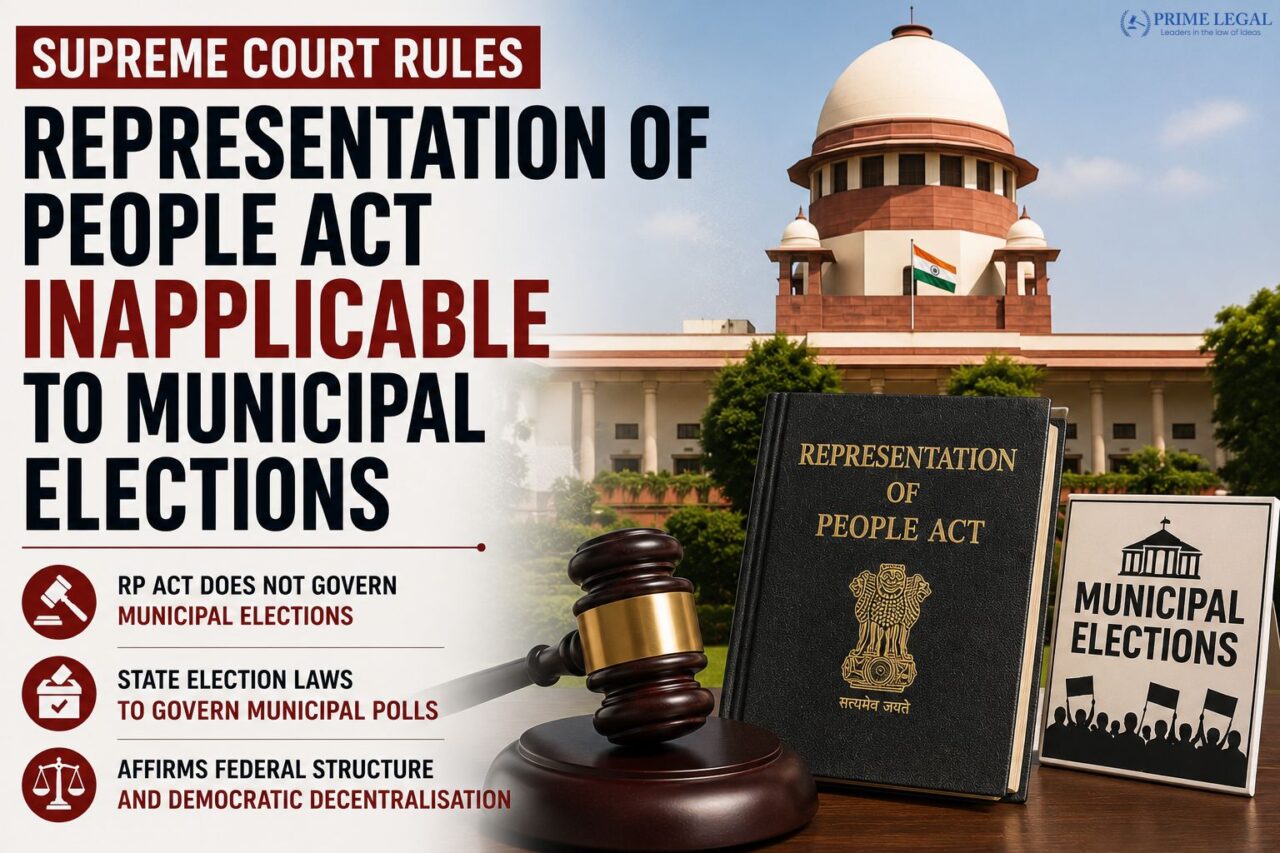
In the case of Chandriken Kishor Dafda v. State of Gujarat & Anr., the Supreme Court of India clarified that the penal provision of Representation of the People Act, 1951 (RPA) is not applicable to the municipal elections.
The Court noted that candidates who are accused of giving false affidavits in local body polls could not be prosecuted under the RPA, but only under the Indian Penal Code (IPC) if the local body law does not have any penal provisions.
In this case, the controversy started after the appeal was filed by Chandrikaben Kishor Dafda, against criminal proceedings against her. During the 2015 Gujarat municipal elections, she was accused of trying to cover up information on her husband’s immovable properties. She had earlier been summoned by a Magistrate under Section 125A of the RPA, and the Gujarat High Court earlier ruled against quashing the proceedings.
BACKGROUND
As per the Representation of the People Act, Section 2(d) clearly specifies that election covers only those elections held for Parliament and State Legislature. Hence, the appellant contended that the Act cannot be applicable to municipal elections and that the same are governed by the various local laws such as Gujarat Municipalities Act and the Gujarat Municipalities (Conduct of Elections) Rules.
On reading municipal rules, the Court observed that earlier rules had penalized contestants for making false statements, but in 1990, this was repealed by legislative changes and Indian Penal Code provisions remained as the basis for punishment for such offenses.
The Supreme Court considered whether the Magistrate had taken due cognizance under Section 125A of RPA and whether the appellant was legally compelled to disclose only properties which were solely owned by her husband.
KEY POINTS
- The Supreme Court ruled that the Representation of the People Act’s Section 125A does not apply to municipal elections.
- The Court also held that candidates, who submit false affidavits in the context of local elections, do not have immunity from criminal prosecution, and can be prosecuted under the Indian Penal Code.
- In this decision, the Court held that the offence being taken cognizance under the wrong statute is a “curable irregularity” under Section 465 of the Code of Criminal Procedure if there is no failure of justice.
- The term “myself, my spouse and dependents” in the prescribed format of an affidavit of assets is clarified to mean assets which are only held by the spouse.
- Magistrates must look at the substance of the offence; the Court repeated a previous precedent which said that they would take cognizance of the offence and not of the people.
- In this order, the Court set aside the cognizance order made by the RPA and remanded the matter for the Magistrate to recognize the matter under the relevant laws.
ANALYSIS
The judgment favors the narrow reading of the boundaries, so as to ensure that the Representation of the People Act is not overstretched in respect of local municipal elections. The Court’s decision in favor of the RPA prevented the abuse of the specific electoral penal statutes in the election of the parliamentary and state legislature.
However, candidates were not given the opportunity to avoid being challenged for providing inaccurate data or find a way to prevent electoral irregularities. In the judgement it is mentioned that if a municipal law does not have a penal provision, then the same should be explicitly applied with respect to the IPC filing a false affidavit is still a big offence to the society and it should be investigated.
And the decision strengthens the procedural framework, as it provides an actual solution to errors in criminal law. To ensure honesty and transparency of the electoral process, the Court emphasizes the offense of the substance above the technical mislabeling of the electoral offence by the magistrates at the stage of cognizance.
CONCLUSION
The Supreme Court reiterated in this judgment that transparency and honesty in electoral affidavits are crucial, whether it’s a parliamentary, state or municipal election. To preserve the integrity of the democratic process, the Court has endorsed strict rules of disclosure for spousal assets so that voters can be well-informed.
The judgment is a means to demonstrate the application of appropriate legal mechanisms as a basis for electoral accountability. The judgment is a way to show that the right to vote relies on more than just people taking part. For this right to exist, the electoral system must also be honest, correct and lawful.
“PRIME LEGAL is a National Award-winning law firm with over two decades of experience across diverse legal sectors. We are dedicated to setting the standard for legal excellence in civil, criminal, and family law.”
WRITTEN BY: SHEEN.

