
INTRODUCTION
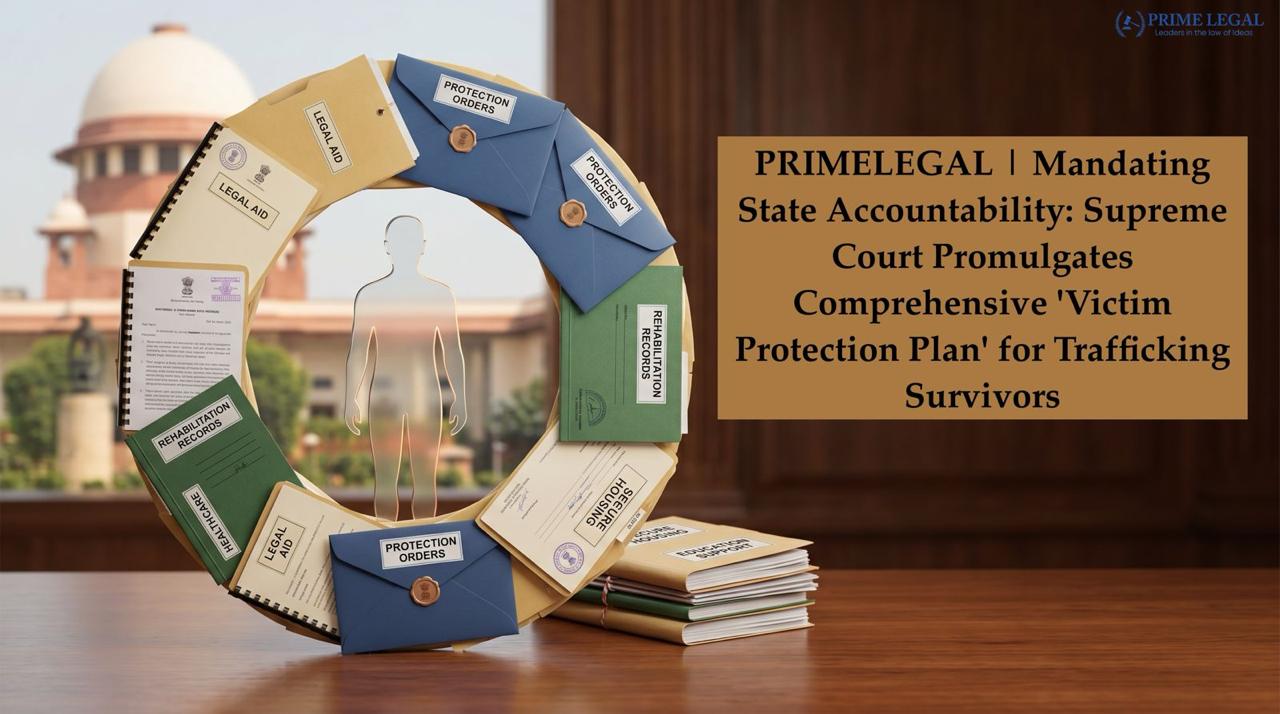
On 29th May 2026, the Supreme Court of India in a landmark decision, issued one of the most exhaustive and comprehensive orders on the issue of Human Rights, by creating a comprehensive ‘Victim Protection Plan’ for survivors of human trafficking and commercial sexual exploitation (CSE). In Prajwala v. Union of India (2026 INSC 609), the Division Bench of Justice J.B. Pardiwala and Justice R. Mahadevan have moved towards a rights-driven approach to the Constitutional framework from a rescue-centric model. It views rehabilitation as a right and not policy of the government and it must be guaranteed as a fundamental right under Article 21 and 23 of the Indian constitution.
BACKGROUND
The roots of this historic order go back to a Public Interest Litigation filed by the anti-trafficking NGO, Prajwala in Hyderabad, in 2004. Amongst the petitioners’ observations was the lacunae in the system-wide rescue, rehabilitation and reintegration process in India; and the fact that trafficking victims were being handled as criminals and not victims of grave crime.
In 2015, while the original writ petition was being disposed of, the Supreme Court agreed to the Union Government’s solemn assurances to bring in an Organised Crime Investigation Agency (OCIA) to counter trafficking networks and a comprehensive standalone anti-trafficking law. The two pledges were not fulfilled though. Parliament’s dissolution in 2018 saw the Bill on the Prevention, Protection and Rehabilitation of Trafficking in Persons, 2018, shelved and a new Bill introduced again in 2021, which continued to languish in Cabinet.
After ten years, Prajwala returned to the Court with a Miscellaneous Application, pointing out that there had been no meaningful action. The Court agreed and the judgment for 2026 was the result. The Court held that there is “no option left” to intervene when it was confronted with the vacuum that had taken a toll on the fundamental rights of the victims.
KEY POINTS
Regarding direction, the Court’s directions, in so exercising its powers under Article 32 and 142 of the Constitution, span the entire range of direction from intelligence gathering before rescue to re-integration after rescue. The Plan has the following key elements:
- There is an enforceable fundamental right to rehabilitation for CSE victims, which transcends rescue or prosecution, and is given by combining a reading of Article 21 (right to life with dignity) and Article 23 (prohibition on human trafficking).
- “Victim is not Criminal”: The Court has specifically made it clear that “No law shall be enacted or applied to treat a victim as a criminal, nor shall any measures be taken which could lead to his criminal liability.” All parties to the system must see them as a crime victim.
- Stage by stage Operational Framework: The Plan introduces binding protocols for pre-rescue intelligence, rescue itself, post-rescue care, rehabilitation, repatriation, reintegration, prosecution, prosecution proceedings, prevention and training of officials.
- Priority of the Adult Victim: Adult victims’ consent should be taken into account in decisions related to rehabilitation and reintegration. An adult victim may not be placed under a rehabilitative process by the State. Also, neither a voluntary sex worker should be ‘rescued’ nor should they be detained by anyone without first conducting an inquiry of the threshold.
- Multi-disciplinary teams of social workers, legal aid service providers and mental health workers are to make up the Enhanced Anti-Human Trafficking Units (AHTUs) to give a comprehensive response.
- Child Victims: Children shall be presented in front of the Child Welfare Committee. If anyone is of uncertain age, the CWC will decide that they are children.
- Survivors can access free legal representation at all stages and access trial protection. The Court blocked the cross-examination aimed at avoiding the victim, but not for the purpose of obtaining evidence.
- The Court recognised that technology is an important tool that traffickers use to organise and evade authorities and thus called on the Union to accelerate its efforts to develop a coordinated legislative and enforcement response to traffickers’ abuse of technology to traffic in persons.
RECENT DEVELOPMENTS
The judgment was also an examination of the lack of adequate legislation. The Court, however, disagreed with the Union and stated that they have been adequately dealt with by the Immoral Traffic (Prevention) Act, 1956 (ITPA), and Bharatiya Nyaya Sanhita, 2023 (BNS). It incorrectly lumps prostitution into trafficking, and the BNS has an imprecise concept of the “means” element of trafficking.
The Court suggested that legislative changes should be made to ITPA Sections 7, 8 and 20 to avoid criminalising victims. It was also unwilling to impose a requirement for an OCIA, pointing out that anti-trafficking functions are currently spread out across various institutions, and offered Parliament and other stakeholders the opportunity to create a specialised body. The Plan shall remain in effect, as a binding law, until there is a comprehensive dedicated anti-trafficking law passed by Parliament.
No doubt the judgment has been compared to Vishaka vs State of Rajasthan and Sampurna Behura vs Union of India in which the Supreme Court had noted the systemic failure of the State and had laid down in great detail what the remedy was.
CONCLUSION
The Supreme Court’s Victim Protection Plan is more than a court order, it’s a constitutional recall. The Court has clearly imposed a positive and non-delegable obligation on the State with regard to trafficking survivors via Article 21 and Article 23. The ruling suggests the end of judicial forbearance of the legislature’s inaction.
This moment and its influence on a shift in the status quo will depend on three things: the political will on the Union’s side to finally pass a law against trafficking; institutional capacity of AHTUs and related agencies to put into practice the detailed protocols contained within the Plan; and ongoing judicial oversight to make sure that the state machine is held accountable. While delivering the judgment, Justice Pardiwala said, “This judgment shall definitely make many innocent and vulnerable young girls and women safe.” Now it’s up to the executive and the legislature to make that happen.
“PRIME LEGAL is a National Award-winning law firm with over two decades of experience across diverse legal sectors. We are dedicated to setting the standard for legal excellence in civil, criminal, and family law.”
WRITTEN BY: ARNAV NAIK

