
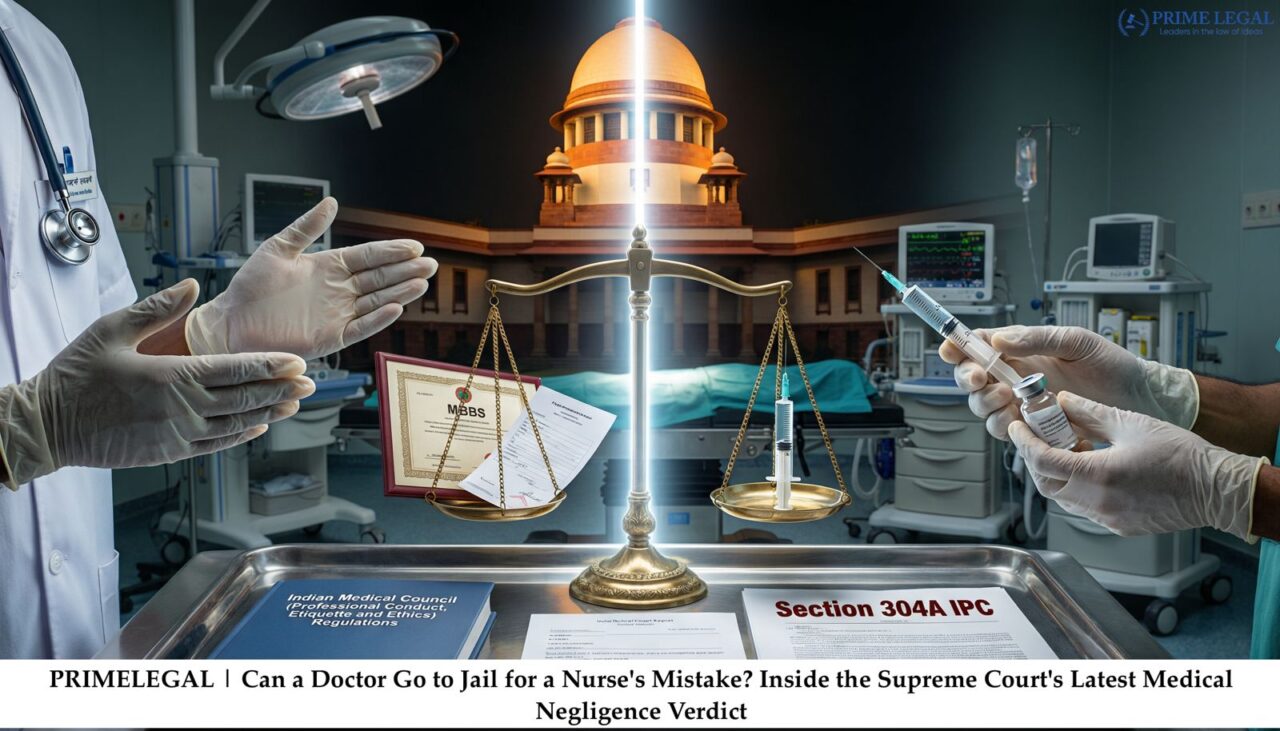
CASE: M.C. Supriya Kumari v. State of Kerala & Others CDJ 2026 SC 849
CASE NUMBER: Criminal Appeal No. of 2026 (Arising out of Special Leave Petition (Crl.) No. 124 of 2025)
COURT: Supreme Court of India
DATE: May 25, 2026
QUORUM: Hon’ble Mr. Justice Pankaj Mithal and Hon’ble Mr. Justice Prasanna B. Varale
FACTS
On May 20, 2002, a patient named K.P. Murlidhar was admitted to Dhanalakshmi Hospital in Kannur for a surgery of piles that was scheduled for next morning. The appellant who was Dr Supriya Kumari was working as a senior anesthetist at the hospital and was involved in the surgery that was about to take place on May 29. In the evening the patient was shifted for recovery but his condition worsened at 8:00 PM and he unfortunately died in the early morning at 4:00 AM. The post mortem report revealed that the patient had a hidden blockage in his left artery and died due to a sudden heart attack.
The police filed a criminal case of medical negligence under section 304-A of the IPC (now Section 106 of BNS). The prosecution accused Dr Priya of being extremely careless because after her shift ended at 5:00 PM she allegedly gave instructions over the phone to the nurse to inject a painkiller, instead of herself coming to give the same. The nurse injected the painkiller incorrectly outside the correct area which caused a swelling increasing the pain. The prosecution claimed that failure to relieve the patient’s severe pain caused massive stress to him which triggered the severe heart attack.
Dr. Supriya applied to the lower courts and Kerala High Court to quash the criminal case against her but when the High Court of Kerala refused to dismiss the case and told her to face the trial, she appealed for relief to the Supreme Court.
ISSUES
- Can an off duty Dr be held criminally liable for medical negligence under Section 304A IPC (now Section 106 of BNS) when it was the nurse who incorrectly administered a painkiller that was otherwise correctly prescribed by the doctor?
- Does an individual’s complete win on merits of a consumer or civil case means that a criminal case based on the same facts cannot be allowed?
- What’s the export medical planner properly formed if it did not include a specialist that was the anesthetist to evaluate the technical medical procedure?
LEGAL PROVISIONS
- Indian Penal Code, 1860 (IPC) / BNS, 2023: Section 304-A / 106 (Causing death by negligence) and Section 34 / 3(5) ( Acts done by more than one person in furtherance of common intention).
- Code of Criminal Procedure, 1973 (CrPC) / BNSS, 2023: Section 482 / 528 (Inherent powers of the High Court to dismiss unfair cases and prevent abuse of the law).
ARGUMENTS
APPELLANT
The Senior Advocate representing her case argued that her shift ended at 5 p.m., and she left the patient perfectly stable. Giving standard phone advice for a correct painkiller to the on-duty hospital staff during an evening emergency cannot be called a “grossly careless” criminal act.
The medicine prescribed was entirely correct. If the nurse failed to inject it properly into the correct space, it was a mechanical error beyond the physical control of the off-duty doctor.
The deceased’s family had already filed a case before the Consumer Forum. After looking at all the evidence, the Forum found the hospital, surgeon, and nurse responsible, but completely cleared Dr. Supriya of any blame. The family never challenged her clearance in higher consumer courts.
The 80% heart blockage was completely unknown until the post-mortem report. The actual cause of death was an internal heart failure, not the painkiller injection.
RESPONDENT
The respondent argued that the doctor’s negligence was proved by an expert panel report. They argued that because the anesthesia was given improperly by an inexperienced nurse without the doctor’s supervision, the patient’s pain was not relieved, directly triggering the heart attack.
They contended that the arguments raised by the doctor were matters for a full trial court to check and determine, meaning the criminal case should not be dismissed halfway.
ANALYSIS
The Supreme Court closely examined the rules of medical negligence. It relied heavily on the landmark case Jacob Mathew v. State of Punjab (2005) 6 SCC 1, which established that criminal negligence against a doctor requires a far higher standard than standard civil negligence. To push a criminal case under Section 304-A, the act must be “grossly” reckless, meaning something that no ordinary, prudent doctor would ever do. Giving a proper prescription over the phone when off-duty does not meet this criminal criteria.
The Court also noted that under the Jacob Mathew guidelines, the police must get an independent opinion from a doctor who is a specialist in that exact same field. Here, the expert panel did not include an anesthetist, making it incompetent to comment on specialized spinal injections.
Crucially, the Court applied the Radheyshyam Kejriwal V. State of West Bengal 2011 3 SCC 581 principle: when a person is fully cleared on merits in a civil or consumer case, allowing a criminal prosecution to continue on the exact same facts is a complete abuse of the legal process. Finally, the Court noted that a criminal conviction requires a direct link between the doctor’s act and the death. Since the patient died from a sudden heart attack caused by a massive, hidden 80% artery blockage, blaming an off-duty anesthetist is against justice.
JUDGEMENT
The Supreme Court allowed the appeal and set aside the Kerala High Court’s order. The Bench officially quashed the criminal case pending before the Judicial Magistrate at Kannur and fully discharged Dr. Supriya Kumari from all criminal charges.
CONCLUSION
This judgment provides important protection to healthcare professionals. It confirms that off-duty doctors cannot be subjected to criminal trials for subsequent execution errors made by hospital staff. By prioritizing a doctor’s prior civil clearance and emphasizing the strict medical guidelines of the Jacob Mathew case, the Supreme Court ensured that doctors can perform their duties without the constant fear of unfair criminal prosecution for natural or hidden health failures of patients.
“PRIME LEGAL is a National Award-winning law firm with over two decades of experience across diverse legal sectors. We are dedicated to setting the standard for legal excellence in civil, criminal, and family law.”
WRITTEN BY: LISHIKA BATRA
Read the judgement copy below:

