
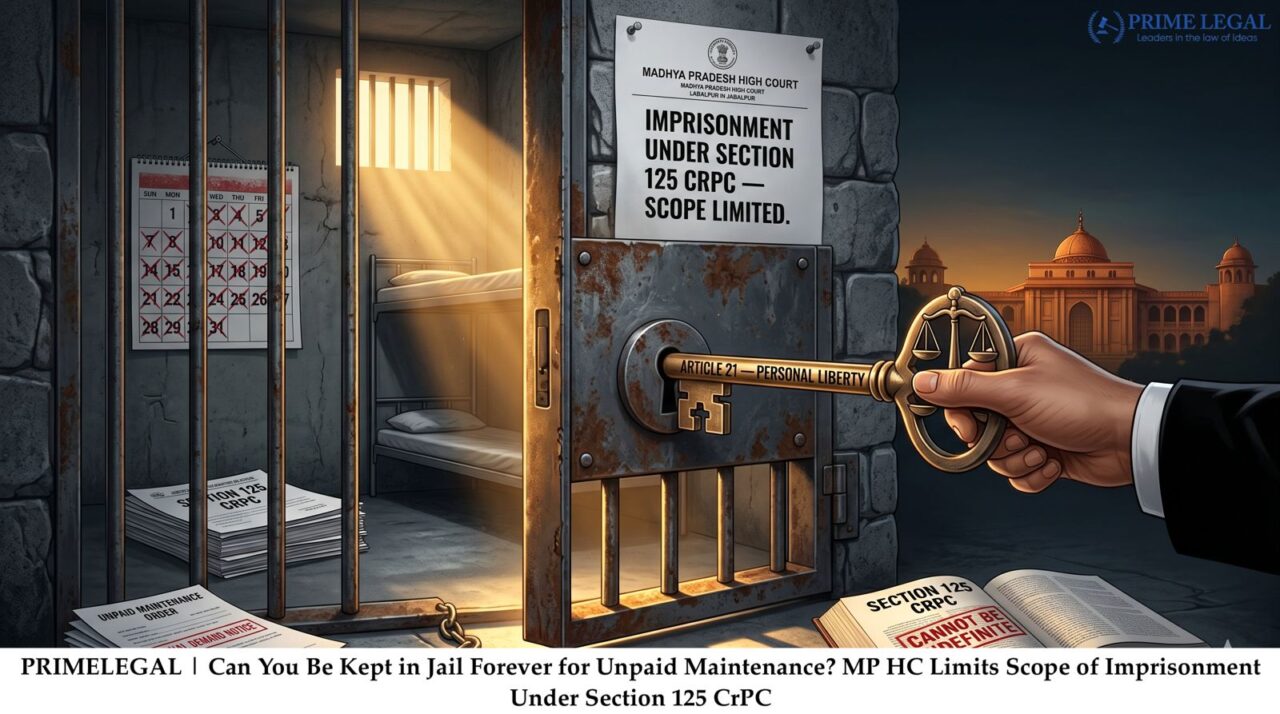
CASE NAME: Laxmikant Soni v. Smt. Radha & Others
CITATION: 2026:MPHC-JBP:40205
COURT: High Court of Madhya Pradesh
DATE: 15 May, 2026
JUDGE: Hon’ble Justice Himanshu Joshi
FACTS
Laxmikant Soni questioned if their orders to deny him leave from judicial custody during maintenance proceedings were legal. The Judicial Magistrate First Class, Deori and the Revisional Court did not allow him to leave custody during the proceedings to execute maintenance.
In a maintenance order under Section 125 Cr.P.C., the court ordered the petitioner to pay Rs.3,000 every month. The parties began execution proceedings to recover unpaid money amounting to Rs.1,38 000. By a warrant, the police arrested the petitioner on 30 October, 2025 and he remained in judicial custody.
ISSUES
- Whether prolonged incarceration in maintenance execution proceedings could assume a punitive character.
- Whether continued detention of the petitioner was justified despite his financial condition and partial payment of maintenance debts.
- Whether lower courts failed to consider petitioner’s rights under Article 21.
LEGAL PROVISIONS
- Section 125 of the Code of Criminal Procedure, 1973 (now Section 144 of the BNSS, 2023) – Mentions maintenance to wives, children and parents in cases of neglect or refusal to maintain.
- Section 144(3) of the Bharatiya Nagarik Suraksha Sanhita, 2023 (BNSS) – Recovery of maintenance debts through execution proceedings.
- Section 480 of the Bharatiya Nagarik Suraksha Sanhita, 2023 (BNSS) – Provision invoked by the petitioner seeking release from judicial custody during proceedings.
- Section 528 of the Bharatiya Nagarik Suraksha Sanhita, 2023 (BNSS) – Empowers the High Court to re-examine the legality and correctness of orders passed by lower courts.
- Article 21 of the Constitution of India – Guarantees protection of life and personal liberty.
ARGUMENTS
PETITIONER
Mr. Laxmikant Soni argued that he was detained for more than four months. Under maintenance laws, he cannot be indefinitely detained. He also brought up the fact that he was a labourer and the only earning member of the family. He claimed that he could not clear the dues after paying Rs.20,000 because of the detention. He also relied on medical grounds to support his release application.
RESPONDENT
The wife and children had to ask the court for money for living expenses and this situation occurred because the petitioner did not fulfil his legal or moral duties. By their account, he did not pay the required amounts many times even though he had the chance to do so. Due to those actions, the total amount increased.
It was stated in their submission that the money the petitioner paid is small when a person compares it to the total debt he owes. The respondents claimed his release is not appropriate. On this matter they also said that two lower courts already made the same decisions against the petitioner. As a result, they argued that a higher court should not change the outcome under Section 528 BNSS because there is no obvious violation of the law.
ANALYSIS
In the High Court, the judge observed that maintenance proceedings are measures for social welfare which exist so that wives and children do not become destitute, but the court must ensure that enforcement mechanisms operate in a way that is fair and proportional under the constitution.
It was emphasized by the Court that when a person is in prison during maintenance execution proceedings, the process is only a method to force a person to comply with an order. To keep a person in detention indefinitely as a punishment is not allowed. On this matter the Court noted that the petitioner was in jail for more than five months during those specific execution proceedings.
As the Court held further, the act of keeping a labourer who has no money in prison is a process that stops him from being able to earn money. By doing this the legal system defeats the goal of maintenance law. If the petitioner pays Rs.20,000, he shows that he is willing to follow the order for maintenance.
Due to the petitioner’s medical conditions, the Court observed that it is necessary to consider the human rights that come from Article 21. At the same time the court made it clear that the right of the wife and children to receive maintenance is still in effect. And the release of the petitioner from custody is not an act that removes his legal debt for maintenance.
JUDGEMENT
To conclude the case, the High Court set aside the orders from the Revisional Court and the JMFC. For the petitioner to be free from custody immediately, he must provide a bond of Rs.50,000 with a surety. There is also a direction from the court that he must deposit Rs.25,000 within thirty days and he must continue to pay future maintenance at regular intervals.
CONCLUSION
The judgment clarified that detention in maintenance execution proceedings is coercive and not punitive. The Court reaffirmed that prolonged incarceration defeating a person’s earning capacity undermines the very purpose of maintenance law while still preserving the wife and children’s right to maintenance.
“PRIME LEGAL is a National Award-winning law firm with over two decades of experience across diverse legal sectors. We are dedicated to setting the standard for legal excellence in civil, criminal, and family law.”
WRITTEN BY: SAMANA.
Read the judgement copy below:

