
INTRODUCTION
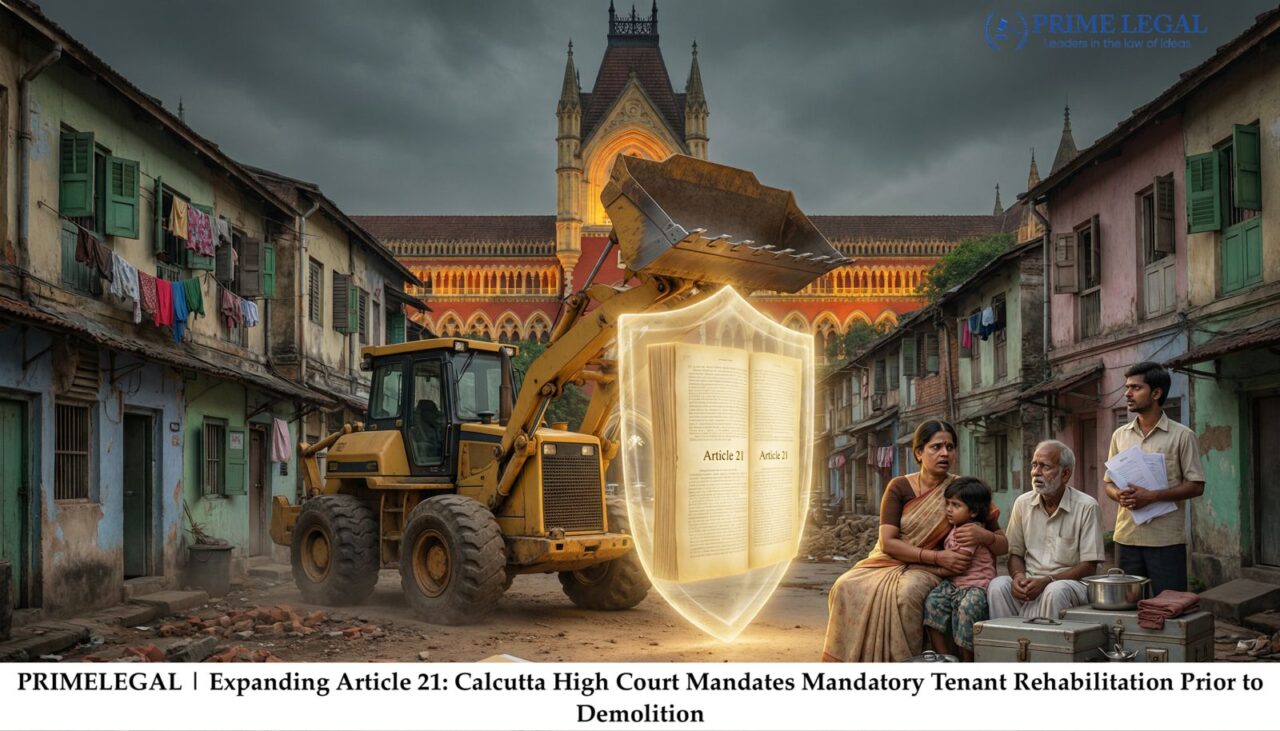
In Indradevi Sonkar v. Howrah Municipal Corporation & Ors. (WPA 11655 of 2026), the Calcutta High Court stated that authorities are not legally allowed to remove tenants for demolition unless they first evaluate plans for housing. It was the view of the Court that the right to shelter is a necessary part of the right to life which Article 21 of the Constitution protects.
The dispute occurred regarding an unauthorised construction in Howrah. When demolition proceedings were initiated under Section 177 of the Howrah Municipal Corporation Act, 1980, the residents approached the court. The demolition process put the residents of the building at risk of losing their home, but the Court did not stop officials from taking action against construction that lacks legal permits. It stated that the destruction process must maintain respect for individuals and follow the protections that the Constitution provides.
BACKGROUND
As the case developed, it focused on a fifth floor that builders created without authorisation in Howrah. To remove the illegal part of the structure, authorities issued orders that impacted the individuals who rent space there. On this matter one resident asked the Court for help because they wanted to avoid a situation where they must leave suddenly.
For many years the legal system in India has expanded Article 21 so that it means more than staying alive. Due to different rulings, courts define the “right to life” so that it includes the ability to earn money, live with respect, maintain health and have a home. In cases like Olga Tellis v. Bombay Municipal Corporation besides Chameli Singh v. State of Uttar Pradesh, the Supreme Court stated that having a home is linked to the way people are treated and their safety within society.
Against this constitutional background, the Calcutta High Court was required to balance two competing concerns. Firstly, the need to remove illegal constructions and the obligation to protect individuals from being rendered homeless overnight.
KEY POINTS
- The Court stated again that Article 21 of the Indian Constitution includes the right for a person to have a place where they can live, or simply put, a right to shelter.
- It highlighted that the occupation of an illegal construction by people cannot prevent legal actions, such as demolitions from being taken against them.
- But the Court also emphasised that tenants and occupants cannot be treated inhumanely during demolition proceedings.
- The landlord/developer was asked to make other accommodation arrangements for the tenant before his place is demolished.
- The judgment stressed that constitutional protections continue to apply even when authorities are acting against unauthorised structures.
- A humanitarian approach was taken by Hon’ble Mr Justice Raja Basu Chowdhury.
ANALYSIS
The judgment is important because the Court uses a method that considers different interests. It is not a decision that makes illegal building lawful or provides an excuse for it. The Court describes how the removal of buildings affects people. In urban areas that grow quickly, tenants are the people who have the least power in disagreements about new construction. Many individuals do not have money for protection or a way to get other housing immediately.
By ordering that individuals receive new housing before a building is removed, the Court shows that the loss of a home changes more than just the ownership of land. It affects how people feel respected, how they earn money and if they are safe and stable. The judgment is a way to make Article 21 focus more on the well-being of people while it still allows the government to apply local laws.
There is a possibility that this decision will change how future construction and removals happen. It encourages the government and builders to use methods for relocation that are more considerate of human needs.
CONCLUSION
In this ruling the Calcutta High Court shows that the range of Article 21 is changing. The judges give importance to a style of governing that focuses on the respect because of individuals. As the Court confirms that authorities must take down buildings that are not legal, it also states that officials cannot ignore the values in the constitution during this process.
To conclude the judgment is a reminder for those who manage cities. For development to occur, officials must remain aware of the rights and the health of regular individuals, especially the who are at risk of being moved from their homes.
“PRIME LEGAL is a National Award-winning law firm with over two decades of experience across diverse legal sectors. We are dedicated to setting the standard for legal excellence in civil, criminal, and family law.”
WRITTEN BY: SAMANA.

