
CASE NAME: Hirani Developers v. Nehru Nagar Samruddhi CHS Ltd. & Others
CASE NUMBER: Civil Appeal Nos. of 2026 (@ SLP (C) Nos. 38407–38411 of 2025)
COURT: Supreme Court of India
DATE: 13 May 2026
QUORUM: Hon’ble Mr. Justice Sanjay Kumar and Hon’ble Mr. Justice K. Vinod Chandran
FACTS
Hirani Developers and Nehru Nagar Samruddhi Co-Operative Housing Society entered into an agreement for the redevelopment of the society’s property. This agreement included an arbitration clause.
The developer later executed Permanent Alternate Accommodation with individual members of the society. Clause 14 of the agreement stated that all conditions of the Development Agreement would form a part of later agreements and that it would be binding on all members.
When these parties approached the Consumer Convention, the developer invoked arbitration and sought for an arbitrator under Section 11, Arbitration and Conciliation Act, 1996, a request that was rejected by the High Court of Bombay, stating that the later agreements did not include a separate arbitration clause.
ISSUES
- Whether the arbitration clause in the Development Agreement stood incorporated into the Permanent Alternate Accommodation Agreements?
- Whether a general reference to an earlier agreement is sufficient under Section 7(5) of the Arbitration and Conciliation Act, 1996?
LEGAL PROVISIONS
- Section 7(5), Arbitration and Conciliation Act, 1996 – Incorporation of arbitration clauses by reference.
- Section 11, Arbitration and Conciliation Act, 1996 – Appointment of arbitrator.
- Case Laws:
- M.R. Engineers and Contractors Pvt. Ltd. v. Som Datt Builders Ltd. [(2009) 7 SCC 696]
- NBCC (India) Ltd. v. Zillion Infraprojects Pvt. Ltd. [(2024) 7 SCC 174]
ARGUEMENTS
APPELLANT
Hirani Developers argued that Clause 14 clearly incorporated all terms and conditions of the Development Agreement into the later agreements, including the arbitration clause. Therefore, the parties were bound to resolve disputes through arbitration.
RESPONDENTS
The respondents argued that the Permanent Alternate Accommodation Agreements did not independently contain an arbitration clause. They contended that a general reference to the earlier Development Agreement was insufficient to bind them to arbitration.
ANALYSIS
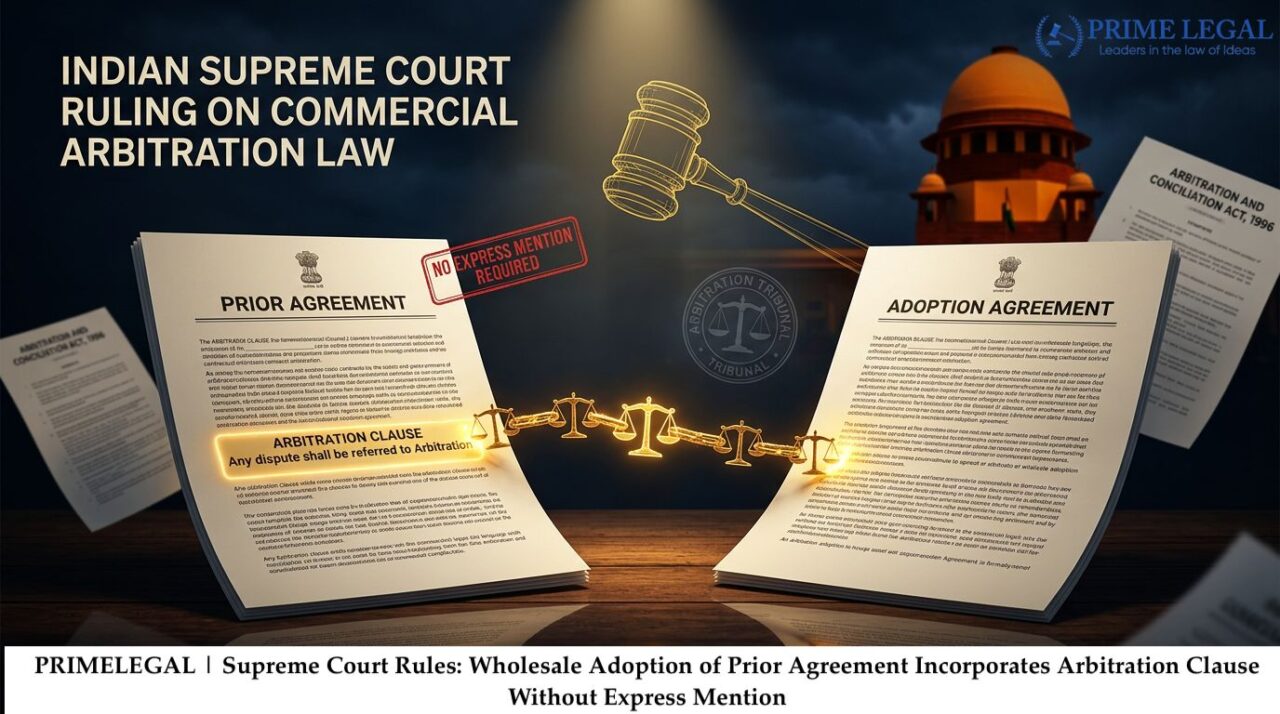
The Supreme Court relied on M.R. Engineers and Contractors Pvt. Ltd. v. Som Datt Builders Ltd. and stated that the arbitration clause gets incorporated if the previous agreement states that all terms will be a part of the later agreement as well.
It was the Court’s observation that Clause 14 explicitly included the Development Agreement. They had a clear intention to include all clauses and bind the parties to them.
JUDGEMENT
The Supreme Court set aside Bombay High Court’s ruling and held that a legally valid arbitration agreement existed between the parties through incorporation by reference. An arbitrator was appointed to resolve the dispute.
CONCLUSION
This judgement reiterated the importance of incorporation by reference under Section 7(5) of the Arbitration and Conciliation Act. It clarified that an arbitration clause from an earlier agreement can become binding in a later agreement if the contract explicitly provides for the inclusion of all terms and conditions.
“PRIME LEGAL is a National Award-winning law firm with over two decades of experience across diverse legal sectors. We are dedicated to setting the standard for legal excellence in civil, criminal, and family law.”
WRITTEN BY: SAMANA
Read the judgement copy below:
Hirani Developers Versus Nehru Nagar Samruddhi CHS Ltd. & Others

