
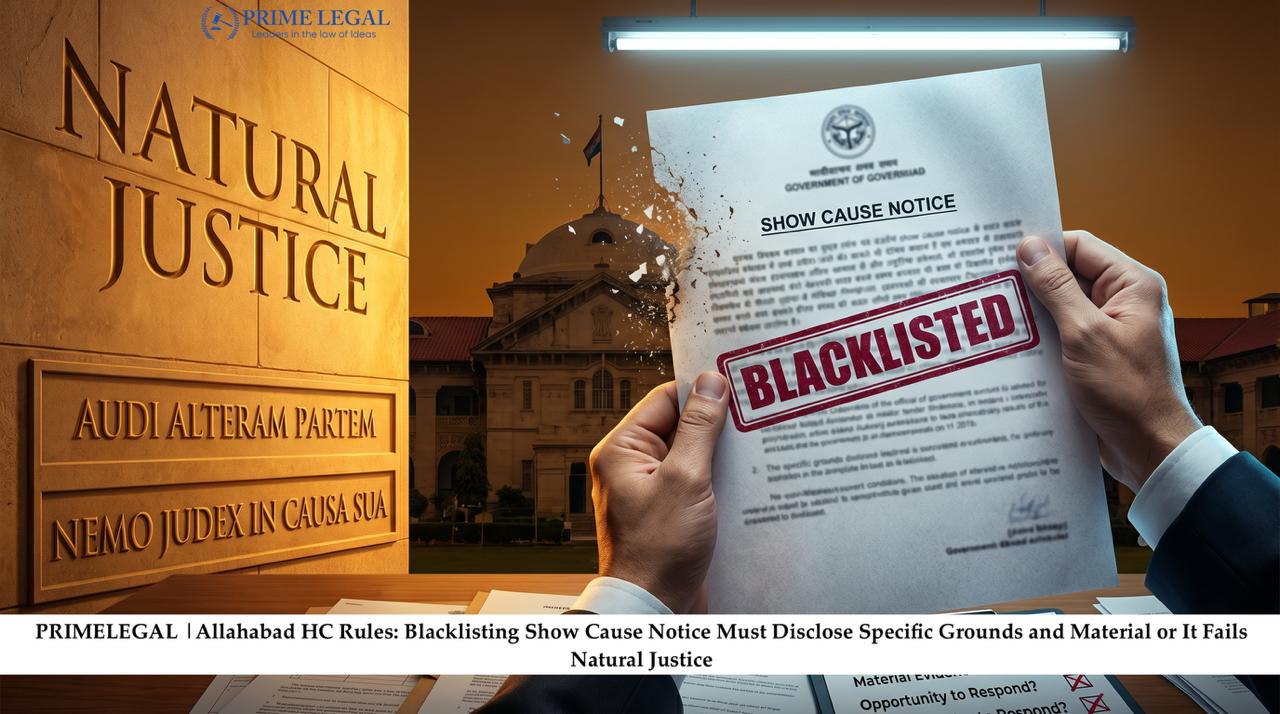
CASE NAME: M/s. Adeeba Naaz Contractor Thru. Proprietor Iftikhar Danish v. State of U.P. Thru. Prin. Secy. Deptt. of Minority Welfare & Waqf Lko, & Others
CASE NUMBER: Writ C No. 1258 of 2026
COURT: High Court of Judicature at Allahabad
DATE: 13 April 2026
QUORUM: Justice Shekhar B. Saraf and Justice Abdhesh Kumar Chaudhary
FACTS
The petitioner, M/s. Adeeba Naaz Contractor, through its proprietor Iftikhar Danish, was awarded a contract pursuant to Tender Notice No. 4715 for the construction of a Government Girls Degree College at Najibabad, District Bijnor. The contract was awarded by the U.P. Waqf Vikas Nigam Limited under the Department of Minority Welfare and Waqf, Government of Uttar Pradesh.
The petitioner contended that show cause notices dated 19.02.2024, 20.08.2024, and 21.12.2024 were never actually served upon it. The respondent-authorities, however, maintained that several notices were issued but were refused by the petitioner. By an order dated 08.01.2025, the Executive Engineer, U.P. Waqf Vikas Nigam Limited, simultaneously terminated the petitioner’s contract and blacklisted it for an indefinite period. The petitioner came to know of this order only through a letter dated 02.01.2026, approximately one year after its passing. Additionally, the respondents had not made payments for work already completed by the petitioner.
ISSUES
1. Whether the termination of contract by the respondents was valid in the absence of a properly served notice to the petitioner.
2. Whether blacklisting for an indefinite period is permissible under law.
3. Whether the impugned order dated 08.01.2025 was passed in compliance with the principles of natural justice.
LEGAL PROVISIONS
1. Article 226 of the Constitution of India.
2. Principles of Natural Justice.
3. Kulja Industries Ltd. v. Chief General Manager, Western Telecom Project, BSNL & Others: (2014) 14 SCC 731.
4. Ragunath Thakur v. State of Bihar and Others: (1989) 1 SCC 229.
5. Gorkha Security Services v. Govt. of NCT of Delhi & Others: (2014) 9 SCC 105.
6. UMC Technology Pvt. Ltd. v. Food Corporation of India: AIR 2021 SC 166.
ARGUMENTS
Petitioner:
Petitioner’s lawyer states that “The contracting party never received any notice of termination and blacklisting”; Therefore there are grounds to believe the order implicating them was not carried out in accordance with established principles of natural justice; Furthermore they have outstanding invoices for work already completed but were not compensated so the blacklisting of this company indefinitely is unreasonable and cannot be executed legally.
Respondents:
The learned Standing Counsel for the State opposed the request of lack of notices received by the petitioner stating there were multiple notices that had been sent out for their show-cause. As such, the member’s action of blacklisting was justified due to non-performance and breach of contractual obligations.
ANALYSIS
The order being challenged was reviewed by the Court, which found that the order did not indicate whether the petitioner had actually been served with a notice prior to its issuance. The lack of this notice was significant because the order both terminated the contract and blacklisted the petitioner indefinitely without any indication that due process had been followed.
With respect to the indefinite blacklisting issue, the Court referenced the Supreme Court’s judgment in Kulja Industries Ltd. v. BSNL, which found that debarment cannot last indefinitely and that the length of debarment must correspond with the severity of the offense committed. The Court also referred to a decision by another panel of judges in M/s Hi Tech Pipe Limited v. State of U.P. (Writ – C No. 11037 of 2024), wherein Justice Saraf had previously found that an indefinite debarment is impermissible.
In respect to the need of prior notice the Court relied upon the ruling of the Supreme Court of India in Ragunath Thakur v. State of Bihar which found that an order with civil consequences must be preceded with a notice and hearing, even if it is not a statutory requirement, as this is a judicial principle related to the rule of law and has been expressed as such. The Court also relied upon Gorkha Security Services v. Government of NCT of Delhi to determine that if the proposed penalty is a blacklisting, the show cause notice must specifically state that a penalty of that type is being proposed, or at least it must be worded in a manner that would allow the notice being issued to reasonably conclude that the proposed penalty will be a blacklisting.
In UMC Technology Pvt. Ltd. v. Food Corporation of India, the Supreme Court quashed a blacklisting order not due to the fact that no show cause notice was issued, but because the notice provided to UMC did not give any indication as to what action will be taken against UMC (i.e., whether UMC would be blacklisted). Therefore, the Court takes the view that total transparency and specificity at the time of the issuance of the show cause notice is very important and that this is not merely a procedural requirement.
The Court ruled that the petitioner could pursue arbitration remedies pursuant to the arbitration clause found in the tender documents and declined to intervene in relation to the non-payment of dues and termination of contract.
JUDGMENT
The Allahabad High Court granted limited relief on the petition. The impugned order dated 08-01-2020 regarding blacklisting the petitioner for an indefinite period was found to have been arbitrarily made and contrary to the principles of natural justice; therefore, it was quashed/quashed and set aside. Besides, the Court held that the petitioner can pursue those remedies available to it under its contract with respect to termination of contract and recovery of any debt it may have against the contract.
CONCLUSION
The Allahabad High Court granted limited relief on the petition. The impugned order dated 08-01-2020 regarding blacklisting the petitioner for an indefinite period was found to have been arbitrarily made and contrary to the principles of natural justice; therefore, it was quashed/quashed and set aside. Besides, the Court held that the petitioner can pursue those remedies available to it under its contract with respect to termination of contract and recovery of any debt it may have against the contract.
“PRIME LEGAL is a National Award-winning law firm with over two decades of experience across diverse legal sectors. We are dedicated to setting the standard for legal excellence in civil, criminal, and family law.”
WRITTEN BY: KISLAY RAJ
Read the judgement copy here:

