
INTRODUCTION
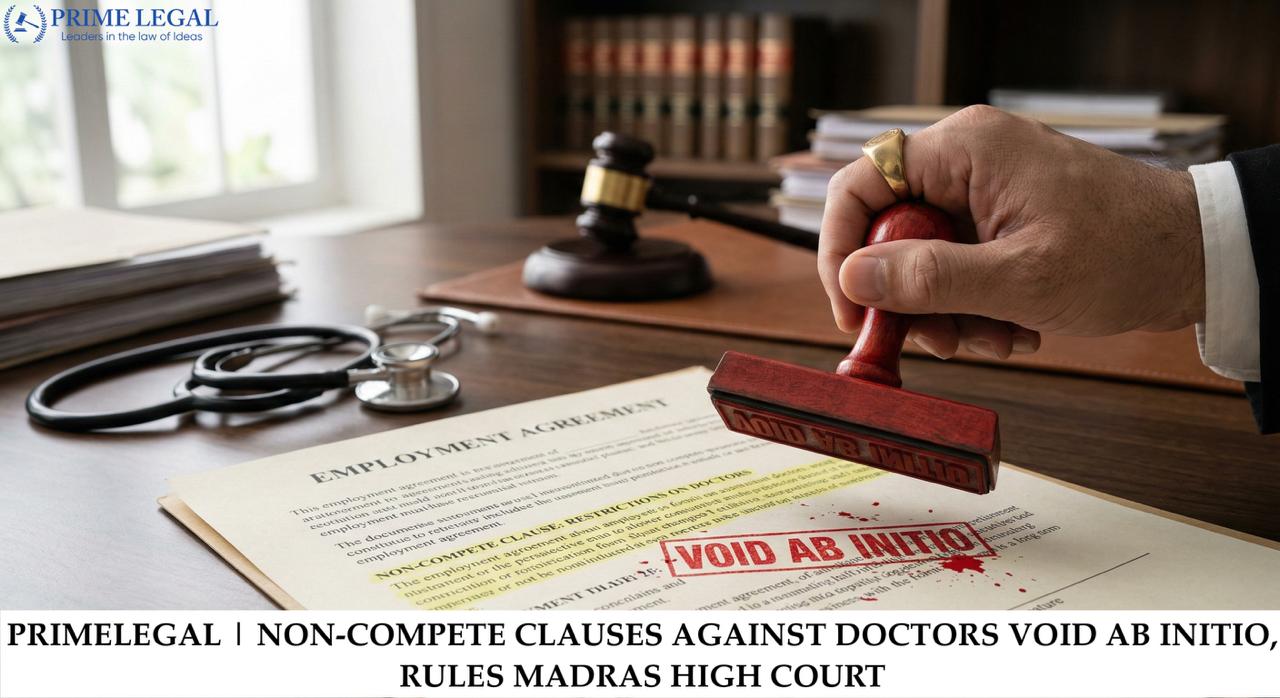
There are rulings that settle disputes. Then there are rulings that settle principles. The Madras High Court’s decision on non-compete clauses in medical employment contracts belongs firmly to the second category. The Court held that such clauses are void ab initio legally non-existent from the moment they are written. Not merely difficult to enforce. Not subject to judicial modification. Gone, as a matter of law, before any court ever examines them. That conclusion will unsettle a great many hospital administrators. For years, non-compete clauses have been treated as standard fixtures in medical employment agreements inserted routinely, rarely negotiated, and widely assumed to carry deterrent weight even when their enforceability was theoretically uncertain. That assumption is now dead.
BACKGROUND
The dispute that produced this ruling is, on its surface, unremarkable. A specialist physician employed at a private multi-specialty hospital in Tamil Nadu resigned his position. The hospital went to court seeking an injunction and damages, anchoring its entire case on a single contractual clause.
The doctor’s defence rested on two arguments. The first was statutory Section 27 of the Indian Contract Act, 1872 renders agreements in restraint of trade void by operation of law, regardless of what parties privately agreed. The second was broader. The doctor urged the Court to recognise that a non-compete imposed on a doctor is not an ordinary commercial restraint between two equal contracting parties. It radiates consequences outward to patients, to communities, to a public health infrastructure that depends on the free movement of qualified practitioners. The Court accepted both arguments entirely. The doctor’s challenge succeeded in full.
KEY POINTS
- The Court’s starting point was Section 27 of the Indian Contract Act. Post-employment noncompete clauses are agreements in restraint of trade. Section 27 renders such agreements void. That much, standing alone, would have decided the case. But the Court went further, characterising the voidness as void ab initio meaning these clauses are treated in law as having never existed at all. They cannot be partially enforced, read down to a narrower scope, or rescued through severance. They are, from inception, a legal nullity. The hospital had no fallback because the law left it none.
- The more striking dimension of the judgment is constitutional. The Court reached into Article 21 of the Constitution which the Supreme Court has long expanded to encompass the right to health and used it as a direct lens for evaluating the clause’s validity. A registered medical practitioner is not merely a private contracting party. He/She holds a statutory registration carrying professional obligations owed to the public, obligations that travel with her registration rather than doctors contract. A clause preventing a doctor from practicing does not merely harm him, it harms every patient who would otherwise have sought his care. Where the constitutional right to health is engaged, a private commercial arrangement cannot simply override it.
- The hospital’s investment argument was heard and rejected. Institutions advancing noncompete clauses invariably argue they have spent money on training, equipment, and building a patient base. The Court’s answer was unambiguous institutional expenditure creates no proprietary interest in a professional’s future career. A doctor’s right to practice derives from his education, training, and statutory registration, none of which the employer owns. Treating employment costs as purchasing a claim over a doctor’s professional future edges, the Court observed, uncomfortably close to professional servitude. No court will sanction that.
- The Indian Medical Council (Professional Conduct, Etiquette and Ethics) Regulations, 2002 provided an independent additional basis. These Regulations impose statutory obligations on every registered practitioner to render medical services and prioritise patient welfare. A contractual clause compelling a doctor to withhold services from patients who need them directly conflicts with those regulatory obligations. Between a private contract and a statutory framework, the contract yields without exception
RECENT DEVELOPMENTS
The Indian Medical Association responded promptly, issuing a formal statement welcoming the ruling and urging hospital managements nationwide to audit existing employment contracts and remove provisions incompatible with the judgment. The corporate hospital sector has reacted with considerably more caution. Several large hospital groups are understood to be seeking legal advice on whether the Court’s reasoning can be distinguished particularly in cases involving doctors with access to proprietary clinical research or genuinely confidential institutional protocols. That question remains open and will almost certainly be tested in future litigation.
What the Madras High Court has done is give the constitutional right to health an active role in the analysis, elevating the inquiry from a purely statutory question to a constitutional one. That is a meaningful doctrinal step. It makes it considerably harder for future courts to reach a different conclusion without directly engaging with Article 21.
CONCLUSION
Void ab initio is not a soft outcome. It leaves no room for negotiation, partial enforcement, or drafting creativity on the next contract. These clauses, in the medical context, are finished and finished completely. Hospitals are on clear notice. The question is no longer whether noncompete clauses against doctors are enforceable. That question has been answered. What remains are narrower questions about how courts will treat carefully drafted confidentiality obligations, what remedies survive for genuine professional misconduct, and how far this judgment’s constitutional reasoning will travel into other professions. Those are important questions. But they should not obscure the ruling’s central contribution. Medicine is not an ordinary commercial enterprise. A judicial system that takes the right to health seriously cannot permit private contractual arrangements to place institutional profit above a person’s access to qualified medical care. The Madras High Court has said so, clearly and on record and that matters well beyond this case.
“PRIME LEGAL is a National Award-winning law firm with over two decades of experience across diverse legal sectors. We are dedicated to setting the standard for legal excellence in civil, criminal, and family law.”
WRITTEN BY: ABHIJIT BOGAR

