
INTRODUCTION
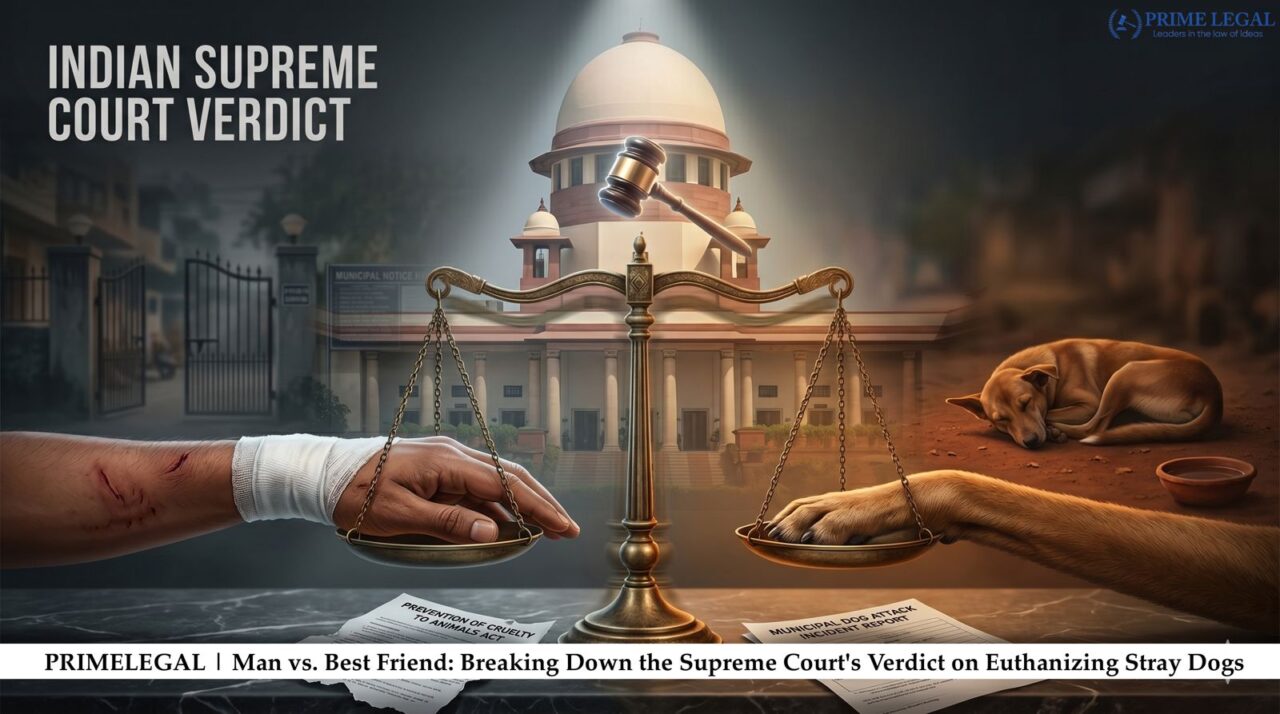
The Supreme Court has stepped into the heated “Man vs. Stray Dog” conflict to set clear rules for local authorities. The Court this issue to Article 21 of the Indian Constitution (The Right to Life and Personal Liberty). It highlighted that citizens have a fundamental right to walk through public roads and use public spaces without any fear of being attacked by the dogs. While the Court agreed that animals should be treated humanely, it made it further that the government cannot sit back and do nothing while people are getting hurt.
BACKGROUND
This legal battle began in July 2025. The Supreme Court took up the case on its own after a tragic incident in New Delhi, where a six-year-old girl died from a stray dog bite and suspected rabies. Initially, the Court passed temporary orders telling local municipalities to round up stray dogs and stop releasing them back into crowded public areas like schools and hospitals.
This led to a disagreement. Animal rights activists argued that removing dogs permanently from their areas violates the government’s Animal Birth Control (ABC) Rules, 2023, these rules state that stray dogs must be returned to the same spot from where they were picked after being sterilized. On the other hand, neighbourhood groups argued that these rules were failing, leading to a 70% jump in dog bite cases in India.
KEY POINTS
- The Court stated that caring for animals is important and moral, it cannot be more crucial than protecting human lives. Public spaces should not become dangerous zones where people have to fight with animals to survive.
- The Court rejected the idea of making the dogs returned to their older spots from where they were picked. It banned authorities from releasing dogs back into high-density population areas like schools, hospitals, colleges, train stations, sports complexes, even if the dogs have been vaccinated.
- The judgement clarified that putting a dog under euthanasia is legal under Indian law, but only as a last option. It is only strictly limited to dogs that have rabies, are suffering from an incurable disease, or are proven highly aggressive and dangerous.
- In a move to increase responsibility, the Court further ruled that anyone who feeds or takes care of stray dogs inside a restricted area\ a public premises must sign an official document for doing so. By doing so, they accept any legal and financial liability arising out of the dog bites of such dogs.
RECENT DEVELOPMENT
In Re: City Hounded by Strays, Kids Pay Price (2026) 1 SCC 774, a Bench comprising Justices Vikram Nath, Sandeep Mehta, and N.V. Anjaria dismissed all appeals from animal rights groups trying to block these restrictions.
To make sure things actually change on the ground, the Court ordered all States and Union Territories to set up at least one fully operational Animal Birth Control Centre in every single district. The top government officials (Chief Secretaries) of all states must submit proof to their local High Courts by August 7, 2026, showing that they are setting up these centers. The Court warned that lazy or careless municipal officials will face strict punishment for ignoring these orders.
CONCLUSION
The Supreme Court’s verdict brings a practical solution to a highly emotional problem. By allowing conditional euthanasia and keeping stray dogs away from schools and hospitals, the Court has focused heavily on protecting vulnerable citizens, especially children and the elderly. However, the judgment also highlights that putting dogs under such conditions is not a permanent solution. The long-term fix still depends heavily on the government running honest, scientific, and humane sterilization and vaccination drives across the country.
“PRIME LEGAL is a National Award-winning law firm with over two decades of experience across diverse legal sectors. We are dedicated to setting the standard for legal excellence in civil, criminal, and family law.”
WRITTEN BY: LISHIKA BATRA

