
INTRODUCTION
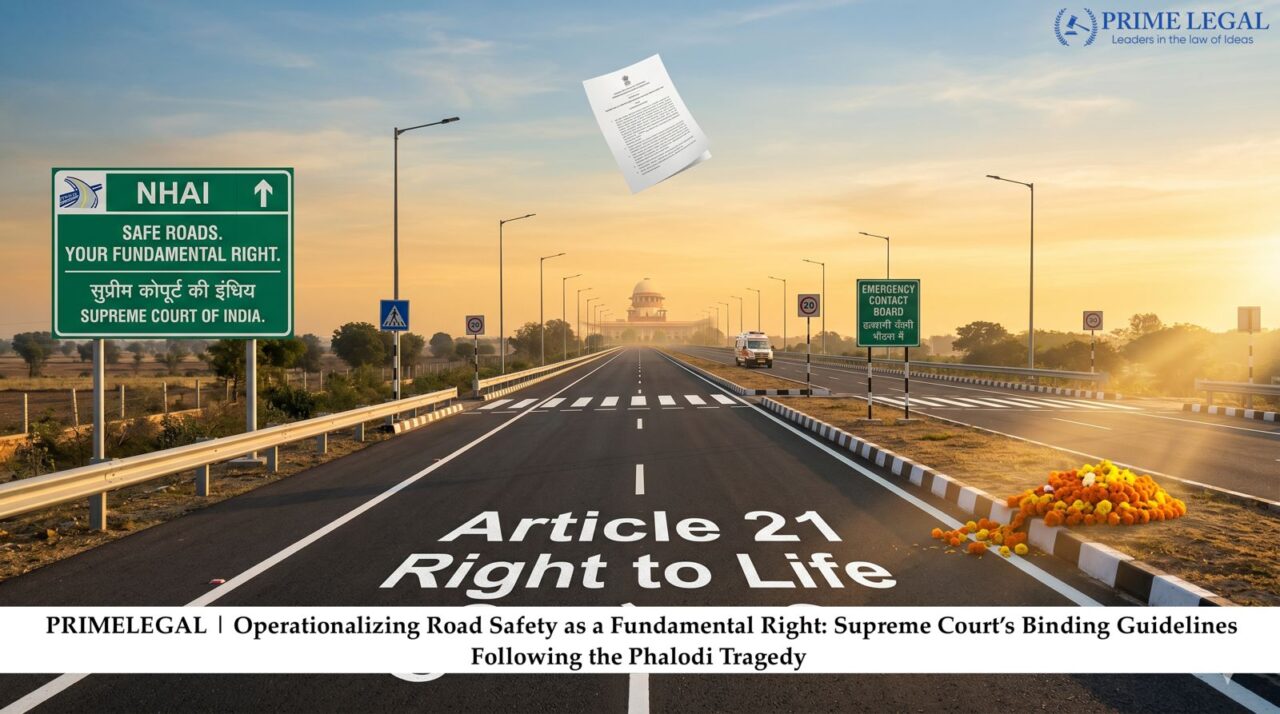
The Supreme Court has for the first time explicitly recognized the right to safe road travel on National Highways as an integral part of the fundamental right to life under Article 21 of the Constitution, and then moved beyond rhetoric by issuing a detailed set of time bound, pan‑India directions to make that right real on the ground. Acting in the Suo Motu matter In Re: Phalodi Accident, a Bench of Justices J.K. Maheshwari and A.S. Chandurkar framed commuter safety as a “positive mandate” on the State, warning that highways cannot be allowed to become “corridors of peril” because of illegal parking, encroachments and chronic administrative neglect. The ruling attempts to convert recurring outrage over gruesome crashes into a concrete compliance roadmap binding on governments, highway agencies and police forces across the country.
BACKGROUND
The case grew out of two back‑to‑back accidents in November 2025. On November 2, a bus carrying pilgrims on the Bharatmala Expressway near Mathoda in Rajasthan’s Phalodi district rammed into a stationary trailer that had been illegally parked close to an unauthorized roadside dhaba, killing 15 people. The very next day, another collision on the Mirjalguda–Khanapur road near Chevella in Telangana took 19 more lives, including that of a 40 day old infant, on a poorly lit stretch without proper dividers, signage or basic safety infrastructure. Disturbed by the pattern, the Court Suo Motu cognizance, called for reports from the National Highways Authority of India (NHAI), the Ministry of Road Transport and Highways (MoRTH) and State authorities, and asked an amicus curiae to assist with systemic suggestions.
KEY POINTS
-
The Court held that the “right to safe passage on roads” is an integral part of the right to life, imposing a positive duty on the State to provide and maintain safe highway conditions, and that financial or administrative constraints cannot justify non‑compliance.
-
It issued a nationwide prohibition on parking or stopping heavy and commercial vehicles on National Highway carriageways or paved shoulders, limiting such halts to designated bays, lay‑bys and wayside amenities, with enforcement through technology driven systems and e‑challans.
-
All unauthorised dhabas, eateries and commercial structures within the highway right of way are to be identified and removed within fixed timelines, and no new licenses or trade approvals may be granted in highway safety zones without prior clearance from NHAI or the relevant highway authority.
-
Every district through which a National Highway passes must constitute a District Highway Safety Task Force headed by the District Magistrate, with police, NHAI/NHIDCL, PWD and local‑body officers jointly responsible for encroachment removal, periodic inspections and coordinated enforcement.
-
Authorities have been directed to identify and publicly notify accident “blackspots” within weeks, and to promptly install lighting, signage, speed calming measures and surveillance equipment on such stretches.
-
NHAI and other agencies must deploy basic life support ambulances and recovery cranes at intervals not exceeding around 75 KM on National Highways, with toll‑free helplines and digital grievance platforms for reporting hazards.
-
MoRTH has been tasked with setting up an inter‑State Highway Safety Coordination Committee to harmonize enforcement standards covering driving‑hour limits, parking rules, surveillance norms and penalties across State borders.
RECENT DEVELOPMENTS
The April 13, 2026 order in In Re: Phalodi Accident directs NHAI, NHIDCL, State PWDs and other implementing agencies to file consolidated, district wise compliance reports within 75 days, making clear that they will be “jointly and severally” responsible for lapses in their jurisdictions. Copies of the judgment have been sent to Chief Secretaries, Directors General of Police, State Legal Services Authorities and highway agencies nationwide, signaling that the directions are meant to operate as hard obligations rather than soft policy advice. This decision is constitutionalizing road safety, wherein future victims of highway negligence may now frame claims as violations of a fundamental right, potentially opening the door to higher public‑law compensation and stricter scrutiny of official inaction. Civil‑society groups working on road safety have welcomed the clarity of the timelines but have also underlined that the true test will lie in day‑to‑day enforcement by over‑stretched local police, transport and revenue officials.
CONCLUSION
The Court concluded these were not “mere accidents” but symptoms of a deeper failure of the State’s protective obligation under Article 21 and of statutory duties under the National Highways Act and the Control of National Highways (Land and Traffic) Act, 2002. By tying commuter safety directly to Article 21 and backing that principle with a dense matrix of operational directions, the Supreme Court has tried to shift road safety out of the realm of periodic outrage and into that of enforceable constitutional obligation. Whether highways remain “corridors of peril” or become safer arteries of movement will now depend on how seriously governments treat these guidelines not as one more judgment to be filed away, but as a binding blueprint for how India builds, polices and repairs its roads.
“PRIME LEGAL is a National Award-winning law firm with over two decades of experience across diverse legal sectors. We are dedicated to setting the standard for legal excellence in civil, criminal, and family law.”
WRITTEN BY: ABIA MOHAMMED KABEER

