
ABSTRACT
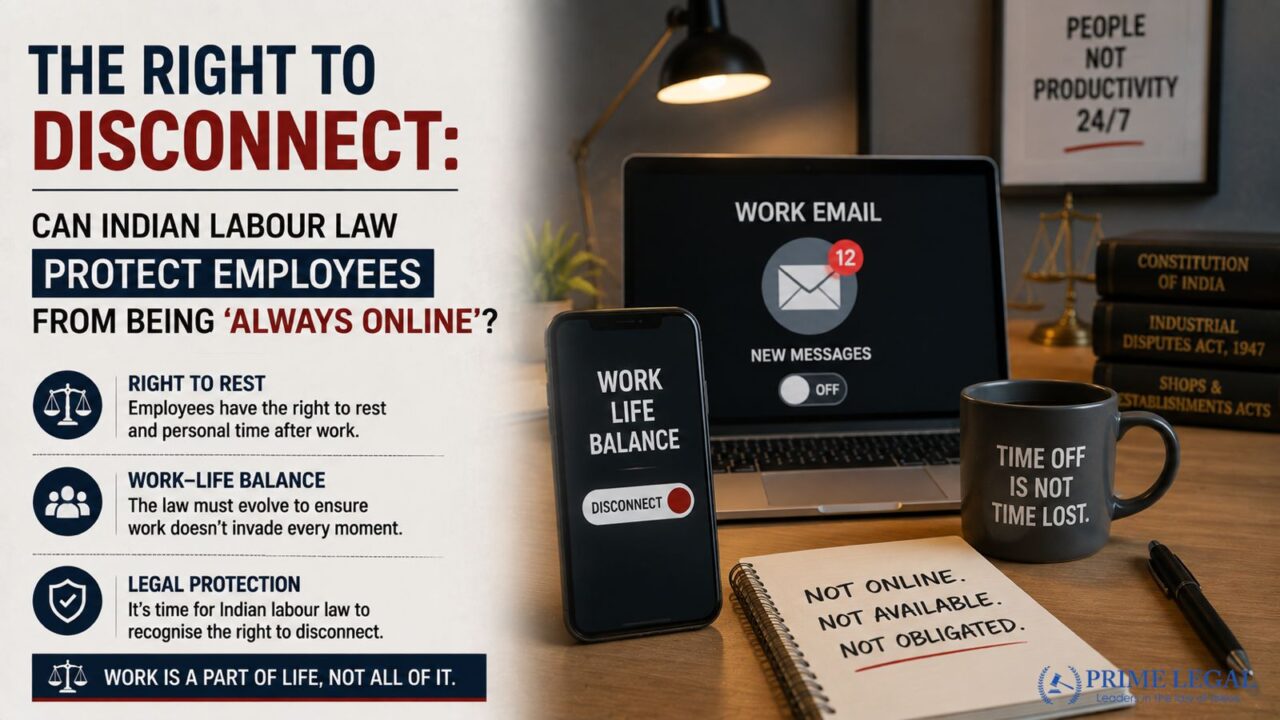
In India, the boundary between professional and personal lives has almost faded away for the white-collar workers due to the existence of smartphones, instant messaging services, and technology supporting work from home facilities. This paper discusses the feasibility of an “enforceable right to disconnect” in India, which can be seen from the loophole present in the four labour laws, the constitutional reasoning based on Article 21, and ongoing legislative efforts – the crucial bill presented in the Lok Sabha and that of the State of Kerala.
KEYWORDS: Right to Disconnect, Labour Codes, Article 21, Occupational Health, Digital Burnout, Kerala Right to Disconnect Bill
INTRODUCTION
The employee who ceases responding to office communication after 8 p.m. today stands to be perceived as a non-cooperative person rather than a person asserting his/her right, which currently is not legally recognized in the country of India. According to International Labor Organization figures, India has an average weekly working hour figure of 46.7, where over 51 percent of employees work for over 49 hours a week, which is much higher compared to the global average figure. Even higher estimates exist: India has a record high average weekly work time globally in 2024, which is 56.2 hours a week, and constant after-office communication creates “telepressure,” a psychological pressure to instantly respond to work-related messages. When the issue gained a human face, a 26-year-old Ernst & Young employee in Pune died after four months of employment, where the cause of her death was linked by her mother to unbearable levels of workplace stress. The fact of this death, together with the merging of the workplace and home during the pandemic period, has increased the demand for legislation to resolve the issue. Instead of questioning whether the workers deserve their right to rest, this paper focuses on whether this right is achievable within the Indian labour laws.
THE GAP IN THE FOUR LABOUR CODES
The major labour legislation reform of India post-Independence – namely, the Wages Code 2019, the Industrial Relations Code 2020, the Social Security Code 2020, and the Occupational Safety, Health and Working Conditions Code 2020 – amalgamated almost thirty central legislations. Out of these, the OSH Code is most pertinent to working time legislation, wherein an eight-hour working day and 48-hour working week have been set out as the norm, besides double pay for overtime work and periods of rest. However, the entire system has been formulated keeping in mind a form of employment which requires presence of the worker at a fixed place of work. None of the four codes deals with out-of-work communication or the broader issue of digital availability outside a designated shift. While Indian labour laws have provisions for regulating hours, shifts, and overtime, they do not make any mention of “connection time,” which is the duration of the availability of an individual, digitally, irrespective of whether he or she is officially on duty. For a lawyer to give advice to a client in respect of legal violation in relation to such after-hour harassment through work communication, it will not be possible to argue in any constructive way as it will merely be an indirect violation.
THE CONSTITUTIONAL ARGUMENT
In the absence of a specific provision, activists have invoked Article 21. Though the right to disconnect has not been judicially recognized in India yet, its normative roots lie in constitutional law on decent working conditions and dignified labour, as the Supreme Court has often reiterated that “right to live with dignity guaranteed under Art. 21 includes right to health,” and in Consumer Education and Research Centre v. Union of India, the Supreme Court has said that decent working conditions and occupational health are part of the right to life. It is a sound doctrine, but a fragile one, in that constitutional arguments of dignity work well in public interest litigation cases involving the state, but much less as an individual claim by an employee against his/her employer.
LEGISLATIVE ATTEMPTS: PARLIAMENT AND KERALA
Two concrete legislative efforts exist, neither yet in force. On 5 December 2025, NCP MP Supriya Sule introduced the Right to Disconnect Bill, 2025 in the Lok Sabha as a private member’s bill, giving employees a legal right to ignore work-related calls, emails, and messages outside official hours and barring employers from disciplining those who exercise it — it has not been taken up for discussion and is not yet law. A related, apparently updated version circulating in 2026 would bar adverse consequences such as disciplinary action, poor appraisals, or denial of career opportunities for employees who decline to respond after hours, and would statutorily require employers to frame a disconnect policy in consultation with unions or employee representatives – though as a private member’s bill, it is rarely enacted.
Kerala has moved further, at least on paper. The state introduced its own Right to Disconnect Bill, 2025, conferring on private-sector employees a statutory entitlement to disengage from work communications beyond prescribed hours and expressly invoking Article 24 of the Universal Declaration of Human Rights on the right to rest and leisure, with protection against disciplinary action such as dismissal, demotion, or withholding of benefits for exercising that right. It is considered to be the first state-level legislative attempt at something like this in India, and the passage of this Bill could be an inspiration for other states, or it could form a model policy for the country in the private sector, although this private members’ bill will only be enforceable in the case of political agreement and government approval, with sectors such as health care, emergency services, and security services requiring operational exemptions. In the comments on the Bill, another point has been made about this Bill’s inconsistency that should be noted by drafters of this Bill, and that is one of the provisions making overtime compensation conditional upon “normal wage rate” which contradicts the labour laws that require double of the normal rate for overtime.
PRACTICAL AND SECTORAL LIMITS
An operational right to disconnect must necessarily account for the realities of sectors. Some industries, including health care, IT support services, and emergencies services, may be carved out of the ambit of the provision due to the inherent nature of their industries; and neither the central, nor the Kerala Bill, currently does so. There is also a gender aspect that must be taken into consideration more than what it usually is when drafting such legislation: employees working for multinational companies across time zones face lack of sleep and imbalance in work-life, which is compounded for women, as they must bear their domestic duties; hence, an operational right to disconnect without any structural support would end up worsening gender disparity at the workplace. Such a statute, which gives the right on the paper, but fails to address compensation provisions, remote-working issues across time zones, and enforcement methods will end up being only a signalling mechanism rather than an effective right.
CONCLUSION
The Indian legal system has the vocabulary necessary for a right to disconnect, and more than just that – live text in legislation at both central and state levels for the very first time. What it does not yet have is the enabling law, enforcement procedure, and the amendment to the OSH Code that would make it possible to incorporate “connection time” into the existing system of working time and overtime regulation. Without any of these Bills being taken up, enacted and armed with employer-friendly penalties, the right to disconnect in India will continue to be a normative claim based on Article 21 jurisprudence of dignity – compelling in argumentation, but lacking a cause of action for employees who are being called on the phone by a boss at 11 p.m. Employers, in the meantime, must not wait for new laws to be passed, but should already begin drafting disconnect policy, especially for cross-time-zone work.
“PRIME LEGAL is a National Award-winning law firm with over two decades of experience across diverse legal sectors. We are dedicated to setting the standard for legal excellence in civil, criminal, and family law.”
WRITTEN BY: DRISHTITA BANIK

