
INTRODUCTION
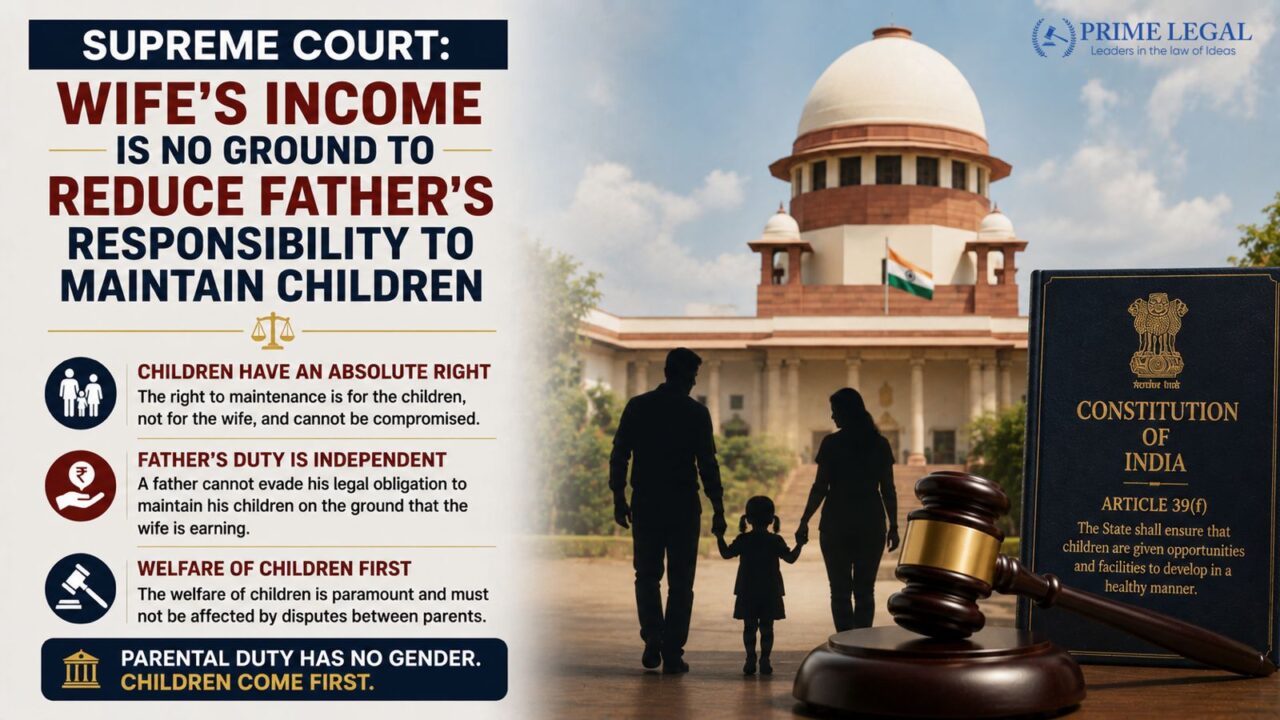
On August 20, 2026, the Supreme Court in Sujata Kumari and Others v. Rahul Kumar and Another, 2026 INSC 896, has set aside an order passed by Allahabad High Court which reduced the interim maintenance payment being made by father to his two minor daughters to 50 per cent of the maintenance pay, observing that merely because the income of the mother is taken into account while deciding the amount of maintenance, it would not be just to reduce the liability of the father to pay the maintenance to his children. A Bench of Justice Vikram Nath and Justice Sandeep Mehta restored the Family Court’s order granting interim maintenance of Rs 30,000 per month to each daughter, observing that the obligation to maintain children is shared by both parents but cannot be divided by arithmetic alone.
BACKGROUND
The appellant-wife and the respondent-husband, both qualified doctors, were married on 18 June 2006. Two daughters, now aged about nine and eight, were born during the marriage; a son born to the couple passed away shortly after birth. Following matrimonial discord, the wife left the matrimonial home with the children and filed a petition under Section 125 of the Code of Criminal Procedure, 1973, now Section 144 of the Bharatiya Nagarik Suraksha Sanhita, 2023. The Family Court refused to grant interim maintenance against the wife, noting that both parties were earning sufficient income, but granted Rs 30000/ month to each daughter as educational and upbringing expenses were being taken care of by the wife. Before the Allahabad High Court, in Criminal Revision No. 10 of 2025, the husband challenged this. The High Court, on 9 February 2026, while accepting the Rs 60,000 per month was enough for the two daughters, reduced the amount to Rs 15,000 per month each, stating that the responsibility for their upkeep was on both the parents and the wife was a gynecologist in practice and earned about Rs 1.5 lakh per month.
KEY POINTS
The wife and children appealed to the Supreme Court from a decision of the High Court, alleging that the Court had erred in halving the maintenance, and that Rs 60,000 per month was appropriate for the needs of the children, and the wife alone cannot be expected to bear a greater share of the burden because she was employed. The Supreme Court agreed, holding that the fact that the wife is earning is not, by itself, a reason to halve the father’s liability, and that the obligation to maintain children is shared by both parents, but “cannot be divided by arithmetic alone.” The Court noted that the daughters lived with the wife, who attended to their day-to-day needs and upbringing while also working, and observed that such care “cannot be measured in money,” describing it as a real and often greater contribution than a purely financial one. The Bench observed that even, if one does not consider the income of the wife at all, the reduction cannot be supported by the High Court having accepted the quantum of Rs 60,000 per month. The Supreme Court clarified that the main proceedings had yet to be determined by the Family Court and the interim orders challenged in the appeal should not affect the determination of the main proceedings.
RECENT DEVELOPMENTS
The Supreme Court, in restoring the Family Court’s order, ordered the husband to pay off any arrears in three months. The judgment brings the law of maintenance claims in line with previous rulings in Rajnesh v. Neha, (2021) 2 SCC 324, which held that a spouse’s employment does not reduce or extinguish the maintenance obligation, and to the law of child maintenance, where the court clarified that it is not possible to mechanically apportion liability based on the respective incomes of the parents. The judgment should have a practical impact on pending cases where fathers argue that they should take less responsibility for payments because of the working mother’s income and may confirm that the unpaid care responsibilities of each parent are also a consideration in determining how to allocate maintenance.
CONCLUSION
The ruling also makes clear that a working mother’s income is not a proportionate cut in a father’s obligation to support his children, and that the care and support of the child is a significant contribution to the child’s upbringing. The Supreme Court has reiterated that the best approach to determining maintenance for children is to do so in light of their actual needs and the capacity of the parents, and not to simply divide the maintenance between two earning parents.
“PRIME LEGAL is a National Award-winning law firm with over two decades of experience across diverse legal sectors. We are dedicated to setting the standard for legal excellence in civil, criminal, and family law.”
WRITTEN BY: GAURAV VIBHU RANJAN

