
INTRODUCTION
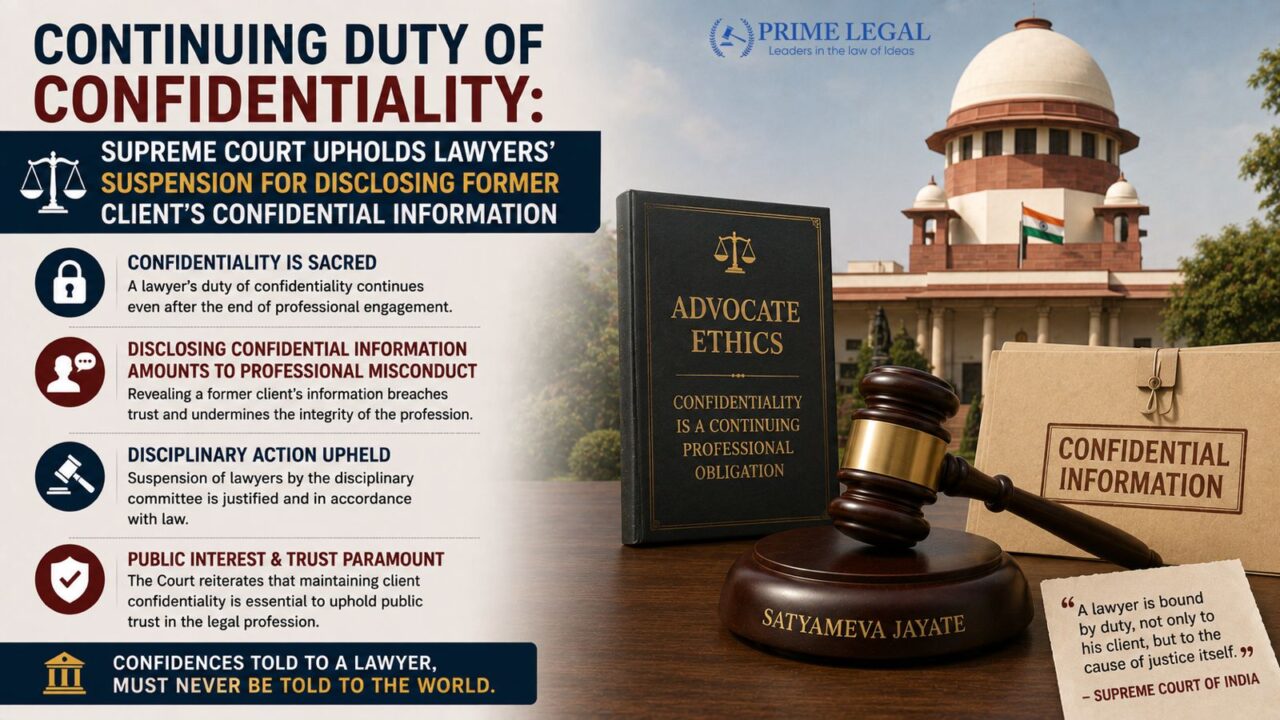
The Supreme Court has upheld the two-year suspension of an advocate’s licence to practice, holding that a lawyer’s duty of confidentiality toward a client survives not only the termination of the engagement but also the client’s subsequent hostility toward the lawyer. A bench of Justice Vikram Nath, Justice Sandeep Mehta and Justice Vijay Bishnoi, in a judgment authored by Justice Nath on 21 August 2026, dismissed cross-appeals filed by both the complainant, Rehana Khan, and her former advocate, Rizwan Siddiquee, against a Bar Council of India disciplinary order, while imposing costs on both sides for what the Court described as a controversy the litigants had “manufactured, prolonged and brought to the highest court.”
BACKGROUND
Khan had engaged Siddiquee as her counsel during 2013 and 2014, in connection with allegations that a senior police official had attempted to sexually assault her. A legal notice was sent to the official through Siddiquee’s office on 15 July 2014, the circumstances of its authorisation being disputed between the parties. On 24 July 2014, Khan lodged an FIR against the official under Sections 376(2), 376C, 354 and 354D of the Indian Penal Code, in which Siddiquee was also named as having acted under the official’s influence. On 5 August 2014, Siddiquee gave television interviews on Aaj Tak and Zee News in which he discussed his communications with Khan, played recorded conversations between them, and characterised her complaint as a “false case of rape.” Khan filed a complaint against him under Section 35 of the Advocates Act, 1961, which the Bar Council of India’s Disciplinary Committee decided on 11 August 2025, suspending his licence for two years, fining him ₹3 lakh payable to Khan, and directing a further ₹2 lakh to the Bar Council’s welfare fund.
KEY POINTS
- Both parties appealed the disciplinary order: Khan sought enhancement of the punishment to permanent disbarment along with ₹2 crore in compensation, while Siddiquee sought to have the finding of misconduct set aside entirely.
- The Court rejected Siddiquee’s argument that the disciplinary order was passed ex parte without proper notice, noting he had entered appearance, filed a written statement, was represented by counsel and participated in the recording of evidence throughout the proceedings, and calling the objection “an afterthought.”
- On the substance, the Court held that “an advocate’s duty is not conditional upon the client’s continued good behaviour towards the advocate,” and that a lawyer cannot use information received in confidence against a client merely because the client has since become an adversary.
- The Bench held that an advocate who considers himself falsely accused has available remedies, placing his version before the investigating agency or suing for defamation but disclosing privileged communications and recorded conversations to a television channel is not among them.
- On Khan’s plea for enhancement, the Court found she had not approached it with clean hands: the record showed she and Siddiquee had discussed ways to entrap the police official during the engagement, she had herself appeared before the media with her face covered on 28 July 2014, and the police official’s discharge by the trial court on 4 December 2015 had never been challenged by her.
- The Court expressed strong disapproval of the conduct of both litigants for suppression, embellishment and lack of candour throughout the proceedings.
RECENT DEVELOPMENTS
The Court dismissed all three connected matters – Khan’s Civil Appeal No. 12256 of 2025, and Siddiquee’s Transferred Case (Civil) No. 30 of 2026 and Civil Appeal No. 7959 of 2026 and upheld the Bar Council’s order in full. In view of the conduct of both parties, the Court additionally imposed costs of ₹5 lakh each on Khan and Siddiquee, to be deposited with the Supreme Court Legal Services Committee within four weeks.
CONCLUSION
The ruling reinforces that an advocate’s duty of confidentiality is not contingent on the continuation of the client relationship or on the client’s later conduct toward the lawyer, and narrows the range of responses available to a professional who believes a former client has wronged them, public rebuttal through the media is expressly excluded. At the same time, by penalising the complainant’s own lack of candour despite the misconduct finding standing in her favour, the Court signalled that relief before it depends on the litigant’s own conduct in equal measure, regardless of which side ultimately prevails on the merits.
“PRIME LEGAL is a National Award-winning law firm with over two decades of experience across diverse legal sectors. We are dedicated to setting the standard for legal excellence in civil, criminal, and family law.”
WRITTEN BY: DRISHTITA BANIK

