
INTRODUCTION
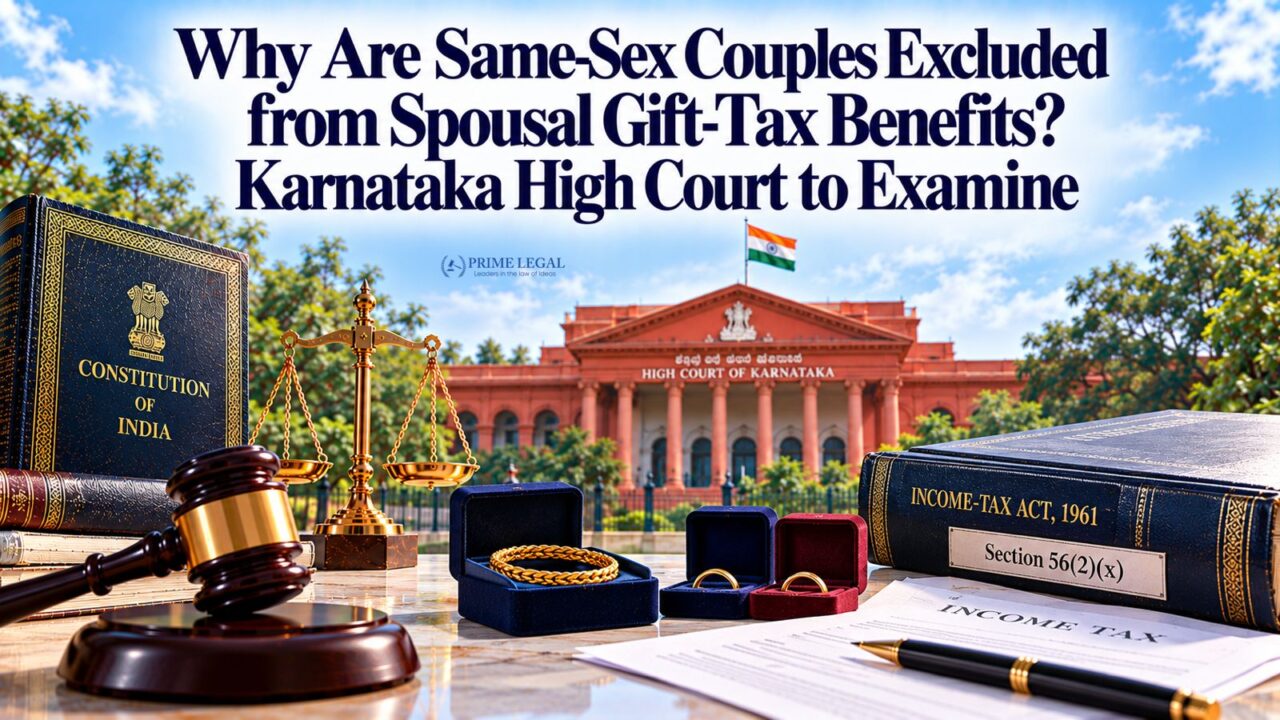
The Karnataka High Court is presently dealing with an important constitutional challenge to the Income Tax Act, 1961. The question before it is whether same-sex partners can be excluded from the tax relief available to husbands and wives. Justice B.M. Shyam Prasad is hearing the petition filed by Anurag Kalia, which argues that denying same-sex couples the gift-tax exemption given to heterosexual spouses amounts to discrimination based on sex and violates Article 15 of the Constitution. At its heart, the case asks whether a tax exemption built around the word “spouse” can be interpreted, or read down, to include same-sex partners who cannot legally marry under Indian law.
BACKGROUND
The dispute began when one partner in a same-sex relationship gifted a 22-karat gold family heirloom bracelet to the other to mark their relationship anniversary. Under the Fifth Proviso to Section 56(2)(x) of the Income Tax Act, money or valuable property received from certain “relatives,” including a “spouse,” is exempt from income tax.
However, because Indian law does not recognise same-sex marriages, tax authorities treat the partners as unrelated persons. The recipient was therefore required to disclose the bracelet as taxable income. If the very same gift had been exchanged between a married heterosexual couple, it would have been wholly exempt. The petitioners contend that this unequal treatment imposes an avoidable financial and administrative burden on same-sex partners only because of the sex of the person receiving the gift.
KEY POINTS
Constitutional equality, not marriage rights: Senior counsel Dr. Dhruv Janssen-Sanghavi made it clear that the petition is not asking for any special benefit, nor is it attempting to reopen the question of marriage equality decided in Supriyo v. Union of India [2023 INSC 920]. The argument is narrower and more direct: Article 15 prohibits discrimination on the ground of sex, and sex is the only real difference between the petitioners and a heterosexual married couple.
Presumption of marriage: The petitioners also pointed out that long-term cohabiting heterosexual couples often receive a legal presumption of marriage, even without formal paperwork. They argued that same-sex couples who show a clear intention to live together permanently should not be denied the same recognition for the limited purpose of tax benefits.
Statutory anomalies: Section 56(2)(x) uses a wide meaning of “relative,” covering a spouse’s siblings, parents, and lineal descendants. This is different from the narrower definition found in Section 2(41). The petitioners stressed that the tax framework was drafted in 2004, when Section 377 of the IPC was still in force, and argued that tax laws cannot be placed beyond constitutional scrutiny.
Response to tax-evasion concerns: Solicitor General Tushar Mehta argued for a strict reading of the statute and raised the possibility of misuse of tax exemptions. The petitioners replied that fraudulent heterosexual marriages could equally be used to evade tax. According to them, the mere possibility of abuse cannot justify taking away a fundamental right from an entire class of citizens.
Discrimination at the point of filing: The petitioners emphasised that the discrimination becomes real when an Income Tax Return is filed. At that stage, a person in a same-sex relationship must declare a gift from their partner as taxable income, while a heterosexual spouse receives the same gift tax-free.
ANALYSIS
This case brings into focus the practical and economic consequences that LGBTQ+ couples continue to face after the Supreme Court’s decision in Supriyo. Although Supriyo held that there is no fundamental right to marry, the present petition is concerned with the tangible financial burden created by a law that appears neutral on its face but operates unequally in practice.
The petitioners have asked the Court to “read down” Section 56(2)(x) so that it does not become constitutionally invalid, and to interpret it in harmony with Article 15. The Union of India, on the other hand, maintains that widening definitions in tax legislation is a matter for Parliament alone. The case therefore exposes the continuing conflict between a strict revenue-oriented reading of tax law and the substantive constitutional promise of equality.
CONCLUSION
Justice B.M. Shyam Prasad has reserved the matter for further hearing so that the respondents can place their complete counter-arguments before the Court. Whatever the final outcome, the ruling is likely to have consequences well beyond this particular couple. It will help decide whether economic benefits, taxation, and spousal rights can remain tied strictly to formal marital status when same-sex couples are legally prevented from marrying in the first place.
“PRIME LEGAL is a National Award-winning law firm with over two decades of experience across diverse legal sectors. We are dedicated to setting the standard for legal excellence in civil, criminal, and family law.”
WRITTEN BY: AASTHA KEDIA.

