
INTRODUCTION
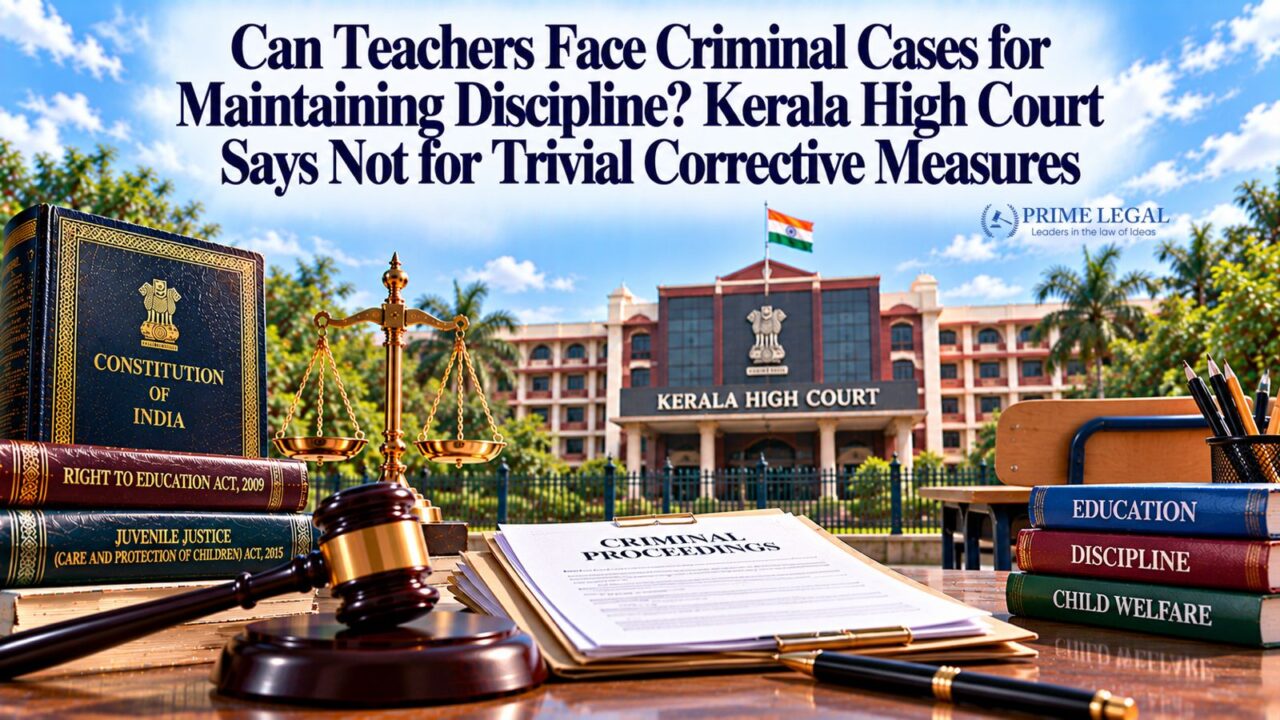
The Kerala High Court has ruled that teachers cannot face criminal prosecution for implementing minor, corrective actions to instill discipline in their class. In a vital ruling, the Court has underlined that while it is the primary responsibility of teachers to disciple students without causing any harm to them, they cannot be charged with any criminal offences under the relevant laws in case they act in a minor way without any malicious intent. The order gives much-needed protection to teachers using their distributive power to ensure discipline and order in educational institutions without fearing unnecessary penal action.
BACKGROUND
In this case, the controversy developed when a teacher was booked under the law for the offence defined under Section 82 of the Juvenile Justice (Care and Protection of Children) Act and Section 323 of the Indian Penal Code (IPC). The complaint stated that the teacher wrongfully held and pulled the hand of a student to force her to sit down because the child was running around the class. The crime was registered about one month after the incident, and proceedings were underway before the Additional Sessions Court in Pathanamthitta. In order to challenge these proceedings, the teacher filed a petition before the High Court of Kerala invoking the provisions of Section 528 of the Bharatiya Nagarik Suraksha Sanhita (BNSS), 2023. The petitioner took the defence that the action was taken as a minor corrective step to maintain discipline and did not intend to harass or injure the student.
KEY POINTS
- Justice Jobin Sebastian, in his capacity as the presiding officer of the Kerala High Court, has nullified the criminal proceedings initiated against the teacher under Section 528 of the BNSS.
- The court has ruled that teachers who administer only light punishments or take minor corrective actions cannot be prosecuted without any reason.
- The court has pointed out that exposing teachers to criminal trials for trivial disciplinary acts could disrupt the entire functioning of educational institutions.
- The bench stated that evidence gathered in the course of the investigation and testimonies of other students revealed no malice or criminal intent on the part of the accused.
- The medical record and the injury certificate revealed that the child in question sustained injuries of minor nature which corroborated the idea that the incident was trivial and ordinary.
- The Court firmly stated that the intentional infliction of corporal punishment with malicious intent constitutes a crime, being punishable by the child protection legislation in force.
ANALYSIS
The ruling establishes an important equilibrium between protecting the rights of a child and the realities of classroom work. The Kerala High Court has differentiated between typical disciplinary measures and criminal actions and therefore protected teachers from frivolous lawsuits. The use of Section 528 of the BNSS shows the willingness of the court to stop the misuse of the law when there are no elements of crime like mens rea. The ruling states that the role of a teacher implies correcting students’ behaviour. If teachers had to worry about facing criminal charges for even the smallest actions, the education system would collapse. The court also made sure to keep the impact of the Juvenile Justice Act by stating that real cases of abuse or malicious corporal punishment would not get this kind of leniency.
CONCLUSION
The verdict of the Kerala High Court reaffirms that the law does not intend to criminalise the routine duties of teachers. The Court’s quashing of the offence has ensured that teachers will be able to carry out their responsibilities properly.
“PRIME LEGAL is a National Award-winning law firm with over two decades of experience across diverse legal sectors. We are dedicated to setting the standard for legal excellence in civil, criminal, and family law.”
WRITTEN BY: SWETHA DUTTA

