
INTRODUCTION
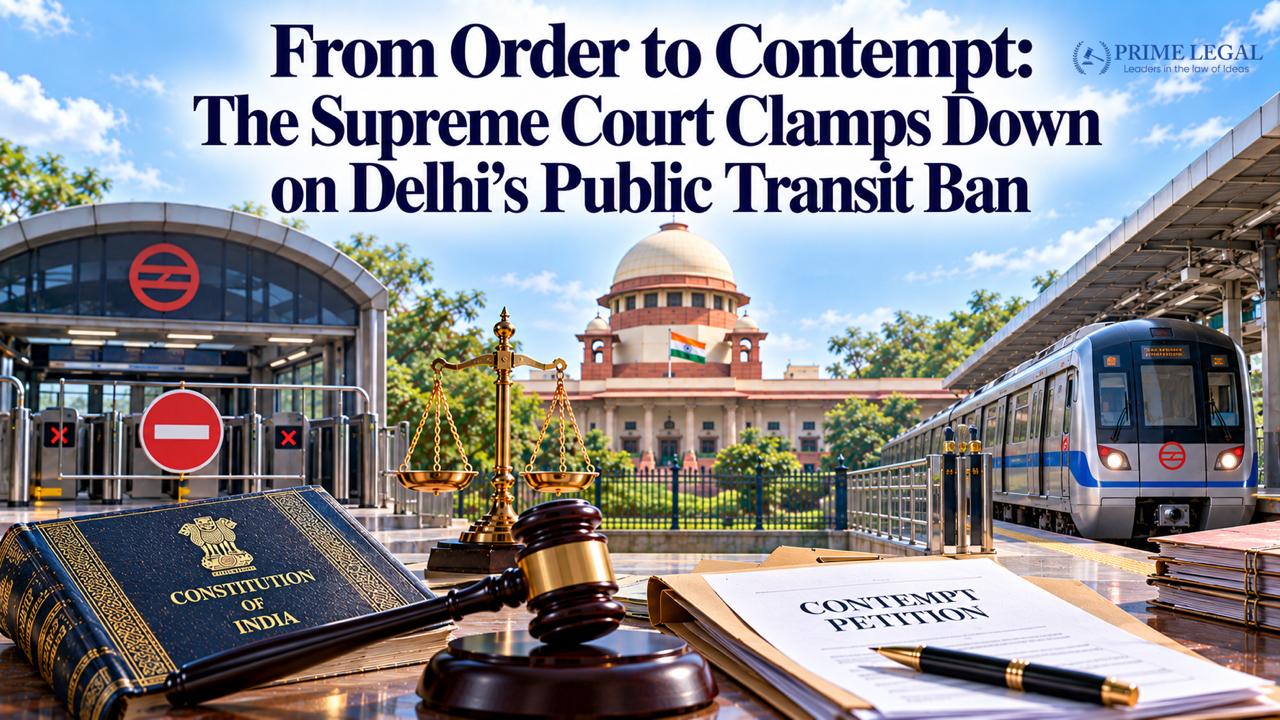
The Supreme Court of India, in M A Baby v. Union of India & Ors. (Writ Petition (Civil) Diary No. 63560/2026 held that notifications ordering the cessation of Metro and rail services in Delhi appear to be overreaching, as they impose a complete ban on essential public transportation. The Bench comprised the Chief Justice Surya Kant, Justice Joymalya Bagchi and Justice V. Mohana.
The Court drew a distinction between a total ‘prohibition’ and the ‘regulation’ of Metro and other train movements. The learned Solicitor General fairly agreed to impress upon the authorities to reassess the prohibitions and to permit these services in a regulated manner, adhering to the principles of proportionality. The Court also directed the publication of a traffic advisory, asked the Competent Authority to consider designating alternative protest sites with basic amenities, and called for a compliance report within four days.
BACKGROUND
During the hearing of other matters on 09.10.2026, an oral mentioning was made by Mr Kapil Sibal, Mr Gopal Sankaranarayanan, and other counsels. They pointed to two communications issued from the office of the Joint Commissioner of Police, Transport Range, New Delhi to the Managing Director of the Delhi Metro Rail Corporation (DMRC), which appeared to have been issued to all the zonal railways. A further reference was also made to an order dated 23.08.2026 issued by the Assistant Commissioner of Police which contained certain prohibitory directives.
The Court noted that Metro trains and all Mail/Express trains arriving at New Delhi Railway Station and Hazrat Nizamuddin Railway Station had been instructed to cease operations or be cancelled in consideration of the potential risk of unruly mob movements towards sensitive locations. The frequency of Metro trains passing through 57 Metro stations was reduced, and their entry and exit gates were to be closed from 9:00 p.m. on 09.10.2026, continuing on 10.10.2026 until the situation normalised. These prohibitory orders were effective from 09.10.2026. It was noted that all Senior Counsel fairly clarified that they did not represent the proposed protestors or the organisers.
KEY POINTS
- The Court found the notifications to be overreaching as they imposed a complete ban on essential public transportation and indicated that a distinction exists between total ‘prohibition’ and ‘regulation’.
- It was noted that the Solicitor General of India agreed to impress upon the authorities to reassess such prohibitions and consequently, permit Metro and other rail services in a regulated manner so that no inconvenience is caused to the residents and general public of Delhi, while adhering to the principles of proportionality.
- The Court directed that a traffic advisory for the smooth movement of vehicles is to be published in newspapers and on online platforms.
- The Court urged the Competent Authority to consider identifying and designating suitable alternative sites capable of housing basic amenities to those engaged in peaceful and lawful protest.
ANALYSIS
The order applies the distinction between ‘prohibition’ and ‘regulation’. A prohibition removes the service for everyone, including residents who have no connection with the protest. Per contra, a regulation allows the authorities to manage risk through while keeping the service available to the public. To that effect, the Court clarified that there shall be no outright prohibition on Metro trains and a prudent decision may be made to permit Metro and other rail services in a suitable and regulated manner. Additionally, the Court directed wide publication of this decision to prevent further inconvenience.
The Court further directed the DMRC, the requisite Railway authorities and Delhi Police (Traffic) to file a compliance report within four days from this decision.
CONCLUSION
The Supreme Court indicated that essential public transport such as the Metro and mainline rail services cannot be outrightly prohibited on account of an anticipated protest and any restriction must be a regulated one that adheres to proportionality. However, such a total prohibition was imposed in Delhi on 10.10.206, disregarding the order. A special Sunday sitting bench of the Supreme Court subsequently issued a contempt notice against the top officials for violating its direct orders, and the matter has thus been adjourned to October 15, 2026.
“PRIME LEGAL is a National Award-winning law firm with over two decades of experience across diverse legal sectors. We are dedicated to setting the standard for legal excellence in civil, criminal, and family law.”
WRITTEN BY- T. R. AISIR RAO

