
INTRODUCTION
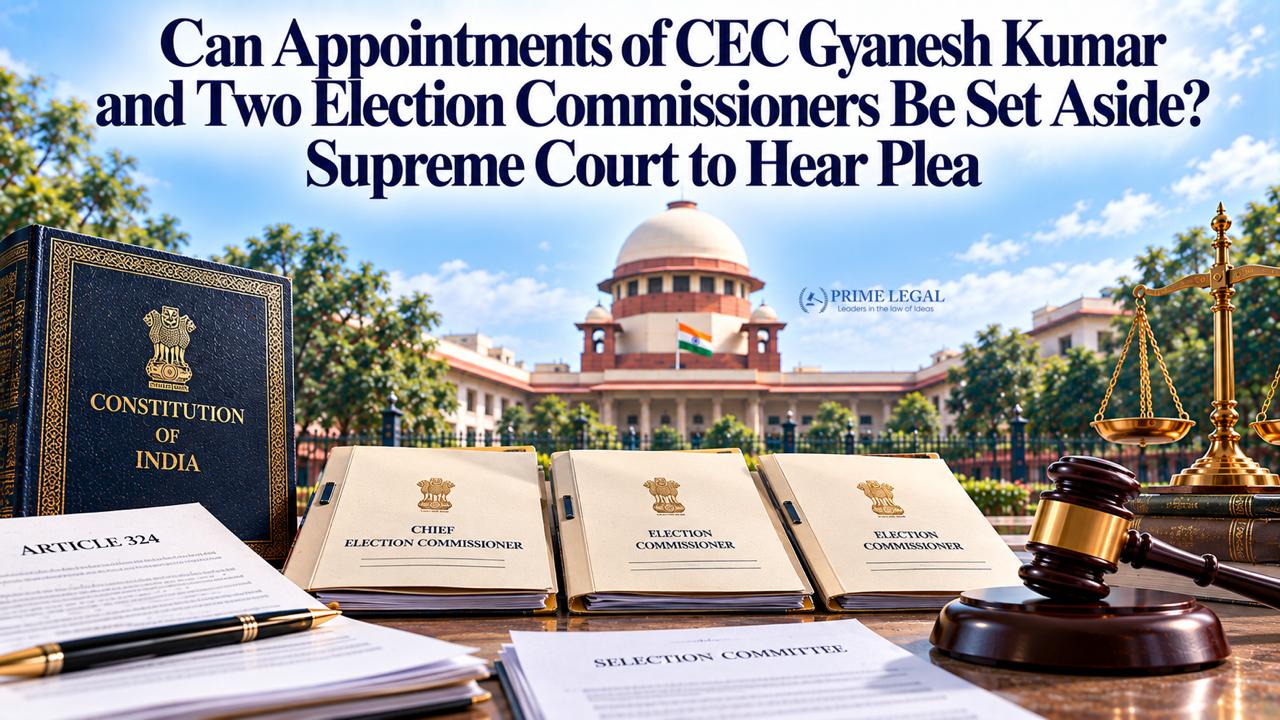
The Supreme Court of India has received a petition concerning the appointments of Chief Election Commissioner Gyanesh Kumar and Election Commissioners Sukhbir Singh Sandhu and Vivek Joshi. The petitioner is now petitioning in court for a quo warranto writ to examine under what authority the persons occupying the positions are holding these positions, and that these positions must be declared vacant in case the amendment is ruled illegal. The legal claim is based on checking whether the appointment procedure laid down by the law relating to appointments of the Chief Election Commissioner and other Election Commissioners (Conditions of Service and Period of Office) Act, 2023 has been adhered to.
BACKGROUND
The problem is caused by two notifications given by the government. The first notification was on March 14, 2024, where the government appointed Gyanesh Kumar and Sukhbir Singh Sandhu to be Election Commissioners owing to some vacancies that were caused in the Election Commission. The second notification was issued on February 17, 2025, where Gyanesh Kumar was appointed to be the Chief Election Commissioner and Vivek Joshi was appointed as an Election Commissioner. The Petitioner has filed a writ petition under Article 32 of the Constitution claiming that these appointments are against Section 5, Section 6 and Section 8(1) of the Act of 2023. The writ petition claims that the selection of the above persons was fast tracked, there was no legal clarity in the entire process of the selection, and also the legal requirement of shortlisting candidates for such key appointments was violated.
KEY POINTS
- The Search Committee was alleged to have constituted a five-member panel in respect of each of the vacancies specified in Section 6 of the statute of 2023, though in March 2024, there were only 6 candidates nominated for 2 positions which means that there were only 3 nominees per position.
- The grievance claims that Section 5 was transgressed as it asserts that the appointed staff do not fulfil the necessary qualification as they do not have any experience and familiarity with the process of management and implementation of elections since their past records shine no light on any duties related to elections.
- The claim alleges that there was a leak by the Secretary of the Legislative Department in that the Secretary sent more than a couple of hundred names to the Leader of the Opposition before the Search Committee had officially completed preparing its shortlist.
- The petition refers to the February 2025 appointments and asks whether the legal conditions need to be applied again when one of the sitting Election Commissioners is raised to the position of Chief Election Commissioner.
- The plea asks for a writ of quo warranto to determine whether the appointments are legal and if it is possible to remove those appointed from office due to their constitutional protections provided by Article 324(5).
- The petition also mentions the earlier observations made by the Supreme Court in March 2024, where the court had raised its concerns over the quick process of selection and insisted that the full data about candidates be provided to the members of the committee in advance.
ANALYSIS
This case challenges the constitution of the country’s apex election authority under the recently approved 2023 Act. The issue revolves around the important question of whether the executive is required to comply with the numerical and qualitative requirements established by the legislative authorities as per Sections 5 and 6 of the Act. If the Court concludes that the Search Committee has failed to form the five-member panel as required for every position that needs to be filled or that the appointees do not have the requisite competence as required under the law, it would create a significant precedent in terms of adherence to administrative norms with respect to the positions provided for in the Constitution. Furthermore, assessing whether the transparency requirements under Section 8(1) have been met would ensure that the Selection Committee is expected to meet the principles of procedural fairness. The outcome would also determine the extent of the rigour with which the provisions of the Act would be applied.
CONCLUSION
This appeal will be very significant for the Supreme Court as it will help in interpreting the limitations applicable under the 2023 Act regarding appointments to the Election Commission. By resolving this quo warranto petition, the Supreme Court will finally decide whether there were procedural irregularities that would necessitate setting aside the appointment of some of the top election officials in the country and ensuring accountability and transparency of the highest level of democratic governance.
“PRIME LEGAL is a National Award-winning law firm with over two decades of experience across diverse legal sectors. We are dedicated to setting the standard for legal excellence in civil, criminal, and family law.”
WRITTEN BY: SWETHA DUTTA

