
INTRODUCTION
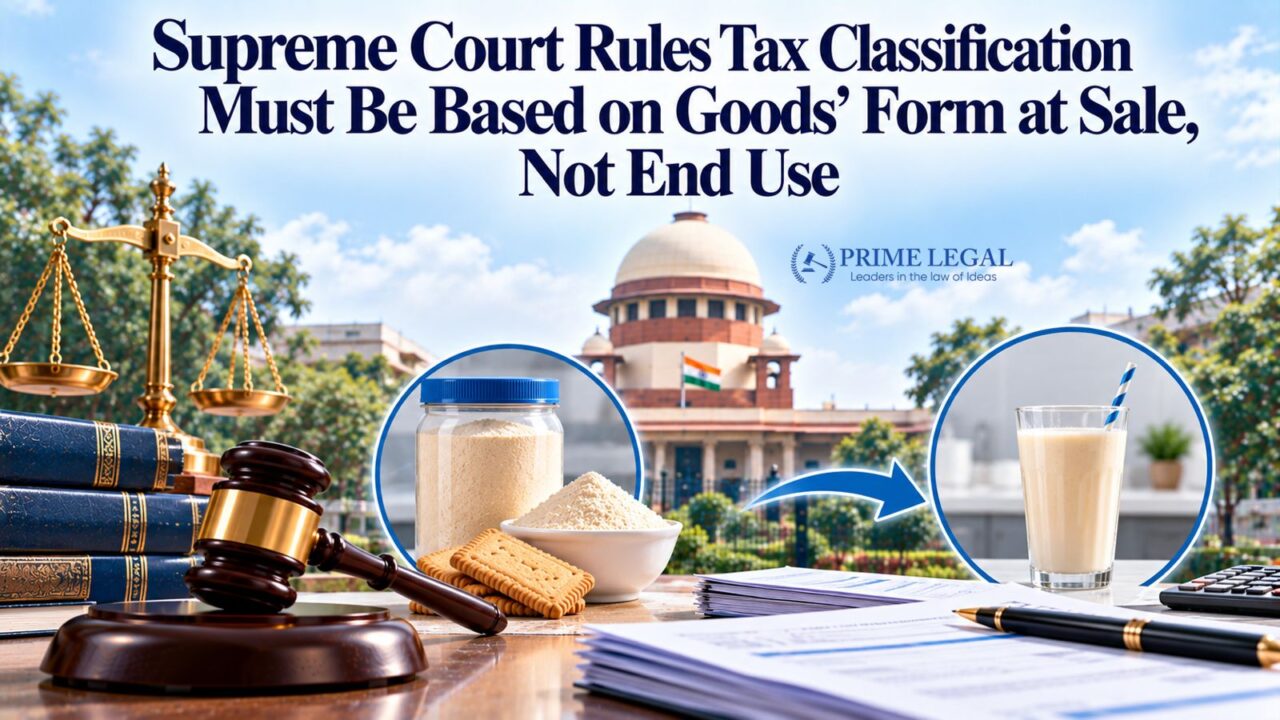
The Supreme Court of India, while dismissing the appeals filed by the Appellants, held that ‘GRD Powder’ and ‘GRD Mix’, manufactured and marketed by Cadila Health Care Ltd., are not ‘Non-Alcoholic Drinks and Beverages’ under the M.P. Commercial Tax Act, 1994 (hereinafter referred to as “the Act”). The Bench of Justice Manmohan and Justice Arun Palli held that classification depends on the form of the good at the time of sale and not on how the consumer later uses it. The appeals challenged the judgment of the Madhya Pradesh High Court dated 03.08.2011, which had classified the goods under the residuary entry and taxed them at 8% for the Assessment Year 1997-1998.
The Appellants argued that the packaging and instructions require the consumer to dilute the good with milk or water which makes it a health drink. Nevertheless, the Court ruled that since the goods were sold in powder form they fell within the residuary entry thereby, attracting 8% tax.
BACKGROUND
The dispute concerned the tax classification of ‘GRD Powder’ and ‘GRD Mix’ for the Assessment Year 1997-1998. The Appellants contended that the indications on the products, in graphical representation and in instructions required the consumer to dilute the goods with milk or water. It therefore claimed that they were ‘Non-Alcoholic Drinks and Beverages’ under Entry 20(ii), Part IV, Schedule II of the Act which attracts tax at 10%.
The Respondent contended that the goods were sold across the counter in the form of powder and biscuit. They were, therefore, taxable at 8% under the residuary entry in Part VII of Schedule II, which covers all goods not included elsewhere in the Schedule. The Madhya Pradesh High Court upheld the Respondent’s classification. Thus aggrieved, Appellants appealed to the Supreme Court.
KEY POINTS
- The Supreme Court dismissed the appeals and upheld the High Court’s classification of the goods under the residuary entry which is taxable at 8%.
- Taxing statutes are strictly construed. The Court cannot assume any intention beyond the plain language of the provision and must adopt a literal interpretation unless the language is ambiguous or absurd.
- It was noted that taxable event is the act of supply and the incidence of taxation depends on the nature of the good in the form in which it is sold and not the end use.
- The Court applied ejusdem generis to determine that the common thread is that goods listed in Entry 20(ii) are liquids, so ‘beverages’ cannot extend to goods of a different physical form.
ANALYSIS
The judgment settles that tax classification under a taxing entry is based on the form in which the goods are sold. The consumer’s subsequent act of mixing the powder with milk or water does not alter the taxable event. The same powder could even be used to prepare a solid dish.
Additionally, the Court clarified that the expression ‘including’ in Entry 20(ii) does not mean ‘all encompassing’ and cannot cover all and sundry goods. Consequently, the Court while applying the rule of ejusdem generis, held that the term ‘beverages’ must be construed in the context of the specific accompanying it and cannot be interpreted to encompass goods of different character or form.
The Court while ruling that goods cannot be forced into a specific entry merely to attract higher taxes, reaffirmed that goods which do not answer the description of a specific entry essentially fall within the residuary entry.
CONCLUSION
The Supreme Court vide this decision reiterated that tax classification depends on form of the goods at the time of sale and not on the manner in which the consumer may later use them. The Court emphasised that such classification must be determined by literal interpretation of unambiguous provisions.
“PRIME LEGAL is a National Award-winning law firm with over two decades of experience across diverse legal sectors. We are dedicated to setting the standard for legal excellence in civil, criminal, and family law.”
WRITTEN BY- T. R. AISIRI RAO

