
INTRODUCTION
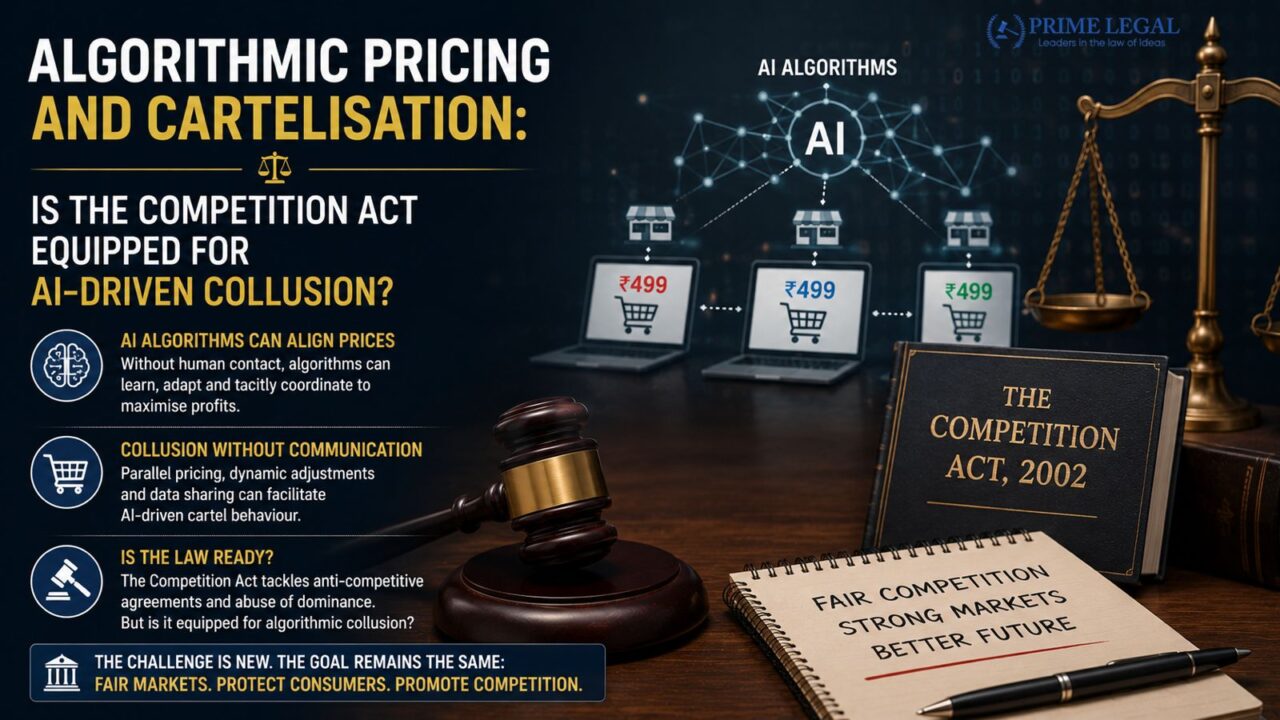
Pricing algorithms are now ubiquitous across e-commerce, ride-hailing, hospitality, and retail. Businesses use them to compute prices in real time and respond instantly to demand, but the same properties that make algorithms efficient can also make coordination between competitors easier, faster, and harder to detect than a smoke-filled room ever was. Regulators worldwide, including the Competition Commission of India (“CCI”), are increasingly asking whether the Competition Act, 2002 (“the Act”), drafted for an era of human cartels, has the conceptual tools to catch a cartel formed, sustained, or invisibly maintained by machines.
UNDERSTANDING ALGORITHMIC COLLUSION
Competition scholars Ariel Ezrachi and Maurice Stucke have classified algorithmic collusion into four broad categories: algorithms as messengers that merely implement a pre-existing human cartel; the “hub-and-spoke” model, where competitors independently use a common third-party pricing tool that aligns their prices; “predictable agent” collusion, where firms deploy their own algorithms to signal and react to rivals’ price changes without any express communication; and, most challenging, autonomous or self-learning algorithms that, through repeated market interaction, converge on supra-competitive prices without being programmed or instructed to do so. It is this last category, sometimes described as tacit algorithmic collusion, that most severely strains the traditional legal concept of an agreement.
THE STATUTORY FRAMEWORK
Section 3(1) of the Act prohibits any agreement that causes or is likely to cause an appreciable adverse effect on competition (“AAEC”) in India, and Section 3(3) creates a rebuttable presumption of AAEC for horizontal agreements between competitors that fix prices, limit output, or share markets. “Agreement” is defined broadly under Section 2(b) to include any arrangement or understanding, whether formal, written, or intended to be enforceable by legal proceedings. This broad definition was designed to capture tacit and informal coordination between humans. It was not designed with autonomous software in mind, and it presupposes some form of meeting of minds, or at minimum a communicated intention, between the parties alleged to have colluded.
INDIAN JURISPRUDENCE: SAMIR AGRAWAL
The best Indian authority on algorithmic pricing is the Supreme Court’s judgment in Samir Agrawal v. Competition Commission of India, (2021) 3 SCC 136. The informant claimed the two companies used their respective pricing algorithms to create a hub-and-spoke cartel among their drivers, who had no ability to negotiate fares. The CCI, the National Company Law Appellate Tribunal, and finally the Supreme Court all rejected the claim, holding that a hub-and-spoke arrangement requires an underlying agreement among the “spokes,” and that drivers using an app-determined fare, without any exchange of information with each other, cannot be said to have colluded. The Court also noted that Ola and Uber used different, independently developed algorithms that priced each ride on the basis of numerous variables such as time, traffic, and demand, distinguishing the facts from a scenario where rivals adopt a single shared pricing tool. While the outcome addressed the specific facts at hand, it left the harder question open: what happens when competitors use algorithms that, without any human contact, learn to coordinate on their own?
LESSONS FROM EXCEL CROP CARE AND RAJASTHAN CYLINDERS
Indian cartel jurisprudence has long recognised that direct evidence of an agreement is rare, since cartels are formed in secret. In Excel Crop Care Limited v. Competition Commission of India, (2017) 8 SCC 47, the Supreme Court held that cartelisation may be established on a balance of probabilities through circumstantial evidence, such as identical bids sustained over several tenders. However, in Rajasthan Cylinders and Containers Limited v. Union of India, (2020) 16 SCC 615, the Court cautioned that mere parallel pricing behaviour is not, by itself, proof of a cartel, and that “plus factors” pointing to actual coordination must be shown, since parallel outcomes can also result from oligopolistic market structures. This tension is amplified by algorithmic pricing: when every competitor’s algorithm is separately optimising against publicly observable prices, convergence on similar prices may be an entirely rational, independent response to market conditions rather than the product of any concerted design, making the “plus factors” test difficult to apply to code that leaves no email trail, meeting minutes, or telephone record to examine.
GLOBAL RESPONSES: EU AND US EXPERIENCE
Other jurisdictions have grappled with the same problem through varied routes. In Eturas UAB and Others v. Lietuvos Respublikos konkurencijos taryba, Case C-74/14, the Court of Justice of the European Union held that travel agencies using a common online booking platform could be liable for a concerted practice under Article 101 TFEU if they were aware of a discount cap imposed through the platform and failed to distance themselves from it, even without any direct communication among the agencies. This lowers the evidentiary bar considerably, allowing awareness of a shared technical restriction, rather than an explicit agreement, to found liability. In the United States, the Department of Justice’s prosecution in United States v. David Topkins, No. CR 15-00201 (N.D. Cal. 2015), targeted price-fixing among online poster sellers who agreed to adopt and program specific pricing algorithms in furtherance of a human agreement; because the underlying agreement between competitors was proved through direct communications, the algorithm was treated merely as the mechanism of implementation. Similarly, the UK Competition and Markets Authority’s 2016 decision against Trod Limited and GB eye Limited fined online sellers of posters and frames for using automated repricing software to avoid undercutting one another on Amazon’s UK marketplace. What is notable across these cases is that liability was still ultimately anchored in some form of proven awareness or communication; none of them establishes that a purely autonomous, self-learning algorithm converging on collusive prices without any human agreement would attract liability, and the Organisation for Economic Co-operation and Development has itself acknowledged this as an unresolved gap in competition law generally.
THE CCI’S OWN RECKONING
The CCI has begun to confront this gap. Its 2025 Market Study on Artificial Intelligence and Competition flagged algorithmic cartelisation, self-preferencing, and price discrimination as emerging concerns in India’s digital markets, and CCI Chairperson Ravneet Kaur has publicly observed that algorithmic pricing, automated decision-making, and non-human collusion present new-age challenges requiring regulators to remain agile. Separately, the Committee on Digital Competition Law submitted its report and a draft Digital Competition Bill to the Ministry of Corporate Affairs in February 2024, recommending an ex-ante regulatory framework, loosely modelled on the European Union’s Digital Markets Act, that would impose obligations of transparency and non-discrimination on large “Systemically Significant Digital Enterprises” before harm occurs, rather than waiting for the CCI to establish a completed contravention after the fact. The Bill also proposes a dedicated Digital Markets Unit within the CCI to build the technical capacity needed to scrutinise algorithmic conduct, though commentators have pointed out that the CCI’s existing staffing constraints may limit how quickly such a unit can become operational.
CHALLENGES SPECIFIC TO AUTONOMOUS ALGORITHMS
Three difficulties stand out for autonomous, self-learning algorithms specifically. First, the requirement of an agreement or meeting of minds under Sections 2(b) and 3 sits uneasily with algorithms that independently learn to sustain higher prices without being instructed to coordinate; existing doctrine has no settled answer for whether, or how, such convergence can be attributed to the firms that deployed the algorithms. Second, the Act’s investigative machinery, built around search-and-seizure of documents and testimony, is not designed to audit source code, training data, or the reward functions of a learning system, which demands specialised technical expertise the CCI does not yet possess at scale. Third, cross-border enforcement is complicated where the algorithm, its developer, and its commercial deployer sit in different jurisdictions, raising questions about who bears responsibility when a third-party vendor’s pricing tool is adopted by multiple competing firms.
WAY FORWARD
A combination of legislative clarification and institutional capacity-building appears necessary. Amending the Explanation to Section 3 to expressly address algorithmic facilitation of collusion, along lines already contemplated by the Digital Competition Bill for large digital enterprises, would reduce ambiguity about whether autonomous convergence can be treated as an agreement in appropriate circumstances. Mandating algorithmic audits and disclosure obligations for firms using shared or third-party pricing tools, akin to the transparency requirements under the EU’s Digital Markets Act, would also help regulators detect hub-and-spoke risks before they mature into full-blown cartels. Equally important is the CCI’s technical capacity: a well-resourced Digital Markets Unit staffed with data scientists and economists, as recommended by the Committee on Digital Competition Law, would be indispensable to examining how a pricing algorithm actually behaves, rather than relying solely on outcome-based inferences drawn from price data.
CONCLUSION
Samir Agrawal correctly closed the door on treating every algorithmically-priced digital platform as a hub-and-spoke cartel, but it does not resolve what should happen when algorithms, left to their own devices, learn to collude without any human intervention. The Competition Act, 2002, built around the concepts of agreement and meeting of minds, was not designed for this problem, and the CCI’s own market study and the pending Digital Competition Bill suggest that Indian regulators recognise as much. Until legislative and institutional reform catches up, courts and the Commission will likely continue examining algorithmic pricing disputes through the existing lens of concerted practice and circumstantial evidence, a framework built for human cartels now being asked to do considerably more.
“PRIME LEGAL is a National Award-winning law firm with over two decades of experience across diverse legal sectors. We are dedicated to setting the standard for legal excellence in civil, criminal, and family law.”
WRITTEN BY: GAURAV VIBHU RANJAN

