
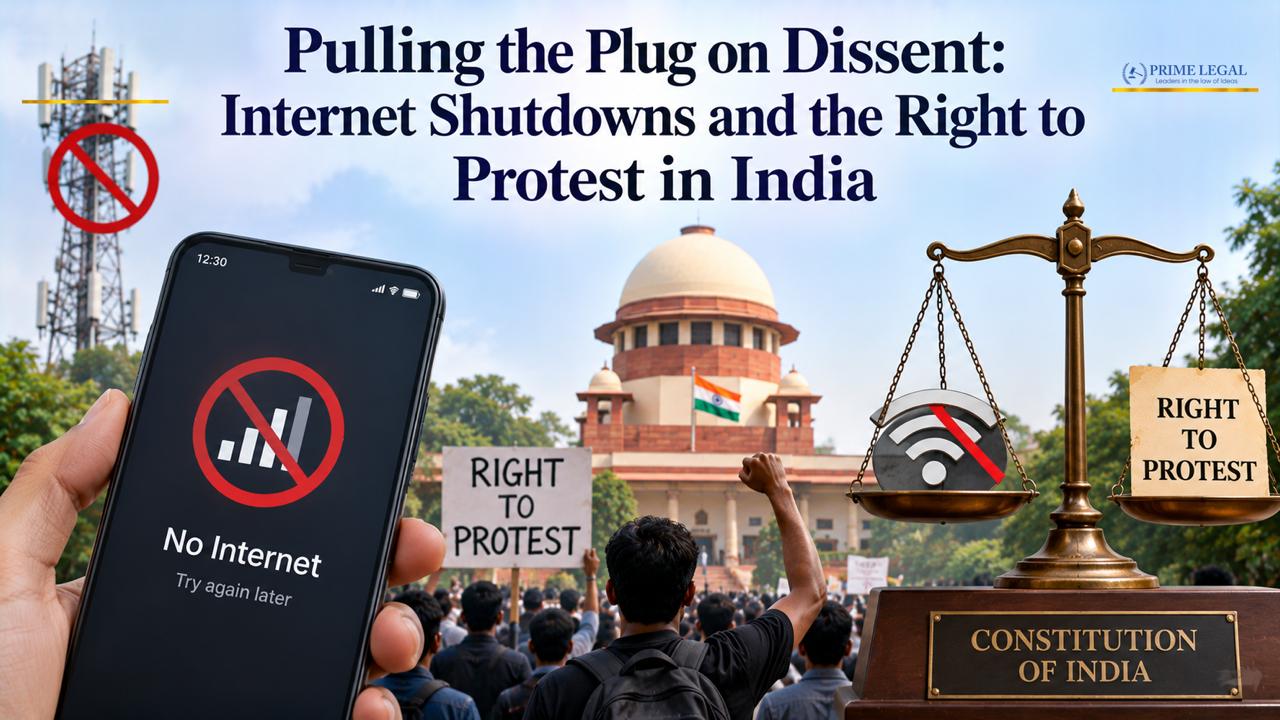
PRIME LEGAL | Pulling the Plug on Dissent: Internet Shutdowns and the Right to Protest in India
Abstract
With the advent of the digital era, the internet has ceased to be merely a means of communication and has become a necessary tool for the enjoyment of fundamental rights like the right to freedom of speech and expression, access to information and the right to protest peacefully. Internet shutdowns are an important tool used by the State in India to ensure public order and deal with security threats. The increasing use of internet shutdowns raises many constitutional issues about the extent to which the government can impose restrictions on digital communication without infringing upon democratic rights. While the State is granted powers to impose restrictions on the use of the right to freedom of speech and expression under Article 19(2) of the Constitution, any such restrictions imposed must fulfill the criteria of legality, necessity and proportionality. In Anuradha Bhasin v. Union of India (2020), the Supreme Court has ruled that internet speech and expression enjoys constitutional protection under Article 19(1)(a). Nonetheless, the continued use of internet restrictions underscores the difference between constitutional guarantees and their enforcement. This article analyzes the constitutional validity of internet restrictions in India, their effects on the right to peaceful protest, the legal provisions dealing with the same.
Keywords: Internet Shutdowns, Right to Protest, Freedom of Speech, Article 19, Digital Rights, Constitutional Law, Public Order.
- Introduction: When The Internet Falls Silent, Does Democracy Lose Its Voice?
The freedom of protest is not just the right to be able to meet in public places. In a democracy, this means the capacity of the citizenry to challenge the decisions of the government and hold those in power accountable. Conventionally, such gatherings used to occur through meetings, demonstrations, rallies, and even newspapers. But with the advent of digital communications, it seems that the internet has changed how democracy functions. Social networking sites are used now to organize a demonstration, disseminate information, garner support from the public and highlight issues which might otherwise go unnoticed. However, the increased significance of electronic communication has also led to a new tool that is being used by the State to limit participation of its citizens in democratic processes; that of an internet blackout. This is done by restricting the internet service of the particular geographical region and preventing any kind of communications and information flow.
While such actions are justified by the government on the basis of national security, public order and prevention of any kind of unrest or violence, the larger constitutional issue remains that can the State maintain public order by limiting fundamental freedoms upon which democracy rests?
This becomes more important in cases where there is an internet shutdown that takes place during times of protest and political rallies. When the authorities intend to block the spread of wrong information, at the same time they may stop the protesters from being able to communicate, journalists from reporting, and citizens from receiving important information. In other words, internet shutdown is not just a technological problem; it could become an issue of fundamental human rights. This article contends that the State is empowered to put reasonable restrictions, but this power should not be exercised at will.
- Constitutional Framework: The Right to Protest in a Digital Democracy
There are various fundamental rights guaranteed by the Constitution of India which ensure democratic participation. Article 19(1)(a) provides for the right to freedom of speech and expression. It includes the right to express opinions, get information and disseminate ideas. In today’s world, the internet is one of the key sources of these rights. Therefore, blocking the use of the internet affects the individual’s right to express opinions and participate in discussions. Article 19(1)(b) provides for the right to assemble peacefully and unarmed. It forms the basis of all peaceful demonstrations and protests. In the modern world, the internet often helps in organizing such assemblies, where the participants can share information and discuss issues. But these rights are not unlimited.
Article 19(2) allows putting reasonable restrictions on the right to freedom of speech and expression on specified grounds, such as sovereignty and integrity of India, security of the State and public order. In the same way, Article 19(3) allows putting reasonable restrictions on the right to peaceful assembly in the interests of sovereignty and integrity of India and public order. However, the presence of such restrictions does not mean that the government can do anything and everything it wants. There should be some legal ground for any restriction imposed by the government, and it should meet the requirements of reasonableness and proportionality. It is not enough that there is some chance of violence at the protest to shut down the Internet.
- Legal basis for Internet shutdowns in India
The current legal framework for Internet shutdowns in India is Section 20(2)(b) of the Telecommunications Act, 2023, read with the Telecommunications (Temporary Suspension of Services) Rules, 2024. Section 20(2)(b) empowers the Central Government or State Government or an officer authorized by them for suspension of telecommunication services in case of public emergency or for the protection of public safety on public order, security of the state and integrity and sovereignty of India. The new 2024 Rules provide procedural protections pertaining to the suspension orders. 3. Suspension orders should be in writing by the competent authority and reasons should be recorded. Each order shall be published with the reasons for suspension, the geographical area to which it applies and its period of suspension which shall not exceed fifteen days. Notably, Rule 3(4) provides for considering whether the objective of the suspension can be achieved through some other reasonable means. Suspension orders are also subject to review by a Review Committee.
One such provision is that of Section 69A of the Information Technology Act, 2000, under which the government has the power to deny public access to certain online information in certain cases. However, blocking certain content is quite different from blocking the entire Internet service. The importance of this lies in the fact that while a complete shutdown may be an effect on persons engaged in criminal activities, it will have an effect on common people, journalists, companies, and even peaceful protestors.
- Judicial Interpretation: Anuradha Bhasin v. Union of India (2020)
Another judicial order that has been one of the major rulings regarding the internet shutdown in India is that of Anuradha Bhasin v. Union of India (2020). This case came up after the imposition of internet services and communication restrictions in Jammu and Kashmir in August 2019. Anuradha Bhasin, the Executive Editor of the Kashmir Times, challenged the restrictions that affected the process of journalism and dissemination of information before the Supreme Court. The Supreme Court held that there are protections given under the Constitution for freedom of speech and expression under Article 19(1)(a) and freedom to carry on trade and business under Article 19(1)(g). Moreover, indefinite internet shutdowns are not permissible. The orders for the suspension of internet services need to be made known and the same must be challengeable at the judicial forum concerned. Moreover, the Court also looked at the invocation of Section 144 of the Code of Criminal Procedure, 1973 and observed that the provision cannot be applied for the suppression of legitimate expression of grievances and opinions or democratic rights. Repeated invocation of the provision was also treated as an abuse of power. Significantly, the Court also held that total shut down of telecommunication services is a harsh step which can only be resorted to when it becomes absolutely necessary.
The judgment laid down the important constitutional principle that the state cannot take internet shutdown to be an automatic response to any public unrest. Each restriction must be justified by the necessity and must not exceed the requirement of the matter. The judgment did not recognise the access to internet to be an independent fundamental right but held that the constitutional rights enjoyed through the internet need to be protected.
- Impact of Internet Shutdowns on Freedom of Peaceful Assembly
There are multiple impacts of internet shutdowns on the ability to take part in democratic practices. First, they interfere with organizing peaceful assemblies. In the modern world, protesters use the internet to organize meetings, get updates and coordinate their activities. Internet restrictions can deprive people of vital information to conduct peaceful mobilization. Second, internet shutdowns interfere with people’s ability to get information. In the course of demonstrations, citizens use digital means to get informed about events, obtain necessary information, and know government decisions. If people do not have internet access, they will need alternative sources.
Third, internet shutdowns have an impact on journalist freedom of speech. Journalists rely on digital communications to cover events, send pictures, and make updates. Restrictions in access may stop independent reporting and monitoring of governmental actions. Fourth, restrictions in internet access can influence people’s safety and work. Emergency aid requests, digital transactions, remote learning and communicating with families become impossible for people. Moreover, people suffer because of internet shutdowns even if they are not connected to protests. Furthermore, recurrent shut down could lead to a chilling effect on democratic engagement. Those who know that their protests will be met with communications blackouts may be deterred from speaking out or joining together out of fear of being shut down. The impact of internet shutdowns is not just digital inconvenience but it impacts the exercise of fundamental rights by the citizens.
- Public Order Versus Fundamental Rights: Where Does The Proper Balance Lie?
The role of the Government indeed is to preserve public order, ensure national security and prevent violence. There can be no passiveness in case demonstrations pose threats to public order. In some cases, limitations on internet services may be unavoidable for preventing the spread of incendiary materials or organizing attacks and violent actions. But just because there is an objective of the state authorities does not mean any measures taken in pursuit of that objective should automatically be lawful. According to the proportionality test, a restriction shall pursue a legitimate aim, must be suitable and necessary for achieving this objective, and there must be no other ways which would be less restrictive of the right at issue and equally effective. In addition, the proper balance must be established between public interest and the rights of an individual. A complete internet shutdown is something that should be used only if other methods are not effective. It is necessary to protect public order, but it can never become an excuse for limiting constitutional rights.
- Conclusion and Suggestions: Protecting Dissent in a Digital Democracy
India needs to adopt a rights-based approach to internet shutdowns balancing national security and constitutional rights. The state must ensure that internet shutdowns are justified, confined to specific geographical areas, limited in duration and conform to the Telecommunications (Temporary Suspension of Services) Rules, 2024.In all cases the proportionality test should be applied and targeted measures and non-intervention measures should be prioritized over blanket internet shutdowns. Besides, transparency and timely issuance and publication of the orders and judicial scrutiny should safeguard against arbitrary exercise of power. Most importantly, the decision on whether the shutdown can continue needs to be made based on the threat posed.
In the end, Internet shutdowns pose an essential question of the nature of democracy: Is it possible for a State to maintain public order through the curtailment of the very rights which will help the citizens hold it accountable? While national security is a valid reason, it cannot be used as a general reason to muzzle peaceful dissidents. The right to protest, the freedom of speech, and access to information should be preserved even when there is public unrest. As stated in the case of Anuradha Bhasin v. Union of India, constitutional rights do not disappear in cyberspace.
“PRIME LEGAL is a National Award-winning law firm with over two decades of experience across diverse legal sectors. We are dedicated to setting the standard for legal excellence in civil, criminal, and family law.”
Written by – Krittika Sengupta
References:
- Constitution of India, 1950 – Article 19(1)(a): Freedom of Speech and Expression.
- Constitution of India, 1950 – Article 19(1)(b): Right to Assemble Peaceably and Without Arms.
- Constitution of India, 1950 – Article 19(2): Reasonable Restrictions on Freedom of Speech and Expression.
- Constitution of India, 1950 – Article 19(3): Reasonable Restrictions on Peaceful Assembly.
- The Telecommunications Act, 2023 – Section 20(2)(b).
- The Telecommunications (Temporary Suspension of Services) Rules, 2024.
- The Information Technology Act, 2000 – Section 69A.
- The Code of Criminal Procedure, 1973 – Section 144 (relevant to the judgment in Anuradha Bhasin).
- Anuradha Bhasin v. Union of India, (2020) 3 SCC 637.
- Shreya Singhal v. Union of India, (2015) 5 SCC 1.
- Mazdoor Kisan Shakti Sangathan v. Union of India, (2018) 17 SCC 324.
- Himat Lal K. Shah v. Commissioner of Police, (1973) 1 SCC 227.
- Freedom House, Freedom on the Net 2024: India.
- Software Freedom Law Center, India (SFLC.in), Internet Shutdowns in India – Reports and documentation.
- Internet Freedom Foundation (IFF), research and publications on internet shutdowns and digital rights.
- Supreme Court of India – Official judgment in Anuradha Bhasin v. Union of India. Supreme Court Judgment
- Government of India, Gazette Notification – Telecommunications (Temporary Suspension of Services) Rules, 2024. Official Gazette Notification

